 Ferndale
 Custer's Exterior Climate Challenge
Custer sits in the northern stretch of Whatcom County, close enough to the water and open farmland that homes here take a different kind of weathering than houses further inland. It's not one dramatic storm that wears down an exterior in this part of the county — it's the accumulation. Salt-laden air moving in off the Strait of Georgia, months of low-angle rain that never seems to fully stop, and a shade-and-moisture combination that keeps north-facing walls and rooflines damp for weeks at a stretch. Individually, none of those factors is unusual for the Pacific Northwest. Together, and applied to a home year after year, they separate exteriors that were built to handle this climate from exteriors that were built for somewhere else.
We work throughout Ferndale and the surrounding Whatcom County communities, and Custer is one of the areas where the difference between a correctly chosen, correctly installed exterior and a generic one shows up fastest. Open, semi-rural lots with less windbreak than you'd get in a denser neighborhood mean siding, trim, and roofing take wind-driven rain more directly. That's the starting point for how we approach every job out here.
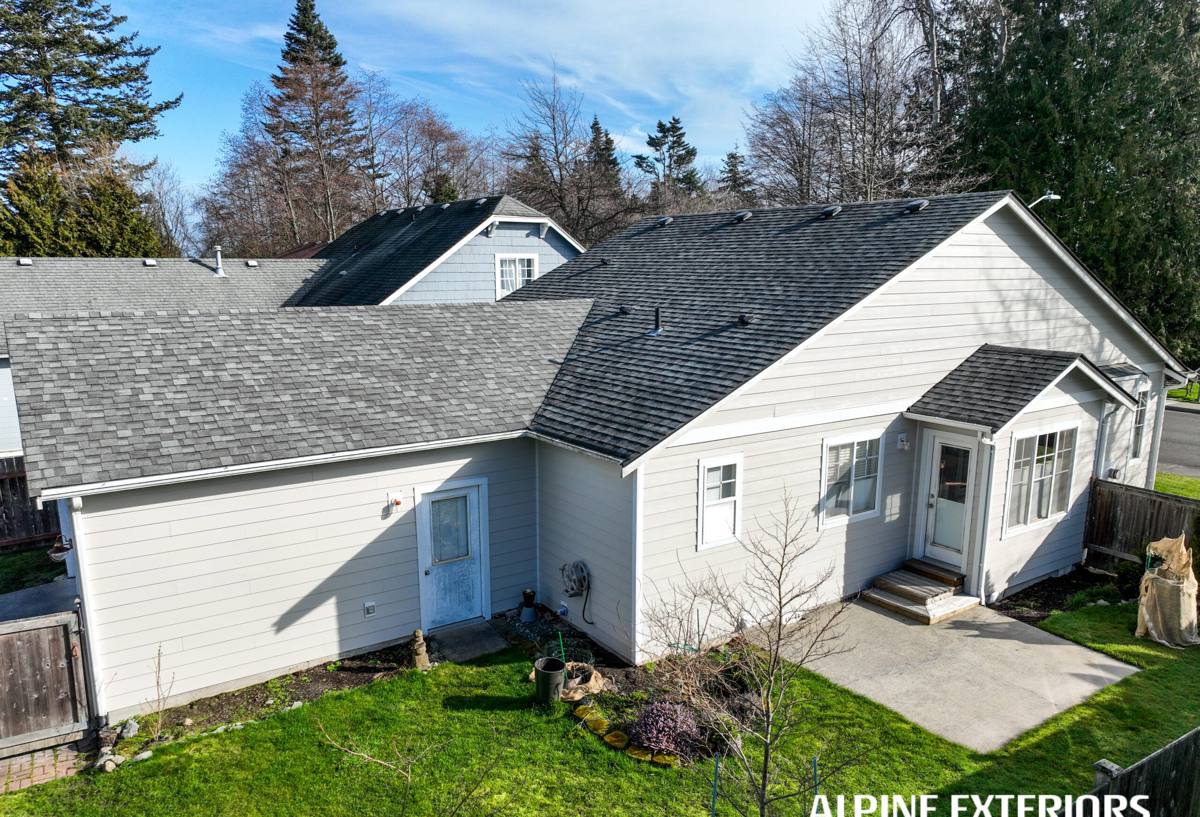
What Salt Air, Driving Rain, and Moss Actually Do to a Home
Salt Air and Corrosion
Proximity to saltwater doesn't just affect boats and outdoor metal furniture. Airborne salt accelerates corrosion on fasteners, flashing, and any exposed metal trim, and it interacts with certain siding coatings in ways that speed up fading and surface breakdown. Homes closer to open water or exposed to onshore wind patterns see this fastest, but even properties set back from the water get some exposure over enough years. The practical impact is that hardware and finish choices matter more here than they would in a drier, inland climate.
Driving Rain and Wind-Driven Moisture
Whatcom County doesn't get the heaviest rainfall totals in Western Washington, but it gets a lot of sustained, wind-pushed rain — the kind that doesn't just fall straight down but gets forced sideways into wall assemblies, window flanges, and butt joints in siding. That's a different stress than a downpour on a still day. It tests every seam, every piece of flashing, and every point where two materials meet. Siding and trim that aren't detailed correctly at those transitions are where water finds its way behind the cladding, and once it's behind the siding, the damage is happening where you can't see it until it's serious.
The Long Moss Season
Whatcom County's combination of moisture, mild temperatures, and tree cover gives moss and algae a long growing window — realistically most of the year on shaded or north-facing surfaces. On roofs, moss holds moisture against shingles and lifts them over time. On siding, algae staining and moss growth in horizontal laps are mostly a cosmetic problem, but they're also a sign that a surface is staying wet longer than it should, which matters more for materials that are sensitive to sustained moisture exposure.
Why We Only Install James Hardie Fiber Cement Siding
We made a decision as a company to install one siding system: James Hardie fiber cement, using their HardieZone engineered product lines. We don't install vinyl, LP SmartSide, Cemplank, Allura, or primed wood siding like spruce or cedar. That's not a marketing position — it's a standard we hold because of what we see on homes in exactly this kind of climate.
Vinyl siding is affordable and low-maintenance in the sense that it doesn't need painting, but it's a thin material that can warp in temperature swings and doesn't hold up structurally the way fiber cement does over decades of wind-driven rain exposure. Wood-based composite and OSB-core products like LP SmartSide perform well when installation and caulking are perfect and stay perfect for the life of the product — but any breach in that seal, especially in a climate with this much sustained moisture, lets water into an engineered wood substrate that's vulnerable to swelling and deterioration once it's wet. Primed wood siding needs an ongoing paint maintenance cycle that most homeowners underestimate, and any lapse in that cycle exposes raw wood to exactly the rain and moss conditions Custer sees for most of the year.
James Hardie fiber cement is cement, sand, and cellulose fiber — non-combustible, dimensionally stable, and not vulnerable to rot the way wood-based products are. The HZ5 product line is engineered specifically for climates with extended wet-cold cycles, which describes Whatcom County well. ColorPlus finishes are baked on at the factory under controlled conditions, which gives a harder, more UV- and moisture-resistant finish than field-applied paint, and they carry a separate finish warranty from the substrate warranty. None of that makes fiber cement maintenance-free — it still needs correct installation and periodic caulk and paint upkeep at trim and penetrations — but it starts from a materially stronger position against the specific conditions this area produces.
Beyond Siding: Roofing, Windows, and Decks
Siding doesn't work in isolation. On most Custer homes, the exterior envelope is really four systems working together — siding, roofing, windows, and any deck or outdoor living space — and a weak point in one puts stress on the others.
Roofing
Roofing is the first line of defense against the moss and moisture conditions described above, and it's also where wind-driven rain finds gaps if flashing at valleys, chimneys, and roof-to-wall transitions isn't detailed correctly. We handle roof repair and installation as part of the same exterior scope, because a roof leak that's ignored eventually shows up as siding or trim damage below it.
Windows
Window flanges and the siding-to-window transition are one of the most common water entry points on any home, and it's a detail that matters even more in a climate with this much sustained wind-driven rain. Whether we're replacing windows outright or integrating new siding around existing ones, correct flashing sequencing at that transition is non-negotiable.
Decks
Outdoor living space in Whatcom County has to handle the same moss, moisture, and salt-air exposure as the rest of the home, plus direct UV and foot traffic. Ledger board flashing where a deck attaches to the house is a frequent failure point we look at closely, since it's another place where water can get behind the exterior envelope if it isn't detailed right.
What Correct Installation Looks Like in This Climate
Fiber cement siding performs the way it's designed to only when it's installed to manufacturer spec, and in a climate like Custer's, the details that get skipped on a rushed job are exactly the ones that matter most.
- Weather-resistive barrier installed and lapped correctly behind the siding, with all penetrations sealed
- Proper flashing at every window, door, and roof-to-wall transition — not just caulk substituting for flashing
- Correct fastener type and spacing, using materials rated for coastal or high-moisture exposure
- Minimum clearance maintained between siding and grade, decks, roofing, and other hardscape to prevent wicking
- Butt joints and seams sealed per Hardie's published installation guidelines, not general best-guess practice
- Factory-primed cut edges re-sealed on site wherever a board is trimmed
Skip any one of these on a home exposed to Whatcom County's rain and salt air, and you're giving moisture a path in regardless of how good the siding material itself is. This is where installation quality matters as much as product choice.
How Siding Materials Compare in Custer's Climate
| Factor | James Hardie Fiber Cement | Vinyl | Wood/Engineered Wood |
|---|---|---|---|
| Salt air resistance | Strong — non-combustible cement substrate, factory finish | Moderate — can fade and become brittle over time | Weak without diligent paint maintenance |
| Driving rain / wind exposure | Strong when correctly flashed and installed | Moderate — panels can warp or loosen in high wind | Moderate to weak — vulnerable if moisture gets behind the surface |
| Moss and moisture in shaded areas | Resists rot; may need periodic cleaning | Doesn't rot but can trap moisture behind panels | High risk — swelling and decay if sustained wet |
| Maintenance cycle | Periodic caulk/trim check; ColorPlus finish reduces repainting | Low maintenance but limited repair options if damaged | Regular repainting/resealing required |
| Fire resistance | Non-combustible | Combustible | Combustible |
Ongoing Care for Custer Homes
Even the right siding system needs some attention in this climate. A short annual routine goes a long way toward protecting the investment.
- Rinse siding annually to clear salt residue and prevent algae buildup, especially on north-facing and shaded walls
- Check and clear roof moss before it spreads and lifts shingles — earlier is easier than later
- Inspect caulking at trim, window flanges, and butt joints for cracking once a year
- Keep gutters clear so overflow doesn't run down siding faces or pool near the foundation
- Trim back vegetation and tree cover where it's keeping walls shaded and damp longer than necessary
Why a Local Crew Matters
A crew that works across Whatcom County regularly sees how these conditions actually play out on real homes — which walls take the worst of the driving rain, which roof valleys hold moss longest, where salt exposure shows up first. That's different from following a generic installation manual without knowing the climate it's being applied in. We install one siding system because we've seen what holds up here and what doesn't, and we bring that same standard to the roofing, window, and deck work we do alongside it.
If you're weighing a siding replacement, a roof repair, new windows, or deck work on a Custer property, we're happy to take a look and walk you through what we'd recommend and why. Reach out for a free, no-pressure estimate — there's a form right below to get started.