 Ferndale
 Picking a siding color is the fun part. But on the north Whatcom County coast, the color you pick is also making a promise about how your house is going to look in five, ten, and twenty years — through salt air off Bellingham Bay, driving winter rain, and the long gray moss season that coats anything that stays damp too long. James Hardie's ColorPlus Technology was built specifically to keep that promise. Here's what it actually is, how the color system works, and what to think about before you choose.
What "ColorPlus Technology" Actually Means
ColorPlus is not paint applied on site. It's a factory-controlled finishing process: the color is baked onto the fiber cement panel or plank in multiple coats under conditions no jobsite can replicate — consistent temperature, no wind-blown debris, no moisture, and a curing process that lets each coat fully set before the next goes on. The result is a finish that's more uniform and more tightly bonded to the substrate than a field-applied paint job can be.
That matters more than it sounds like. A big share of exterior paint failure isn't the paint itself — it's application conditions. Painting fiber cement outdoors in a marine climate means fighting humidity, temperature swings, and the risk of trapping moisture under the coat before it's cured. ColorPlus removes that variable entirely by finishing the material before it ever leaves the plant.
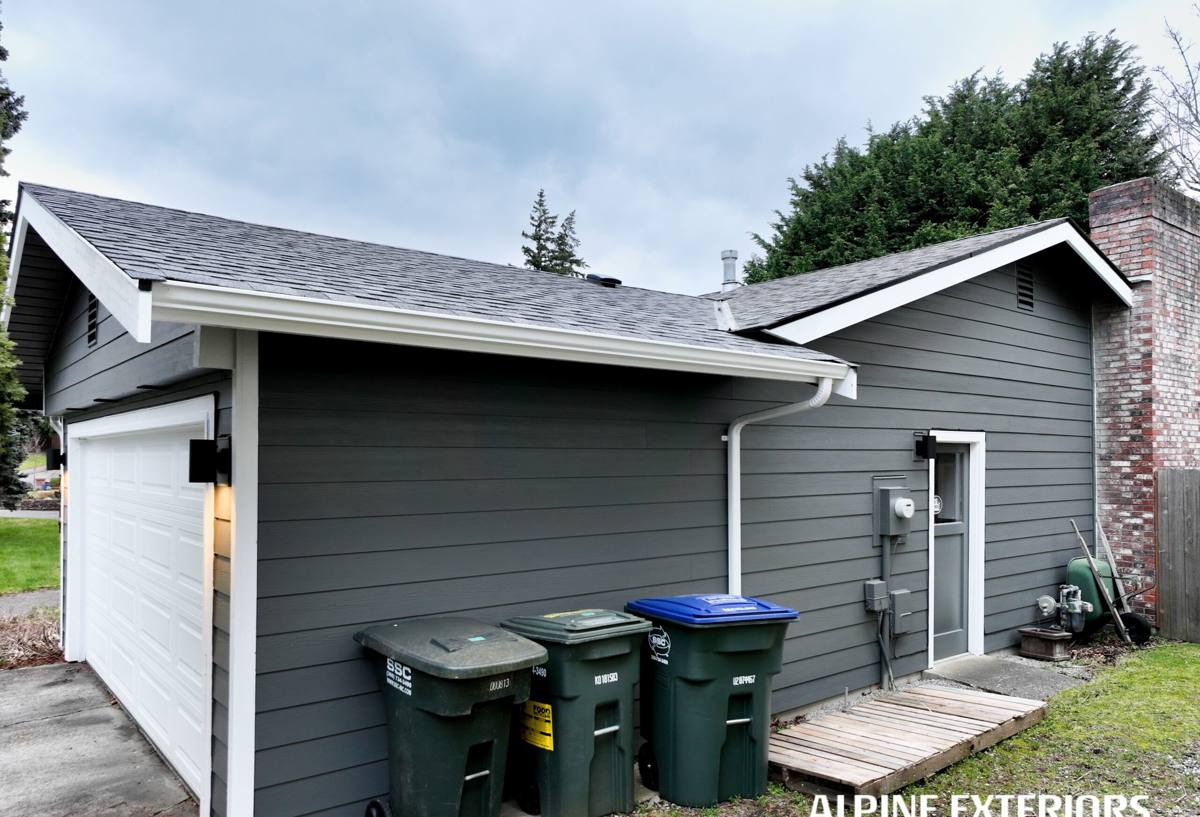
Why the Factory Finish Matters in Ferndale's Climate
Ferndale sits close enough to the water that homes take on a steady low-grade dose of salt air, on top of the rainfall totals typical of northwest Washington. That combination is hard on any exterior finish. Salt is abrasive and hygroscopic — it holds moisture against a surface — and the region's long wet season means siding often doesn't get a real chance to fully dry out between storms for months at a stretch.
A weak or thin finish shows this wear as chalking, fading, and eventually cracking that lets water behind the coating. Once water gets behind a finish on fiber cement, you're not just dealing with cosmetics — you're risking the substrate itself. ColorPlus is engineered with UV-resistant resins and a coating thickness that's tested for exactly this kind of exposure, which is a large part of why it carries a much longer finish warranty than typical field paint.
Moss and Algae Add a Second Layer
Whatcom County's shade, moisture, and mild winters are close to ideal moss and algae growing conditions. That's a surface-growth issue more than a finish-failure issue, but color choice interacts with it: darker, flatter colors tend to show algae streaking and moss shadowing more visibly than lighter, satin-finish colors, simply because the contrast is higher. It's worth factoring into a color decision even though it isn't a defect in the product.
The ColorPlus Color Palette: Lines and Options
James Hardie offers ColorPlus finishes across a curated palette designed to work with a range of architectural styles, from crisp modern to traditional Pacific Northwest. Depending on the product line and region, the standard palette generally includes neutrals and classics such as Arctic White, Iron Gray, Aged Pewter, Pearl Gray, Khaki Brown, Navajo Beige, and Monterey Taupe, along with deeper accent tones like Countrylane Red, Mountain Sage, Boothbay Blue, Evening Blue, Timber Bark, Woodstock Brown, and Rich Espresso. Availability varies by product (lap siding, panel, shingle, and trim) and can shift over time, so the exact current lineup should always be confirmed before finalizing a design.
ColorPlus colors are engineered to be used as a system — field color, trim color, and accent color are designed to coordinate, which takes a lot of the guesswork out of matching. Trim, fascia, and soffit products are available in coordinating ColorPlus colors so the whole exterior reads as one finish system rather than a patchwork of separately sourced materials.
ColorPlus vs. Site-Painted Fiber Cement
Homeowners sometimes ask why they'd pay a premium for a factory color instead of installing primed board and having it painted afterward. Here's the honest comparison:
| Factor | ColorPlus (Factory-Finished) | Primed Board, Field-Painted |
|---|---|---|
| Application conditions | Controlled factory environment | Weather-dependent jobsite conditions |
| Coating consistency | Uniform multi-coat process | Varies by crew, weather, and paint quality |
| Typical repaint interval | Long-interval touch-up only | Repaint needed on a shorter cycle |
| Warranty on finish | Separate, longer finish warranty | Substrate warranty only; paint is not warrantied by Hardie |
| Cut-edge treatment | Factory-matched touch-up available | Must be fully field-painted regardless |
| Upfront material cost | Higher than primed board | Lower material cost, added labor cost later |
Primed board isn't a bad product — it's a legitimate option when a homeowner wants full control over the paint brand or a custom color outside the standard palette. But it shifts the durability of the finish onto the quality of a separate paint job, done outdoors, in a climate that doesn't offer many ideal painting weeks.
Warranty: What's Actually Covered
James Hardie backs the fiber cement substrate itself with a long-term limited warranty, and ColorPlus finishes carry their own separate finish warranty on top of that — covering things like fading and peeling within the warranty terms. That two-part structure is one of the clearest practical advantages of ColorPlus: the color and the board are warrantied as a matched system, rather than the homeowner being left to sort out whether a failure was a "material problem" or a "paint problem."
It's worth reading the specific warranty terms for the product line and color you choose, since coverage details and duration can differ between standard and premium palette options. A contractor who installs Hardie regularly should be able to walk you through exactly what's covered before you sign off on a color.
Choosing a Color for a Whatcom County Home
A few practical things worth weighing before you commit:
Light Exposure and Orientation
South- and west-facing walls take more direct UV even here, while north-facing walls stay shaded and damp longer — which is exactly where moss and algae take hold fastest. Some homeowners choose a slightly different maintenance expectation, or a lighter tone, on the shaded elevations for that reason.
Neighborhood and Architectural Fit
Ferndale's mix of older farmhouse-style homes, newer developments, and craftsman-influenced builds all read differently in different colors. A muted, traditional palette tends to sit well with the area's older housing stock, while some of the deeper accent tones work better as trim or door accents than full-field colors on smaller lots.
HOA and Permit Considerations
Some newer developments in and around Ferndale carry HOA color restrictions. It's worth checking your covenants before falling in love with a color — swapping later means recutting and repurchasing material.
Resale Neutrality vs. Personal Preference
Neutral tones are the safer resale bet, but ColorPlus makes bolder choices low-risk in a way that field paint doesn't, since the finish itself isn't compromised by the color — a deep navy or forest green will hold up structurally the same as a neutral gray, so the decision comes down to taste, not durability.
Living With Colored Hardie Siding: Cleaning and Care
ColorPlus siding still needs basic upkeep in a wet marine climate — it just needs far less than a painted surface. A soft wash with a garden hose and mild detergent once or twice a year handles most dust, pollen, and light surface grime. In shaded, moisture-prone areas where moss or algae take hold, a gentle wash with an appropriate cleaner (never a high-pressure setting aimed directly at seams or joints) keeps growth from staining the finish over time.
- Rinse siding from the top down with a standard garden hose nozzle, not a pressure washer, to avoid forcing water behind joints and trim
- Check caulked joints and trim seams annually, since caulk failure — not the ColorPlus finish — is the most common source of moisture intrusion
- Keep gutters clean and downspouts directed away from siding to reduce the constant wetting that feeds moss and algae
- Trim back shrubs and trees touching the siding so shaded wall sections get some airflow and light
- Touch up any cut edges or fastener heads with factory-matched touch-up paint rather than a mismatched hardware-store color
- Have a contractor check for damage after major windstorms, which are common enough on this stretch of coast to loosen trim or crack panels
Getting the Finish Installed Right
A ColorPlus finish is only as good as the installation protecting it. Field cuts expose raw fiber cement edges that need factory touch-up paint or sealant to match the warranty's terms — skipping that step is a common shortcut that leaves a vulnerable seam right where water collects. Proper flashing, correct fastener placement, and manufacturer-specified gaps at joints all protect the finish from the inside out, keeping moisture from ever reaching the coated surface from behind.
This is really an installation-quality issue as much as a product issue: the same ColorPlus board installed to spec versus installed with shortcuts can have very different outcomes after a decade of Whatcom County winters. It's worth asking any contractor bidding the job how they handle cut-edge sealing and manufacturer installation requirements before work starts.
If you're weighing colors for a siding project in Ferndale or elsewhere in Whatcom County, we're happy to bring physical color samples out to your home so you can see how they read in your actual light and against your roofline. Reach out for a free, no-pressure estimate — there's no obligation, just a straight answer on what would work well on your house.