 Ferndale
 One Product, No Exceptions — Here's Why
Walk into most siding companies and you'll get a menu: vinyl if you want cheap, LP SmartSide if you want wood grain on a budget, fiber cement if you want to spend more. We don't offer that menu. We install James Hardie fiber cement siding and nothing else, on every job, in every neighborhood from downtown Ferndale out toward Lake Terrell Road and the county line.
That's not a marketing gimmick. It's a decision we made after years of tear-offs, warranty calls, and callbacks tied to the same handful of products. When a crew specializes in one system, they know its flashing details cold, they know how it moves with the seasons, and they're not guessing at fastener schedules between three different manufacturers' spec sheets. Standardizing lets us get better at one thing instead of mediocre at five.
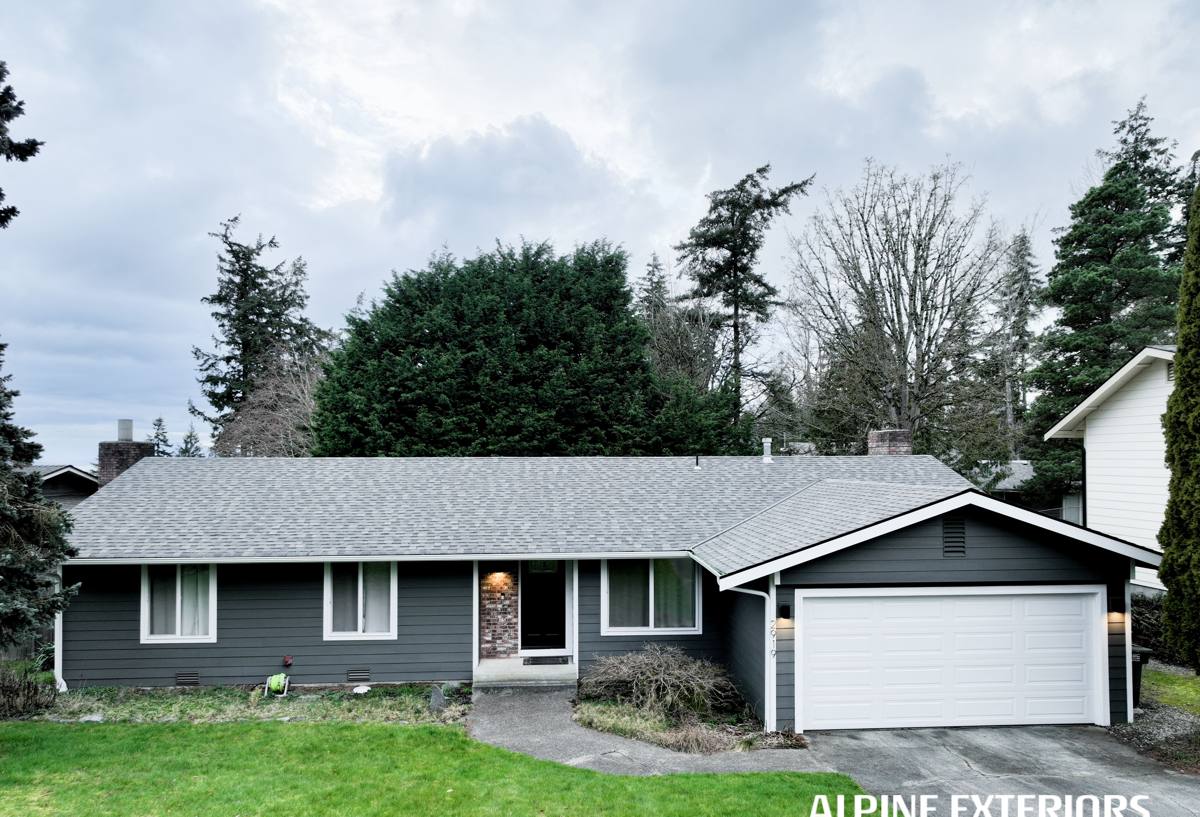
What Ferndale's Climate Actually Does to Siding
Whatcom County isn't a brutal climate in the way of a Midwest freeze-thaw cycle or a Gulf Coast hurricane zone, but it's a slow, relentless one, and slow-and-relentless is exactly what wears siding out over a couple of decades.
Salt Air and Marine Moisture
Ferndale sits close enough to Bellingham Bay and the Strait of Georgia that salt-laden air is a constant, even a few miles inland. Salt air accelerates corrosion on fasteners and trim, and it holds moisture against exterior surfaces longer than dry inland air would. Materials that rely on paint film or factory coatings to keep moisture out are under more stress here than they would be on the east side of the Cascades.
Driving Rain
Storms coming off the Strait don't just fall straight down — wind-driven rain hits siding at an angle, working its way behind poorly lapped panels, through open joints, and into any gap where flashing was skipped or shortcut. Over a wet Whatcom County winter, a siding system's water-management details matter more than its color or texture.
A Long Moss and Mildew Season
Cool, damp, and shaded conditions for much of the year make Ferndale prime territory for moss, algae, and mildew growth on north-facing and tree-shaded walls. Porous or absorbent siding materials hold that moisture and feed the growth; siding needs to shed water and dry out quickly, or it becomes a long-term maintenance headache.
None of this is exotic weather. It's the ordinary Pacific Northwest cycle. But "ordinary" repeated for 20+ winters is exactly what separates siding that holds up from siding that doesn't.
What James Hardie Fiber Cement Actually Is
James Hardie siding is made from a mix of Portland cement, sand, cellulose fiber, and water, cured into a dense, non-combustible board. It's not plastic (like vinyl), it's not an engineered wood product (like LP SmartSide), and it's not solid wood (like cedar or primed spruce). That composition is the whole reason it behaves differently in our climate.
HZ5 Engineering
James Hardie engineers its products by climate zone, and the HZ5 formulation is built for the Pacific Northwest's wet, moderate-temperature conditions — different moisture and freeze-thaw tolerances than the HZ10 line sold in hot, dry Southwest markets. We install HZ5 product for the same reason we wouldn't install roofing rated for a desert climate on a house in Ferndale: the engineering should match the actual weather the house will see.
It Doesn't Feed Moss and Rot the Way Organic Materials Do
Fiber cement doesn't rot, and it isn't a food source for the fungi that cause wood decay. It still needs to be kept clean of built-up moss and debris like any exterior surface, but it isn't structurally vulnerable to the kind of soft-spot rot that shows up on cedar or spruce siding after a decade of damp winters.
Non-Combustible
Fiber cement doesn't contribute fuel to a fire the way wood-based products can. That's less of a driving factor in a marine climate like Whatcom County than in wildfire-prone regions, but it's a real, permanent difference in the material itself — not a coating that wears off.
The ColorPlus Finish — Why Factory-Applied Color Matters
Color and finish are where a lot of siding problems actually start, regardless of the substrate underneath. James Hardie's ColorPlus Technology bakes the color onto each board in a controlled factory environment, in multiple coats, before it ever reaches a job site.
- Factory application means consistent coverage on every board — no thin spots from wind, temperature, or a rushed field crew
- The finish cures in a controlled environment, so it bonds more evenly than paint applied on-site in variable weather
- Touch-up systems are formulated to match, so repairs after a ding or a new attachment blend in rather than standing out
- It comes backed by its own finish warranty, separate from the substrate warranty
Compare that to primed wood siding or trim that arrives ready for a painter to finish on-site, often in less-than-ideal Ferndale weather — cool temperatures and high humidity are not kind to field-applied paint, and a rushed coat is one of the most common reasons siding looks tired again within five or six years.
The Product Lines We Install
"James Hardie" isn't one product — it's a system, and we install several lines depending on the house and the look a homeowner wants.
HardiePlank Lap Siding
The most common choice for Ferndale homes — horizontal lap boards in a range of textures (smooth, cedarmill) and exposures. This is the direct fiber-cement answer to traditional lap wood siding, without the maintenance cycle.
HardiePanel Vertical Siding
Used for board-and-batten looks or as an accent alongside lap siding — common on garages, gables, and modern-leaning designs.
HardieShingle
A staggered or straight-edge shingle profile for homes going for a Craftsman or cottage look, without the upkeep of real cedar shingles.
HardieTrim
Fiber cement trim boards for corners, fascia, and window/door surrounds — keeping the whole exterior envelope in one consistent, climate-engineered material rather than mixing fiber cement field siding with wood trim that ages differently.
Why We Don't Install the Alternatives
This is the part homeowners usually want a straight answer on, so here it is — product by product, no exaggeration either direction.
| Product | What it does well | Why we stopped installing it |
|---|---|---|
| Vinyl siding | Low upfront cost, low maintenance day-to-day | Can warp or distort in temperature swings, dents easily, and doesn't hold up structurally the way fiber cement does over a long ownership period |
| LP SmartSide | Wood-look texture, easier to install than some materials, reasonable cost | An engineered wood product — moisture intrusion at cut edges or seams is a bigger long-term risk in a climate as consistently damp as ours |
| Cedar siding | Authentic wood look and feel, popular regional aesthetic | Requires ongoing staining or sealing and is genuinely vulnerable to rot and moss in shaded, damp conditions if maintenance lapses |
| Primed spruce/wood siding | Lower material cost, familiar to painters | Relies entirely on field-applied paint holding up in our humidity — the weakest link is often the paint job, not the wood |
| Cemplank / Allura (other fiber cement brands) | Similar composition to Hardie, competitive pricing | We standardized on one manufacturer's engineering, warranty structure, and finish system rather than mixing brands across our install crews |
None of these are bad products in an absolute sense — plenty of them are installed successfully across the country. Our decision is about what we've seen hold up, without maintenance drama, specifically in a wet marine climate over a 20-30 year ownership window. We'd rather install one thing well than five things adequately.
Installation Details That Determine Whether Any of This Actually Works
Fiber cement siding, including James Hardie, fails prematurely almost exclusively because of installation mistakes — not the material itself. This is true of any siding, but it's worth being specific about what correct installation actually requires:
- A starter strip set to the correct reveal, so the first course sits flat instead of flaring out
- Proper flashing at every window, door, and horizontal trim transition — this is the single biggest factor in whether driving rain stays out
- Correct fastener type, spacing, and placement (Hardie specifies this precisely — over-driven or misplaced nails void warranty coverage and crack boards)
- Proper clearance from grade, roofing, and decking so the bottom edge of the siding isn't sitting in standing water or snow
- Caulked and back-primed cut edges where boards are field-cut, since factory finish doesn't extend into a fresh cut
- Correct panel gapping to allow for the material's normal expansion and contraction
A homeowner comparing bids should ask contractors directly how they handle each of these — the answers reveal a lot more than the price per square foot does.
Warranty and Long-Term Cost
James Hardie backs its siding with a non-prorated limited warranty on the substrate, and the ColorPlus finish carries its own separate coverage — both are transferable to a new owner if the home sells, which matters for resale in a market where buyers increasingly ask what the siding is and when it was done.
On upfront cost, fiber cement typically runs higher than vinyl and can run higher than engineered wood, depending on the project. Where it tends to even out — and often come out ahead — is in the 15-25 year window, where the alternatives are facing repainting, panel replacement, or moisture-driven repairs that fiber cement, installed correctly, generally avoids.
What to Look for Whether You Hire Us or Someone Else
- Ask which specific Hardie product line and climate zone (HZ5 for this region) is being quoted
- Ask to see the flashing and fastener details in writing, not just "we'll handle it"
- Confirm whether the installer is a James Hardie certified/preferred contractor
- Ask how cut edges and field seams will be sealed and finished
- Get the warranty terms in writing before signing, including what voids them
If you're weighing a full re-side or replacing storm-damaged sections on a Ferndale home, we're happy to walk the exterior with you, point out where moisture is actually getting in, and put together a straightforward, no-pressure estimate. Use the form below to get started.