 Ferndale
 Lynden sits inland from the coast, cradled in the Nooksack River valley, but "inland" in Whatcom County doesn't mean dry. The same marine weather system that soaks Bellingham and Ferndale pushes east through the valley and settles in for months at a time. Add the agricultural humidity of the surrounding farmland, the shade from mature trees on older residential lots, and long stretches of grey, still air in the winter, and you get a climate that is genuinely hard on exterior building materials — even if you never see whitecaps from your front porch.
We work throughout Whatcom County, and Lynden homes show us the same pattern over and over: siding failure that has nothing to do with age and everything to do with moisture that never fully leaves. This page covers what that climate actually does to a house, and how we approach siding, roofing, windows, and decks differently because of it.
What Lynden's Climate Actually Does to a House
Whatcom County's weather isn't dramatic — it's persistent. That's the part homeowners underestimate. A single hard storm rarely does much damage to good siding. What causes damage is months of low-grade dampness that never fully dries out between rain events.
Driving Rain and Wind-Driven Moisture
Storms moving in off the Pacific and through the Strait of Georgia tend to arrive with wind, not just rain falling straight down. That means water gets pushed sideways into siding laps, window trim, and corner boards — areas that were only ever engineered to shed water falling vertically. Over years, wind-driven rain finds every weak seam, gap, or poorly caulked joint in a building envelope.
A Long Moss and Mildew Season
Lynden's tree cover, agricultural humidity, and long overcast stretches create ideal conditions for moss, algae, and mildew to take hold on north-facing walls, shaded elevations, and anywhere siding stays damp longer than it should. Once organic growth establishes itself on a porous or absorbent surface, it holds moisture against the material and accelerates whatever decay process is already underway.
Marine Humidity, Even This Far Inland
Whatcom County's overall climate is marine-influenced, and that humidity doesn't stop at the water's edge. It travels up the valley and settles into the air around homes in Lynden, keeping ambient moisture levels elevated for much of the year. Combined with the region's mild temperatures, this creates a near-constant low-level dampness that wood-based and wood-adjacent siding products are especially vulnerable to.
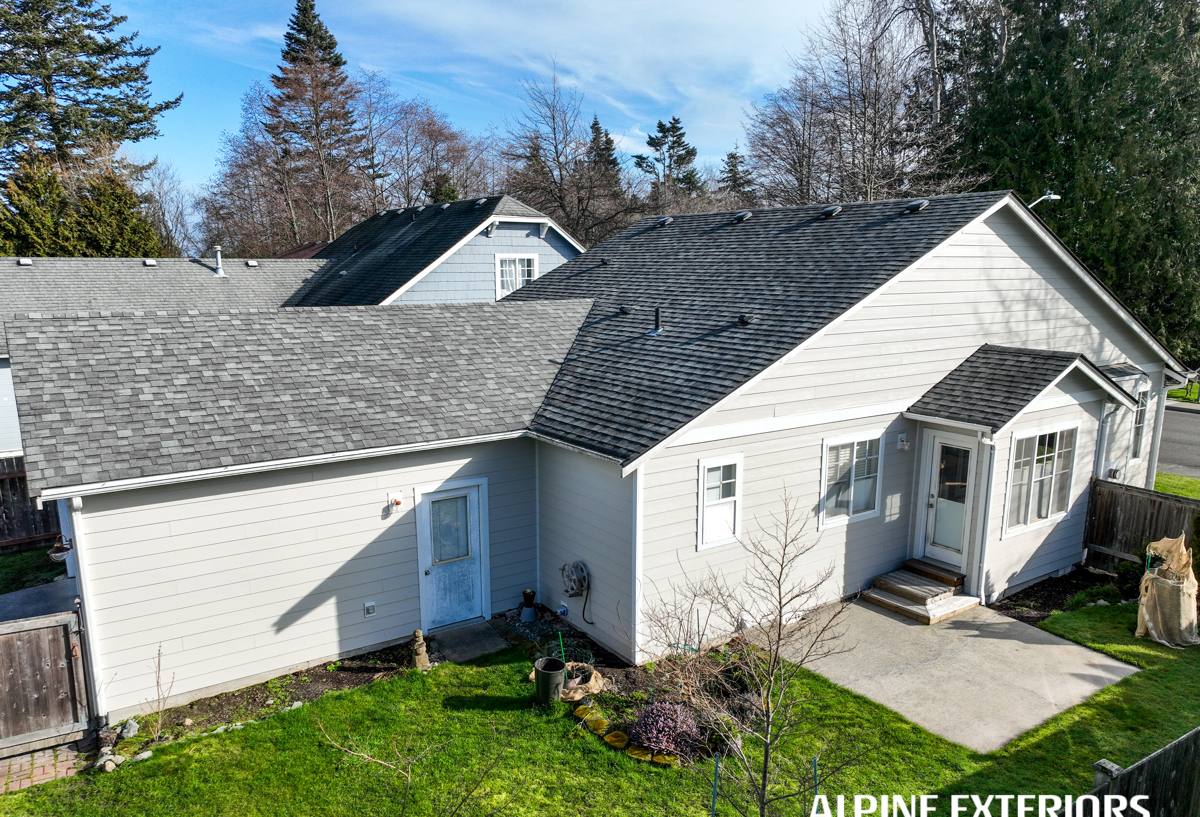
Why This Matters for Siding Choice
Every siding material handles sustained moisture differently. Some are engineered for it; some tolerate it grudgingly; some simply aren't built for it. We install James Hardie fiber cement siding exclusively, and the decision comes directly from what we see on Whatcom County houses.
| Material | How It Handles Sustained Moisture | Long-Term Concern in This Climate |
|---|---|---|
| Cedar / primed spruce | Absorbs moisture directly into the wood fiber | Rot, cupping, and repaint cycles every few years |
| Vinyl | Doesn't absorb water, but seams and panels flex and gap over time | Water can travel behind panels; limited moisture management design |
| LP SmartSide | Engineered wood strand with a resin coating; better than raw wood but still wood-based | Edge and cut-end swelling if the factory seal is compromised during install |
| Fiber cement (James Hardie) | Non-combustible, dimensionally stable, engineered specifically for wet climates | Performs consistently when installed to manufacturer spec |
We're not going to tell you cedar or LP SmartSide are bad products — they're not, and plenty of houses around the country wear them fine. But we made a professional call a long time ago that in a climate like this one, we didn't want to keep telling homeowners the same story: repaint the wood siding again, replace the swollen panel edges again, chase the caulk failures at every seam again. James Hardie's fiber cement is engineered to resist moisture absorption, doesn't feed mold or mildew growth the way wood does, and holds its factory finish for decades instead of years. For a valley that stays damp as long as Lynden's does, that's the difference between a siding job you think about once and one you keep managing.
How We Approach Siding Work in Lynden
Correct fiber cement installation is not a generic process — it changes based on the house, the elevation, and the exposure. On Lynden projects specifically, we pay close attention to:
- Rain screen and drainage gap detailing so moisture that does get behind the cladding has somewhere to go instead of sitting against the wall sheathing.
- Flashing at every horizontal transition — window heads, trim boards, deck ledgers — since these are the spots wind-driven rain finds first.
- Caulk and joint sequencing done to Hardie's published specifications, not shortcuts that look fine on install day and fail in year three.
- Fastener placement and nailing patterns matched to the specific HZ10 product line, since Pacific Northwest climate zones call for Hardie's HZ10 formulation rather than the HZ5 version sold in drier regions.
- Ground clearance and grade slope around the foundation line, so splashback and standing water aren't feeding moisture into the bottom courses.
None of this is exotic. It's just attention to the details that matter in a climate that doesn't give a house many dry stretches to recover in.
Beyond Siding: Roofing, Windows, and Decks
Siding doesn't fail in isolation — it fails alongside whatever else is letting water into or around the house. That's why we handle roofing, windows, and decks as well, and why we think about them together rather than as separate trades.
Roofing
A roof that's shedding granules, has failing flashing, or is holding onto moss will send water down the wall plane behind your siding, undermining even a well-installed fiber cement job. Roof condition is one of the first things we check before recommending siding work.
Windows
Old or poorly flashed windows are one of the most common hidden moisture entry points we find during siding tear-off. Window replacement and re-flashing done at the same time as a siding project is often the more efficient — and more protective — path than treating them as separate jobs down the road.
Decks
Deck ledger boards attach directly to the house structure, and a poorly flashed ledger connection is a well-documented source of rot in wet climates. When we build or repair decks in Lynden, ledger flashing gets the same scrutiny as siding flashing, because it's effectively part of the same building envelope.
Why a Local Crew Matters Here
Whatcom County's microclimates aren't uniform. A house a few miles from Lynden's town center, tucked against tree cover or sitting in a low spot near the river valley, can hold moisture differently than one on higher, more open ground. A crew that works this specific area regularly recognizes those differences — which elevations need extra drainage detailing, which sites see heavier moss growth, which older homes in the area tend to have particular flashing issues from how they were originally built.
That local pattern recognition is hard to replicate from a crew that mostly works somewhere drier or only passes through the region occasionally. It's part of why we standardized on one siding system we trust completely, rather than installing whatever a homeowner saw online — a materials mismatch is often worse than an installation shortcut, and we'd rather avoid both.
Maintenance Realities for Lynden Homeowners
Even the right materials need some homeowner attention in this climate. A short, honest list of what actually matters:
- Check north-facing and shaded siding sections once a year for early moss or algae growth, and address it before it spreads.
- Keep gutters clear — overflow during heavy rain is a major contributor to siding staining and moisture intrusion at the roofline.
- Trim back vegetation and tree limbs that keep siding sections shaded and slow to dry.
- Inspect caulking at windows, trim, and corner boards every couple of years; failed caulk is cheap to fix and expensive to ignore.
- Watch for soft spots or discoloration near ground level, where splashback and grade moisture concentrate.
James Hardie siding reduces how often these issues turn into real problems, but no exterior material eliminates the need for basic upkeep in a climate this wet.
What to Expect From a Siding Project Here
Every Lynden property is a little different — tree cover, elevation, sun exposure, and the age and condition of the existing structure all factor into scope and cost. Rather than quote numbers that don't mean much out of context, here's what actually drives the range on a typical project:
| Factor | Why It Matters |
|---|---|
| Existing siding removal and disposal | Tear-off complexity varies with layers, material type, and any hidden rot found underneath |
| House size and elevation count | More wall plane and more complex rooflines mean more flashing detail work |
| Underlying sheathing condition | Moisture damage found during tear-off can require repair before new siding goes on |
| Trim and color package | Full ColorPlus factory-finished trim adds cost but removes future repainting |
| Combined scope | Pairing siding with roofing, window, or deck work can improve efficiency and sequencing |
If you're weighing a siding project in Lynden — whether your current siding is showing moss, cupping, gapping, or you're just planning ahead — we're happy to walk the property, explain what we're seeing, and put together a straightforward, no-pressure estimate. Use the form below to get started.