 Ferndale
 Two Very Different Materials, One Job to Do
Homeowners in Ferndale often come to us comparing two products that get lumped together as "the modern siding options": James Hardie fiber cement and LP SmartSide engineered wood. On paper they look similar — both come as lap boards or panels, both take paint or factory color, both are marketed as upgrades over vinyl or old-growth cedar. But the materials underneath are fundamentally different, and that difference matters a lot once a product is nailed to a house fifteen feet from Bellingham Bay and left to deal with a Pacific Northwest winter.
James Hardie siding is fiber cement: a mix of Portland cement, sand, and cellulose fiber, cured into a rigid, non-combustible board. LP SmartSide is engineered wood: strand-based wood fibers bonded with resin, similar in concept to OSB sheathing, then coated with a wax and zinc-borate treatment and a resin-saturated overlay. One is essentially a masonry product. The other is, at its core, still wood. That distinction drives almost everything else in this comparison — how each product handles rain, how it ages, what it costs to maintain, and what happens at the cut edges and seams where water actually gets in.
We install exclusively James Hardie. This page explains why, without pretending LP SmartSide is a bad product — it isn't. It's a real engineering improvement over old wood siding. But "better than old wood siding" and "right for a wet coastal Whatcom County roofline" are two different bars, and we've made our decision based on the second one.
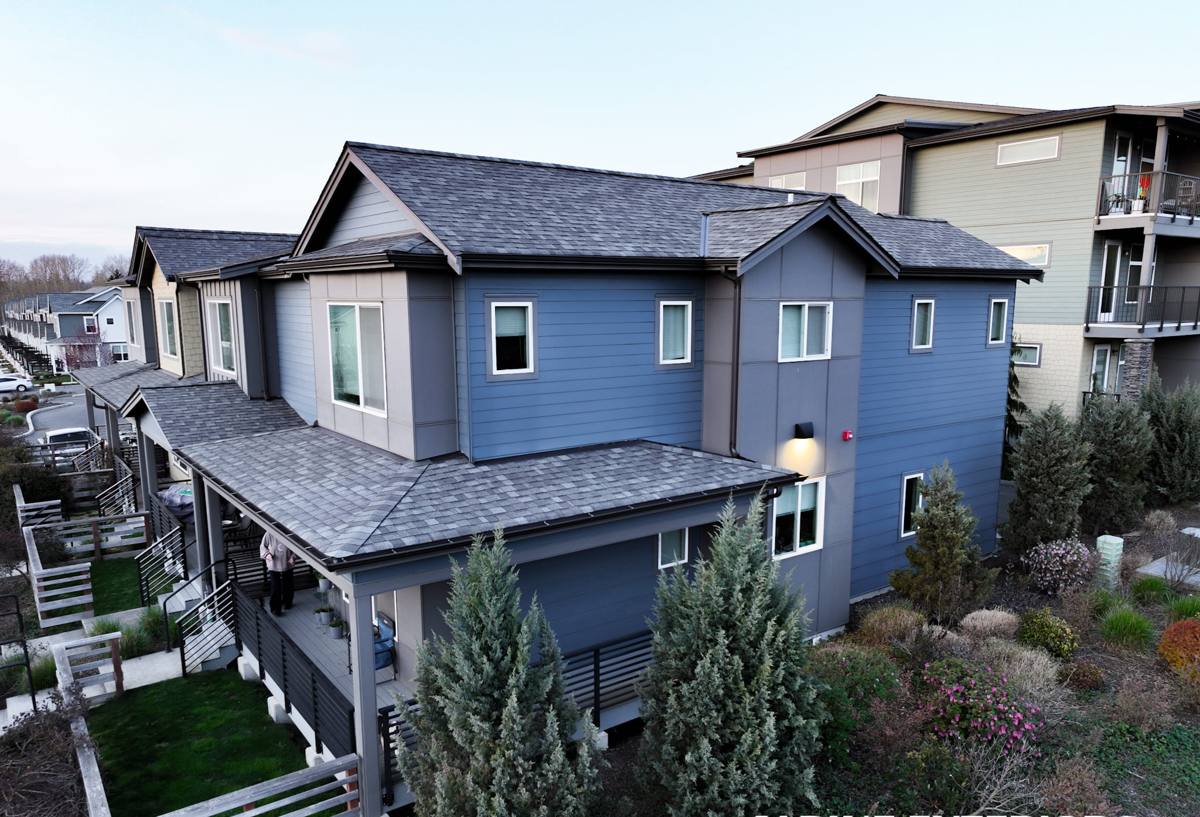
What Engineered Wood Siding Gets Right
LP SmartSide deserves credit before we get into the trade-offs. It's lighter than fiber cement, which makes it easier and faster to handle and cut on site, and it holds a nail well without the pre-drilling or specialized blades fiber cement sometimes calls for near edges. The zinc-borate treatment genuinely improves resistance to fungal decay and insect damage compared to untreated dimensional lumber or plain plywood siding. For a builder working in a drier climate, or on a budget-sensitive project where the siding will get diligent paint maintenance every few years, it's a legitimate, defensible choice.
It also machines and finishes in a way that's familiar to carpenters who grew up working with wood trim, and it's compatible with a wide range of traditional siding profiles. None of that is marketing spin — it's why the product has a real place in the market. Our objection isn't that LP SmartSide is poorly engineered. It's that its core vulnerability — being a wood-fiber product — runs directly into the specific way Ferndale's climate attacks siding.
Why Ferndale's Climate Is Hard on Wood-Based Siding
Ferndale sits close enough to the Strait of Georgia and Bellingham Bay that salt-laden marine air is a constant, not an occasional event. Combine that with the long, low-angle rain that defines a Whatcom County fall through spring — driving rain that gets pushed sideways into wall assemblies by wind off the water — and you have conditions that test the weak points of any siding product almost every month of the year.
Then there's moss. Shaded north and west elevations around Ferndale, especially under mature fir and cedar canopy common on Whatcom County lots, stay damp for weeks at a stretch during the moss season that typically runs from late fall through early spring. Moss and algae don't just look bad — they hold moisture directly against the siding surface far longer than open sun and wind would allow. On a wood-fiber product, that's moisture sitting against exposed cellulose for extended periods. On fiber cement, the same moss is sitting on an inorganic surface that doesn't feed decay even if the homeowner is slow to clean it off.
None of this means engineered wood siding fails quickly or dramatically. It means the maintenance margin for error — how long you can go before caulking a gap, repainting a cut edge, or clearing moss off a shaded wall — is thinner here than it is in a drier region, and we don't think that's the right trade-off to build a house around.
The Core Material Difference: Wood Fiber vs. Portland Cement
It's worth being specific about what "fiber cement" actually means, since the name confuses some homeowners. James Hardie board is roughly 90% Portland cement and sand, with cellulose fiber added for tensile strength and workability during manufacturing. Once cured, the finished board behaves like a rigid masonry product — it doesn't absorb water into its structure the way wood does, it doesn't expand and contract significantly with humidity swings, and it has nothing in its composition that fungal decay organisms can use as food.
LP SmartSide, by contrast, is a wood-strand product through and through. The strands are treated and resin-bonded, which meaningfully slows decay compared to bare lumber, but the base material is still cellulose. If water gets past the surface treatment — through a cut end that wasn't properly sealed in the field, a fastener that split the substrate, or a joint that opened up as the house settled — the underlying material is chemically capable of absorbing that water and, over time, swelling, softening, or supporting decay. Fiber cement doesn't have that failure pathway, because there's no wood fiber for water to act on in the first place.
Where This Shows Up in the Field
The practical difference isn't usually visible in year one. It shows up at butt joints, around window and door penetrations, at the bottom edge near grade, and on shaded elevations — the exact spots where Ferndale's rain and moss pressure concentrate. These are also the spots most dependent on correct field sealing, which brings us to installation sensitivity.
Installation Sensitivity: Why the Details Matter More With Wood-Based Products
Every siding product depends on correct installation, but engineered wood siding has a narrower tolerance for error because its cut edges are its most vulnerable point. Manufacturers of wood-based siding require field-applied sealant on every cut end and any exposed edge, precise fastener placement, and consistent maintenance of that sealant over the life of the siding. Skip a cut edge, let caulking fail after a decade of UV and freeze-thaw, or leave a gap where two boards meet, and you've opened a direct path for water into a material built to absorb it.
Fiber cement isn't installation-proof — it still needs correct fastening, proper clearance from grade and roof lines, and factory-finished cut edges treated with touch-up paint — but a small lapse in edge sealing doesn't carry the same consequence, because the material underneath isn't going to swell or feed decay the way wood fiber will. That's a meaningful difference on a coastline where driving rain finds every gap eventually, and it's a big part of why we don't want our crews' long-term callback risk tied to a product where a missed bead of caulk on one cut end can matter a decade later.
Moisture Behavior and Maintenance Burden, Side by Side
| Factor | James Hardie Fiber Cement | LP SmartSide Engineered Wood |
|---|---|---|
| Core material | Portland cement, sand, cellulose fiber (cured, inorganic-dominant) | Wood strands bonded with resin, zinc-borate treated |
| Water absorption into substrate | Minimal; not a food source for decay organisms | Low but present; treated wood can still decay if saturated |
| Cut-edge sensitivity | Requires touch-up paint on cuts; forgiving of minor lapses | Requires sealant on every cut edge; less forgiving of lapses |
| Behavior in moss/shade areas | Surface can be cleaned; doesn't feed on trapped moisture | Extended damp contact is a real decay risk over time |
| Fire classification | Non-combustible | Combustible (wood-based) |
| Typical repaint interval with factory finish | ColorPlus finish: often 15+ years before repaint needed | Field-painted or factory-primed: shorter typical repaint cycle |
The pattern in that table is consistent: fiber cement's advantages cluster exactly around the conditions Ferndale sees most — sustained damp, salt air, and driving rain. That's not a coincidence; it's why fiber cement was developed in the first place, as a response to the maintenance problems of wood-based and wood-composite siding.
Fire and Pest Considerations
Two factors that come up less often in casual comparisons but matter to homeowners and insurers alike: fire classification and pest resistance. James Hardie fiber cement is non-combustible, which can be relevant for fire-rated wall assemblies and, in some cases, insurance considerations. LP SmartSide, being wood-based, is combustible, even with its treatments.
On pests, the zinc-borate treatment in LP SmartSide is a real deterrent to insects and fungal decay compared to untreated wood, and it's a genuine engineering improvement. But it's still a treatment applied to an organic material, not a structural non-issue the way it is with fiber cement, which has nothing for insects or fungus to consume in the first place. In a county with plenty of moisture-loving carpenter ants and the damp conditions that support them, that's a difference we don't think is worth gambling on.
Finish, Color Retention, and Long-Term Appearance
James Hardie's ColorPlus finish is baked on at the factory in a controlled environment, using a multi-coat process engineered specifically for fiber cement, backed by its own finish warranty separate from the product warranty. LP SmartSide is typically sold primed, with the homeowner or builder responsible for field-applying the finish coat, or factory pre-finished depending on the line — but the coating is going onto a wood-strand substrate that expands, contracts, and can telegraph substrate movement through the paint film over time.
In practice, that means Hardie siding with ColorPlus tends to hold its color and film integrity longer between repaints, which matters in a climate where UV exposure is intense in summer and the wall is soaked for months in winter — a combination that's hard on any paint film, but harder on one applied over a substrate that moves with moisture.
Why We Standardized on James Hardie
We made a business decision years ago to install one fiber cement system rather than offer both fiber cement and engineered wood: James Hardie's HZ5 climate-engineered product line, factory-finished with ColorPlus, backed by a strong transferable limited warranty. Here's the short version of why:
- Non-combustible material with no wood-fiber substrate to swell, rot, or feed decay
- Forgiving of minor field imperfections in a way wood-based products aren't
- Performs well specifically in sustained damp, shaded, and salt-air conditions common in Whatcom County
- Factory ColorPlus finish reduces repaint frequency and protects against UV and moisture cycling
- Backed by a transferable warranty that matters at resale
- One system means our crews specialize deeply in correct installation rather than splitting attention across products
That last point matters more than it might seem. Installation quality is the single biggest factor in how any siding performs over twenty or thirty years, and a crew that installs one system daily, in one climate, develops a level of consistency that's hard to match when switching between product lines with different fastening, flashing, and sealing requirements.
Making the Right Call for Your House
We're not going to tell you engineered wood siding is unusable — plenty of houses around the country wear it successfully with diligent maintenance. But we build and re-side homes in a specific place, with a specific set of conditions: salt air off the water, driving rain that finds every gap, and a moss season that keeps shaded walls damp for weeks. Given that reality, we chose to put our reputation behind a material that doesn't ask a homeowner to stay ahead of caulking and repainting to avoid decay.
If you're weighing siding options for a home in Ferndale or elsewhere in Whatcom County, we're happy to walk your property, look at your exposures, and talk through what James Hardie would look like on your house — no pressure, no sales script. Reach out for a free estimate and we'll give you an honest read on what your siding needs.