 Ferndale
 Why Blaine's Climate Is Tougher on Siding Than Most of Whatcom County
Blaine sits right on the water at the top of Whatcom County, and that location comes with a specific set of exterior problems that inland Ferndale neighborhoods deal with less often. Homes here take on salt-laden air off the Strait of Georgia and Semiahmoo Bay, near-constant winter rain driven sideways by wind off the water, and a moss and algae season that can run eight or nine months out of the year in shaded, north-facing exposures. Individually, none of these is unusual for the Pacific Northwest. Together, and applied to a home day after day for years, they're exactly the conditions that expose weak siding installations and mediocre materials.
Salt air is the piece homeowners tend to underestimate. It doesn't just sit on the surface — over time it works into fasteners, trim joints, and any place where a coating has thinned or cracked, accelerating corrosion and finish breakdown in ways that inland siding never has to withstand. Add in driving rain that pushes water sideways and upward under laps and trim, plus moss and algae that hold moisture against the wall assembly for months at a stretch, and you have a climate that punishes any siding product or installation with even minor weak points.
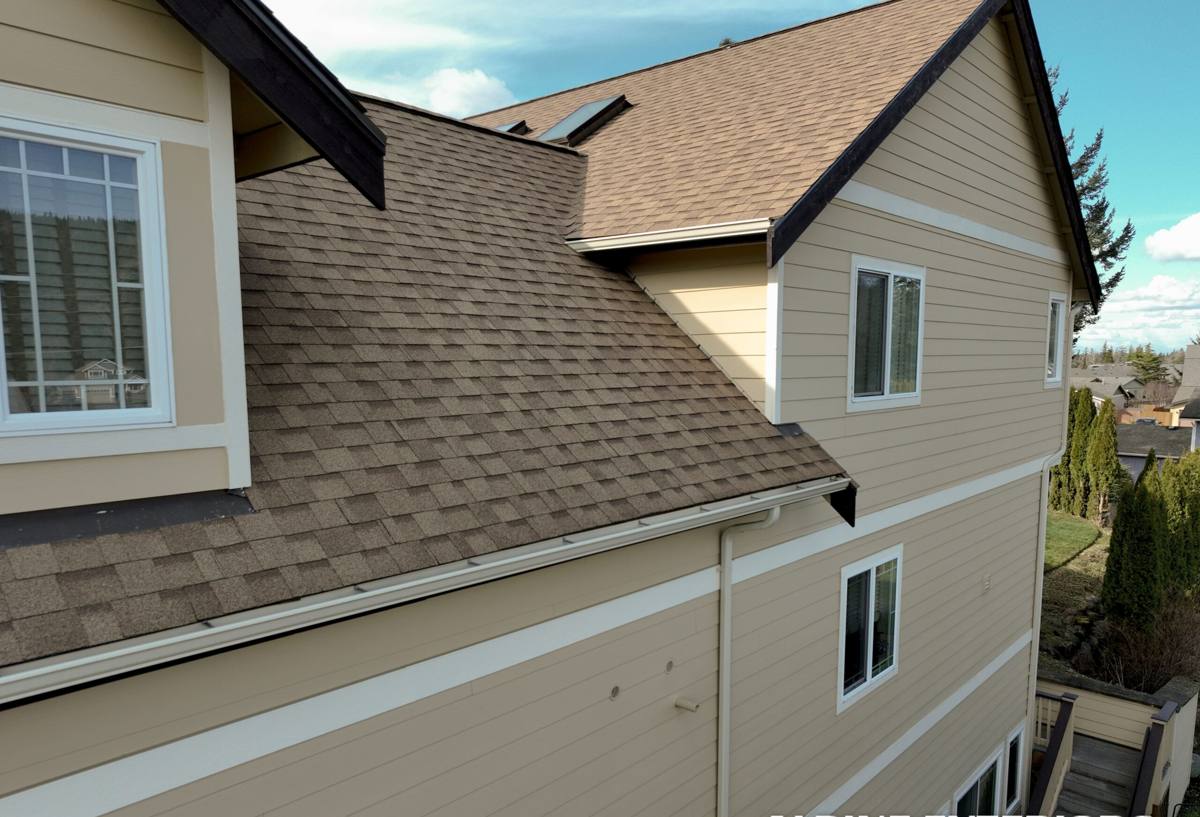
Signs a Blaine Home Needs Siding Replacement, Not Just Repair
Because Blaine's exposure is more aggressive than average, siding problems here tend to show up earlier and spread faster than homeowners expect. Some of the clearest signals it's time to replace rather than patch:
- Soft or spongy spots when you press on the siding, especially near the bottom courses, window sills, and corners
- Paint that keeps failing within a year or two of repainting, even after prep work
- Persistent moss or algae staining that returns within a season of cleaning
- Visible cupping, warping, or delamination in wood-based or engineered wood panels
- Rust streaks or corroded fasteners bleeding through the finish
- Gaps opening up at butt joints, corners, or trim where caulk has failed
- A musty smell or visible mold near exterior walls on the interior side
Any one of these on its own might be a repair. Several together, especially on a home more than 15-20 years old, usually means the underlying material or the original installation has reached the end of what it can handle in this climate.
What a Correct Siding Replacement Job Actually Involves
Siding replacement done right is not just pulling off old boards and nailing up new ones. In a coastal, high-rain environment like Blaine, the work that happens underneath the visible siding matters as much as the siding itself.
Tear-Off and Inspection
Once the old siding is off, the sheathing and framing underneath get a real inspection — not a glance. This is where hidden rot, soft sheathing, or water damage from years of marginal flashing gets found and dealt with before anything new goes on. Covering up a compromised wall assembly with new siding just buys a few years before the same problem resurfaces, worse.
Weather-Resistive Barrier and Flashing
A correctly installed weather-resistive barrier (house wrap) and properly lapped flashing at windows, doors, and every horizontal trim break is what actually keeps driving rain out of the wall. In a location like Blaine, where wind-driven rain is routine rather than occasional, flashing details at penetrations and transitions are where most long-term failures start if they're rushed or skipped.
Fastening and Clearances
Correct fastener spacing, type, and depth matter more in salt air, where the wrong fastener corrodes faster and can telegraph rust stains through the finish within a few years. Proper clearance from grade, decks, and roof lines also keeps siding out of standing water and prolonged dampness — both common on shaded, moss-prone elevations.
Finish and Detailing
Trim, caulking, and touch-up painting at cut edges are the last line of defense against moisture intrusion. Skipping factory-primed or factory-finished cut edges is a small shortcut that shows up as premature paint failure and swelling within a season or two in this climate.
How Common Siding Materials Actually Hold Up on the Water in Whatcom County
| Material | Salt Air Performance | Moisture / Moss Resistance | Maintenance Burden Here |
|---|---|---|---|
| James Hardie fiber cement | Non-combustible, dimensionally stable, factory finish resists salt-driven fading and corrosion at the surface | Doesn't rot, swell, or delaminate from prolonged moisture contact | Occasional wash and caulk check; ColorPlus finish holds color for years without repainting |
| Vinyl siding | Can become brittle and discolored faster under coastal UV and salt exposure | Moisture can get trapped behind panels; doesn't stop moss growth on the surface | Panels crack or warp over time and are hard to color-match when replaced |
| LP SmartSide / engineered wood | Edge and cut-end sealing is critical; salt-air moisture cycling stresses seams | Prone to swelling at joints and butt seams if any moisture gets in | Requires vigilant caulk and paint maintenance to avoid edge swelling |
| Primed spruce / cedar | Natural wood is vulnerable to salt-accelerated weathering and UV breakdown | Absorbs moisture readily; moss and algae take hold easily in shaded, damp spots | Regular repainting and moss treatment needed to keep ahead of decay |
This is a general pattern, not a guarantee for every product on every wall — installation quality changes outcomes for any material. But it's the pattern we've seen consistently enough in this climate that it shaped what we choose to put on homes.
Why We Install Only James Hardie Fiber Cement
We standardized on James Hardie because, installed correctly, it holds up to exactly the conditions Blaine throws at a house: salt air, sustained damp, and long stretches of shade-driven moss growth. It's non-combustible, dimensionally stable across wet-dry cycles, and the ColorPlus factory finish is baked on under controlled conditions rather than applied on site — which matters in a climate where field-applied paint has less time to cure between rain events. Hardie's HZ5 product line is engineered specifically for wet, freeze-prone climates like this one, and the company backs it with a strong transferable warranty when installation follows spec.
That doesn't mean every other product is a bad product everywhere. It means that for the specific combination of salt exposure, rain volume, and moss pressure that Blaine and the rest of coastal Whatcom County deal with, fiber cement gives homeowners the best long-term performance for the investment — and it's the only material we're willing to put our installation standards behind.
Our Process for a Siding Replacement in Blaine
- On-site assessment — we walk the exterior, check for hidden moisture damage, and evaluate sun/shade exposure and wind direction specific to the lot
- Written scope and estimate — clear line items, no surprise add-ons buried in vague language
- Tear-off and sheathing inspection — old siding removed, framing and sheathing checked and repaired as needed before anything new goes up
- Weather-resistive barrier and flashing — installed or repaired to current best practice at every window, door, and horizontal transition
- James Hardie installation — fastened, spaced, and finished to manufacturer spec, including cut-edge sealing
- Trim, caulk, and final detailing — the finish work that determines how the job ages over the next decade
- Site cleanup and walkthrough — debris and fasteners cleared, final review with the homeowner before we call it done
Why Hiring a Crew That Already Works in Blaine Matters
Siding installation practices that work fine in a drier, inland part of the state can fall short right on the water. A crew that regularly works Blaine and the surrounding Whatcom County coastline already knows to treat flashing, fastener choice, and moisture detailing as non-negotiable rather than optional upgrades — because they've seen what happens when those details get skipped in this exposure. That familiarity also means fewer surprises during the job: knowing how local permitting works, what inspection expectations look like in the county, and how wind and rain patterns off the water affect scheduling and sequencing.
It's also worth asking any contractor directly about warranty coverage, manufacturer certification, and what happens if something goes wrong after the crew leaves. A contractor who stands behind one product line, with manufacturer training behind it, has a clearer accountability chain than one juggling several materials and subcontracted crews.
What Siding Replacement Costs Depend On
We don't publish fixed prices because every home is different, but the main cost drivers for a Blaine siding replacement are consistent: the square footage and complexity of the exterior (corners, gables, and trim detail add labor), how much of the underlying sheathing needs repair once old siding comes off, the Hardie product line and profile chosen, and site access. A straightforward single-story home costs meaningfully less than a home with steep rooflines, multiple stories, or extensive trim work. The only way to get a real number is a walkthrough — which is also when hidden moisture damage, if any, typically gets found.
If your Blaine home is showing any of the signs above, or you're simply planning ahead before the next wet season, we're happy to take a look and put together a clear, no-pressure estimate using the form below.