 Ferndale
 Birch Bay's Waterfront Climate Is Harder on Siding Than It Looks
Birch Bay sits right on the water, and that changes what "good siding" means compared to a house a few miles inland in Ferndale or Lynden. Homes here take a steady diet of salt-laden air off the bay, wind-driven rain that hits walls sideways instead of falling straight down, and a long gray stretch from October through April where surfaces rarely get a chance to fully dry out. That combination is exactly what board and batten siding was designed to handle a century ago on coastal and farmhouse-style buildings, but only when the material underneath the classic look can actually stand up to it.
Board and batten's vertical lines and raised battens make it a natural fit for the beach-cottage and modern-farmhouse styles a lot of Birch Bay homeowners want. The look is straightforward. What's not straightforward is picking a substrate that won't punish you in five or ten years once the salt air, moss, and moisture cycle have had time to work on it.
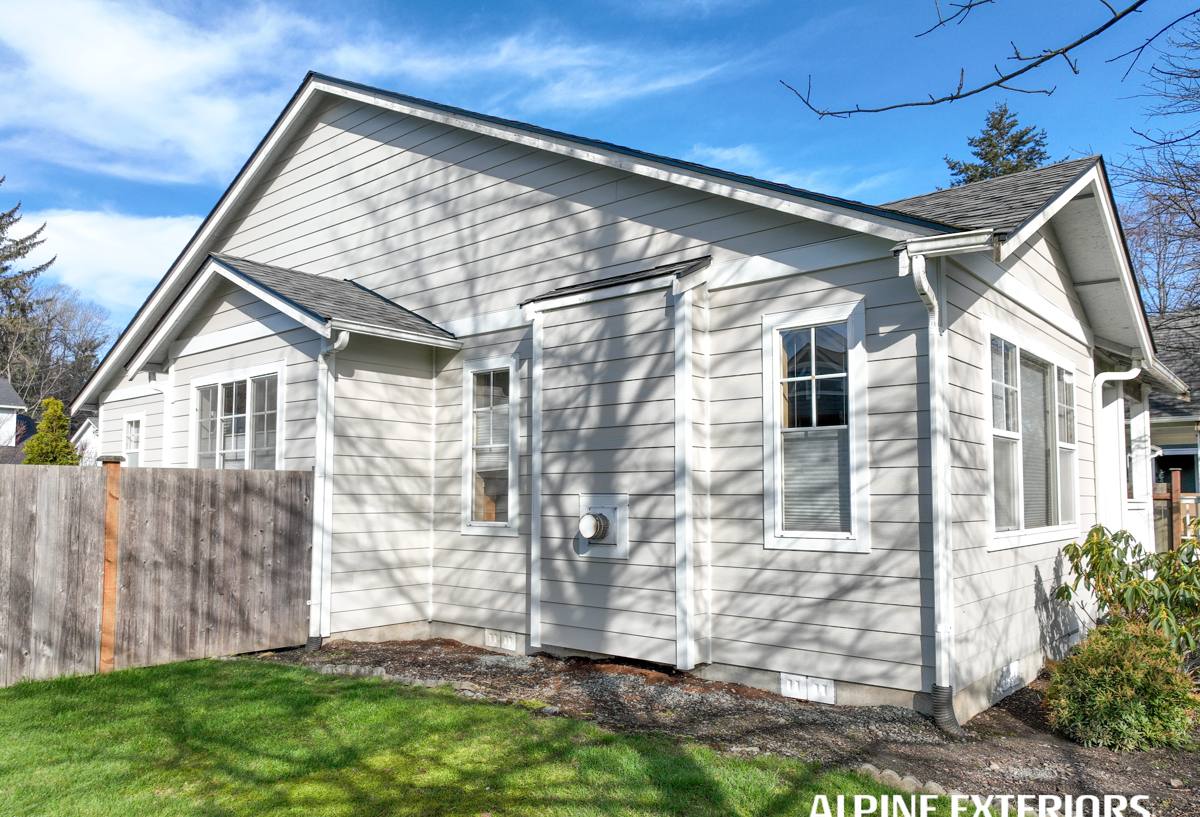
What Board & Batten Siding Has to Do in a Salt Air, Moss-Prone Environment
Board and batten is really a system, not just a plank pattern. In a Whatcom County waterfront microclimate like Birch Bay, that system needs to do several things at once:
- Resist moisture absorption at the vertical seams where wide boards or panels meet the battens — the most exposed joint in this siding style
- Hold paint and factory finish without excessive fading or chalking under sustained UV and salt exposure
- Stay dimensionally stable through repeated wet-dry cycles so battens don't work loose or telegraph movement through the finish
- Shed moss and algae growth on north-facing and shaded elevations, which stay damp longer through the wet season
- Resist swelling, splitting, or rot at cut ends and fastener penetrations, which is where lesser materials fail first
A lot of board and batten failures we see on the water side of Whatcom County aren't design problems — they're material problems. The pattern looks right for years, then the substrate underneath starts breaking down faster than the homeowner expected, usually starting at the batten edges and cut ends where moisture has the most access.
Why We Install James Hardie Board & Batten — Not the Alternatives
We install one siding system on every home we work on, including in Birch Bay: James Hardie fiber cement. We don't offer vinyl board and batten, LP SmartSide, cedar, or primed spruce, and it's worth being straightforward about why, since all of them show up in this style.
Vinyl board and batten
Vinyl handles moisture fine on its own, but it's a thin, flexible material that expands and contracts noticeably with temperature swings — and in a windy waterfront location like Birch Bay, that flex shows up as visible waviness along the battens over time. It's also not rated to stand up to sustained direct flame the way fiber cement is, which matters given the wildfire-smoke and defensible-space conversations happening across Washington.
Engineered wood (LP SmartSide) and cedar
Both are wood-based products, and wood-based siding's biggest long-term vulnerability is exactly what Birch Bay has the most of: sustained moisture. Cedar looks excellent initially but needs ongoing sealing, staining, or painting to keep salt air and rain from breaking down the fibers, and cut ends and board edges are where that breakdown starts. Engineered wood improves on solid cedar in some ways but is still a wood-fiber product with the same core moisture sensitivity, and manufacturer warranties on these products are typically more conditional on maintenance schedules than what fiber cement carries.
We're not saying these products can't be installed well elsewhere. We're saying that for a waterfront exposure like Birch Bay, we'd rather stand behind one material we know performs than sell homeowners something we'd have to caveat.
The James Hardie System We Actually Install
For board and batten specifically, that means HardiePanel vertical siding paired with Hardie's trim boards as battens, finished in factory-applied ColorPlus. A few specifics matter more here than on a typical inland job:
- HZ10 climate engineering — Hardie's HZ10 formulation is built for the wetter Pacific Northwest and is what we spec for Whatcom County waterfront homes, rather than the drier-climate HZ5 formulation used elsewhere
- Fiber cement composition — non-combustible, doesn't absorb and swell the way wood-based panels do, and holds its shape at the batten seams year after year
- ColorPlus factory finish — baked-on, UV- and salt-resistant color that resists the fading and chalking we see on field-painted siding closer to the water, backed by its own finish warranty separate from the substrate warranty
- Correct rainscreen detailing — vertical panel siding depends on getting airflow behind the boards, not just fastening straight to the wall, to keep that damp season from turning into trapped moisture
Comparing Board & Batten Materials for a Birch Bay Exposure
| Material | Moisture behavior on the water | Maintenance burden | Fire rating |
|---|---|---|---|
| James Hardie fiber cement (HZ10) | Engineered for wet, salt-air climates; stable at seams and cut ends | Low — no repainting cycle with ColorPlus | Non-combustible |
| Vinyl | Moisture-resistant but expands/contracts with temperature and wind load | Low, but visible warping over time near the water | Combustible |
| Cedar | Vulnerable to swelling, checking, and rot without diligent upkeep | High — periodic sealing/staining/painting | Combustible |
| Engineered wood (LP SmartSide) | Improved over solid wood but still wood-fiber based; maintenance-dependent warranty | Moderate — coating maintenance required | Combustible |
What Correct Installation Looks Like
Board and batten fails early almost always because of installation shortcuts, not the material choice. On a Birch Bay job, our crew is paying particular attention to:
- Proper drainage plane and rainscreen gap behind the panels, so wind-driven rain that gets past the surface has somewhere to go instead of sitting against the wall sheathing
- Correct batten spacing and fastening pattern per Hardie's engineering specs — not "close enough," since fastener placement affects how the panel handles wind load off the bay
- Fully sealed and primed cut ends on every panel, since a factory finish only protects what's still factory-finished once boards are trimmed to fit
- Flashing detail at every window, door, and roofline transition, which is where the majority of moisture intrusion actually starts on any siding job
- Manufacturer-specified fastener and caulk products, since substituting a cheaper sealant is a common shortcut that shows up as failure years later
Our Process for Birch Bay Projects
Because we already work this stretch of Whatcom County, our process for a Birch Bay home isn't generic:
- On-site assessment — we look at which elevations take the most direct salt spray and wind-driven rain, and which stay shaded and damp longer, since that affects detailing decisions before we order material
- Written scope and product spec — HZ10 board and batten, ColorPlus color, trim, and fastening plan spelled out before work starts, no surprises mid-project
- Tear-off and substrate check — we don't cover over rot or hidden moisture damage; if we find it, we show it to you before closing the wall back up
- Installation to manufacturer spec — rainscreen, fastening, flashing, and sealed cut ends handled the way described above, not shortcut
- Final walkthrough — we go over the finished job with you and explain what little maintenance is actually needed going forward
Living With Board & Batten in a Salt Air, Moss-Season Climate
One of the real advantages of doing this job right the first time is how little upkeep is left afterward. Homeowners on the water side of Whatcom County should still plan on:
- An annual rinse-down to clear salt residue and organic buildup, especially on shaded, north-facing walls where moss gets a foothold
- A visual check each fall before the wet season for any caulk lines that have separated at trim and flashing joints
- Prompt attention to any impact damage — fiber cement resists it well, but any siding benefits from not sitting damaged through a wet winter
- Keeping gutters clear so runoff isn't sheeting down the wall face during heavy rain events
None of that is a repainting or resealing schedule — it's basic homeowner upkeep, which is the point of putting a factory-finished, engineered material on a house that sits this close to the water.
Why It Matters That We Already Work in Birch Bay
Board and batten detailing that works fine in a drier, more sheltered part of Whatcom County can underperform right on the water if a crew treats every job the same. Knowing which Birch Bay elevations catch the worst of the wind and salt, how long moss season actually lasts on shaded walls here, and how the wetter HZ10 spec should be detailed at seams and flashing points isn't something you get from a general-market install — it comes from doing this work in this specific place, repeatedly, and paying attention to what holds up.
If you're weighing board and batten for a home in Birch Bay, we're glad to walk the property with you, look at your specific exposure, and put together a straightforward, no-pressure estimate — just fill out the form below.