 Ferndale
 Decks Take a Different Kind of Beating in Sandy Point
Sandy Point sits right up against the water, and that changes what a deck has to survive year to year. Homes a few miles inland in Ferndale deal with plenty of rain, but they're not getting salt-laden air rolling off the Strait almost daily, and they're usually more sheltered from wind-driven rain hitting the house at an angle instead of falling straight down. Add Whatcom County's long, low-sun moss season and you've got three separate forces working against a deck at the same time: corrosion, water intrusion, and surface growth. A deck built to a generic spec — the kind that would be fine in a dry inland subdivision — tends to show its age fast out here. Fasteners rust before the wood around them even looks tired. Ledger connections stay damp longer than they should. Boards that never fully dry out grow moss in the shaded, low-airflow spots. None of this means decks can't last in Sandy Point. It means they have to be built for the actual conditions, not the average ones.
What "Salt Air, Driving Rain, and Moss Season" Actually Does
Salt air accelerates galvanic corrosion on any metal that isn't rated for coastal exposure — nails, screws, joist hangers, post bases. Once fasteners start weeping rust stains or losing grip, the deck's structural connections are compromised even if the decking boards look fine. Driving rain, especially when it's coming sideways off open water, gets pushed into places vertical rain never reaches: under railing caps, behind ledger boards, into end-grain cuts that weren't sealed. And moss season — those long stretches of low light, high humidity, and slow drying that mark a Whatcom County fall through spring — turns any deck surface that doesn't get full sun and airflow into a slick, green problem within a season or two if it's not managed.
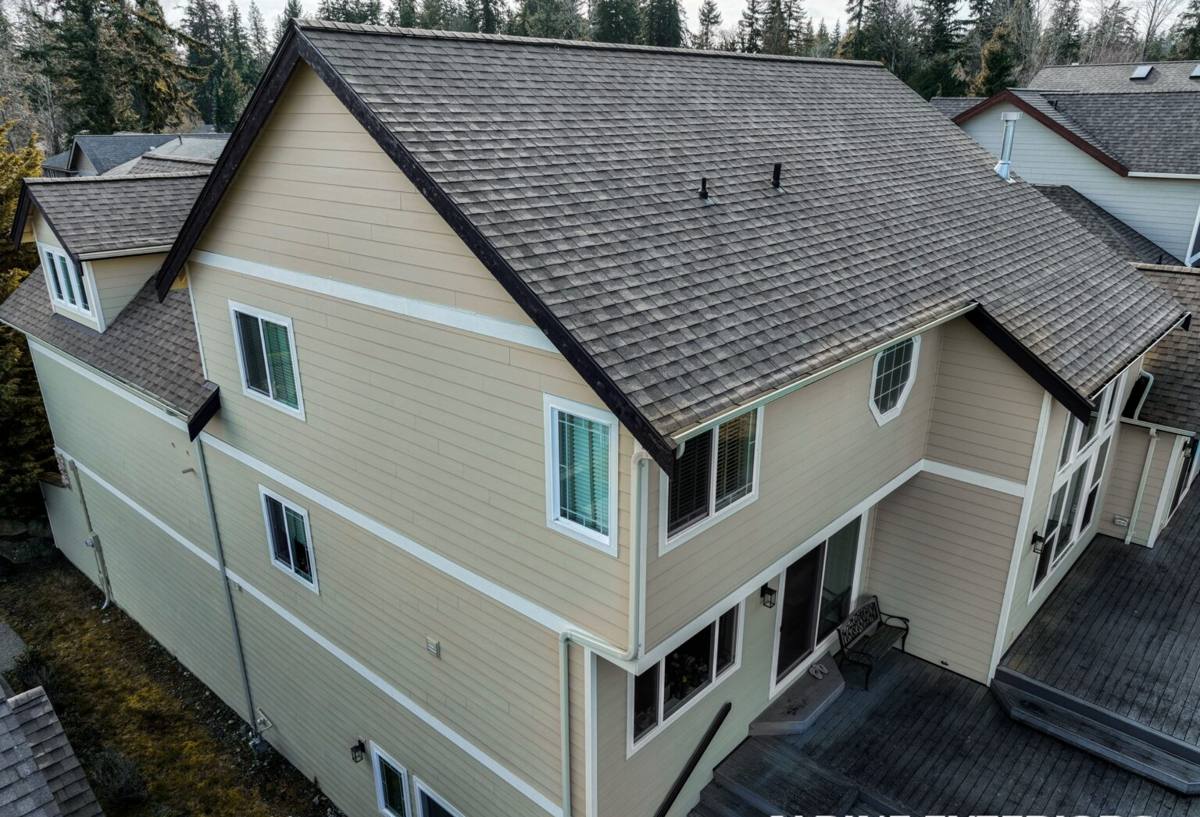
Signs a Sandy Point Deck Needs Replacing, Not Patching
Not every deck problem calls for a full tear-off. But out here, cosmetic issues often point to something structural underneath, so it's worth knowing the difference.
- Soft or spongy spots in the decking, especially near the house or around post locations
- Rust streaking from screw heads or visible corrosion on joist hangers and post bases
- A ledger board that's separating from the house, or siding/flashing above it that looks stained or swollen
- Persistent moss or black-green staining that comes back within weeks of cleaning
- Railings that feel loose or flex more than they used to
- Gaps between boards that have closed up (cupping) or widened unevenly
- A deck older than 15–20 years that's never had the substructure inspected
If it's just a few boards, repair can make sense. If the ledger connection, framing, or footings are involved, replacement is almost always the more honest answer — patching around a compromised structure just delays a bigger repair later.
What a Correct Deck Replacement Involves Here
The Ledger and Flashing Come First
The single most important part of any deck replacement — and the part most likely to get shortcut on a rushed job — is the connection where the deck meets the house. In a driving-rain environment like Sandy Point, that ledger board needs proper flashing that directs water out and away from the house framing, not just a bead of caulk and a bolt pattern. We pull the old ledger, check the rim joist and sheathing behind it for hidden rot (a common find on older Sandy Point decks that were never flashed correctly to begin with), and rebuild that connection to actually shed water instead of trap it.
Framing, Footings, and Hardware
Joists, beams, and posts get inspected and replaced as needed, and every piece of structural hardware goes in rated for coastal/exterior exposure — not the standard-duty fasteners that are fine 20 miles inland but start corroding within a couple of seasons this close to salt water. Footings get checked for frost depth and bearing, particularly on older decks where original construction may not meet current code.
Decking, Railing, and Drainage
Once the structure is sound, decking and railing go on with attention to airflow underneath — tight-to-the-ground or poorly ventilated decks are exactly where moss and rot take hold fastest here. Board spacing, joist orientation, and any skirting are all chosen with drainage and drying time in mind, not just appearance.
Choosing Decking Material for a Salt Air Climate
There's no single "best" decking material — it depends on how much maintenance you want to do and what you're willing to spend up front versus over time. Here's how the common options actually perform in Sandy Point's conditions:
| Material | Salt Air / Moisture Behavior | Moss & Maintenance | General Cost Position |
|---|---|---|---|
| Pressure-treated wood | Handles moisture well if properly sealed; fasteners are the weak point | Needs regular cleaning and periodic sealing to resist moss and graying | Lowest upfront cost |
| Cedar | Naturally rot-resistant but still needs sealing near salt spray | Moss-prone in shaded areas without upkeep; ages to gray if untreated | Mid-range |
| Composite decking | Doesn't absorb water or swell; won't rot from moisture exposure | Some early composite products stained/molded in wet shade; modern capped composites resist this much better | Higher upfront, lower long-term maintenance |
| PVC decking | Fully moisture-immune; no wood fiber to hold water | Very low moss retention on capped surfaces; easiest to keep clean | Highest upfront |
Whatever the surface material, we always spec coastal-rated fasteners and hardware underneath — that's a non-negotiable in Sandy Point regardless of decking choice, because the structural connections are what actually fail first in salt air, not the boards.
How the Replacement Process Works
- On-site assessment. We look at the ledger connection, framing, footings, and current decking condition, and tell you honestly what's structural versus cosmetic.
- Scope and material discussion. We walk through decking and railing options against your budget and how much upkeep you actually want to do.
- Permitting. Deck replacements involving structural framing or ledger work typically require a permit through Whatcom County; we handle that process as part of the job.
- Tear-off and structural rebuild. Old decking, and any compromised framing or ledger connection, comes out and gets rebuilt to current code with coastal-rated hardware.
- Decking, railing, and finish work. Surface material and railing go on with drainage and airflow accounted for.
- Final walkthrough. We go over the finished deck and basic care specific to your material and site conditions.
Permits and Site Considerations in Sandy Point
Sandy Point's waterfront setting means some projects sit near shoreline or critical area regulations that don't apply to a typical inland Ferndale lot, and lot access can be tighter than on a standard suburban street. We check what applies to your specific property before we quote anything, rather than assuming a standard permit path. This is also where local experience matters — a crew that's worked in Sandy Point before knows to ask these questions up front instead of discovering a permitting wrinkle mid-project.
Keeping a New Deck Ahead of Moss Season
A properly built deck out here still needs some seasonal attention — no material is completely maintenance-free in this climate.
- Sweep debris and standing organic material off the deck regularly through fall and winter
- Rinse salt residue off periodically, especially after storms with onshore wind
- Check railing hardware and fastener heads annually for early rust signs
- Keep gutters and downspouts near the deck clear so runoff isn't draining onto it
- Re-seal wood decking on the manufacturer's recommended schedule, not just when it looks dry
- Address any soft spots or loose boards promptly rather than waiting for a bigger repair
Why Local Experience Matters for This Job
Deck replacement isn't complicated in theory — most of the mistakes we see on older Sandy Point decks come from building to a generic standard instead of the site's real conditions. A crew that hasn't worked this stretch of Whatcom County coastline might not think twice about standard fasteners, a caulk-only ledger seal, or decking chosen purely on price. Those shortcuts don't fail right away — they fail two or three winters in, after the salt air and driving rain have had time to work on them. Working Sandy Point regularly means we've already seen which details matter here and build to that from the start, not as an upsell.
If your deck is showing rust, soft spots, persistent moss, or you're just planning ahead, we're happy to take a look and give you a straight read on repair versus replacement. Fill out the form below for a free, no-pressure estimate.