 Ferndale
 Decks in Everson Fail from the Inside Out
Most homeowners notice a deck problem at the surface first — gray, splintering boards, a soft spot underfoot, moss creeping across the walking surface by late fall. But by the time you can see it, the damage usually started somewhere you can't: the ledger board bolted to the house, the joists underneath, or the hardware holding it all together. In Everson and the surrounding Ferndale service area, that hidden decay happens faster than in drier parts of the country because the wood almost never gets a real chance to dry out.
Whatcom County's marine-influenced climate means long stretches of damp air, driving rain that blows sideways into the underside of a deck, and a moss season that can run from October well into spring. Add in salt-laden air that moves inland off the water on a regular basis, and you've got a combination that accelerates corrosion on fasteners and connectors, not just rot in the wood itself. A deck that would last 20+ years in a dry climate can start showing structural problems in half that time here if it wasn't built or flashed correctly the first time.
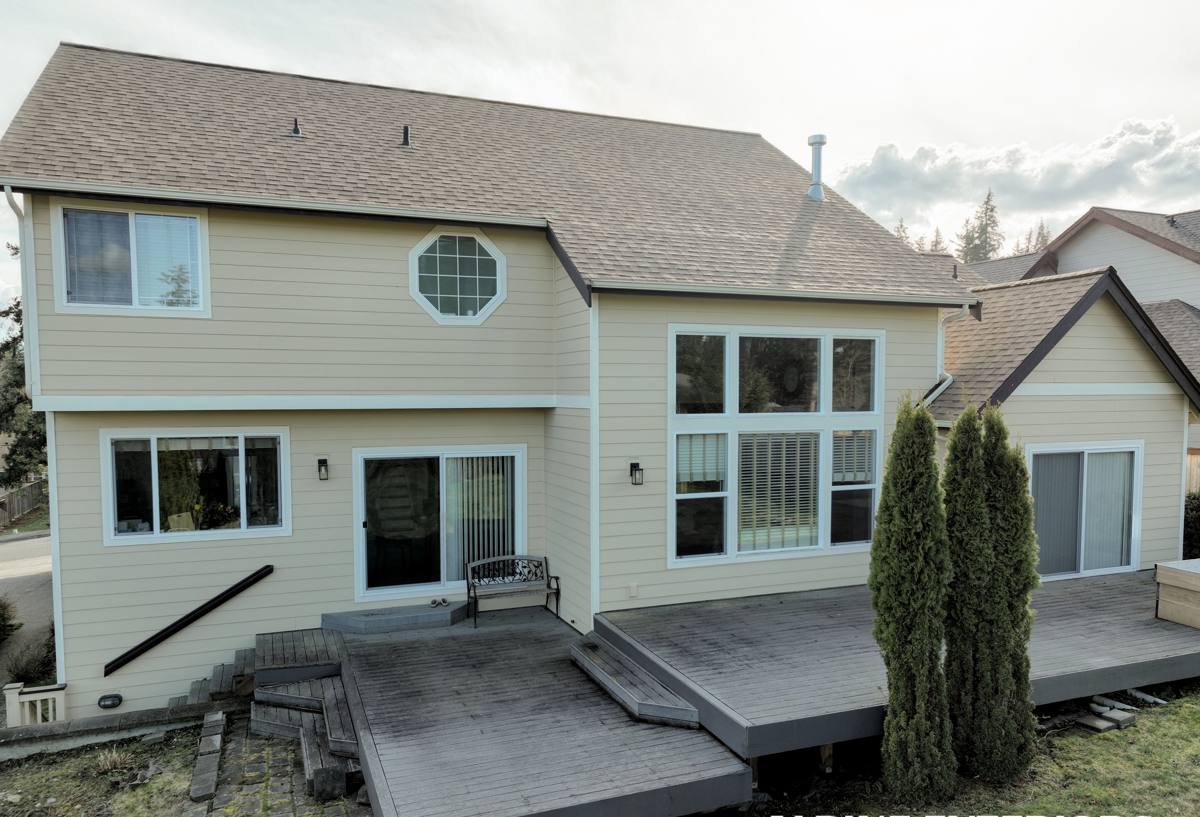
What "Replacement" Should Actually Mean
A lot of deck jobs sold as replacements are really just new boards laid over an old, unexamined frame. That's not a replacement — it's a resurfacing, and it hides problems instead of fixing them. A correct deck replacement means every structural component gets evaluated and, where needed, rebuilt:
- Ledger board removed, the wall behind it inspected for hidden rot, and reattached with proper flashing and structural fasteners — not the nails or undersized lag screws sometimes found on older decks
- Joists and beams checked for rot, checking, and fastener corrosion, especially near the ledger and any post bases sitting close to grade
- Footings inspected for frost heave, settling, or inadequate depth for our soil and freeze conditions
- All structural hardware upgraded to stainless steel or hot-dip galvanized rated for ground contact and treated lumber compatibility
- New decking installed with proper spacing for drainage and expansion, plus flashing tape on top of joists to stop moisture from wicking into the framing
Skip any of these and you haven't replaced the deck — you've delayed the same failure by a few years.
The Ledger-to-Siding Connection: Where Most Failures Start
Because we're a siding contractor first, we look at deck replacement differently than a crew that only builds decks. The single most common failure point we find in this region isn't the decking material — it's the connection between the deck ledger and the house's exterior wall. If that flashing detail is wrong, water gets behind the siding and into the wall framing, and you end up with rot that has nothing to do with the deck boards at all.
A proper ledger installation requires flashing that sheds water out and away from the wall, siding cut back and sealed correctly around the ledger, and a small gap maintained between the deck surface and the siding so water and debris don't sit against it. On older Everson-area homes, we regularly find ledgers bolted directly against original siding with no flashing at all — a shortcut that works fine until the first few wet seasons, and then quietly rots the wall from behind while the deck looks fine on top. Because we work on siding and decks together, we catch and correct this detail as a matter of course, not as an upsell.
Signs the Ledger Connection Has Already Failed
- Soft or spongy siding near where the deck attaches to the house
- Visible gaps, cracked caulk, or missing flashing at the ledger line
- Staining, dark streaks, or peeling paint on siding directly above or below the deck
- The deck itself feels slightly loose or "gives" where it meets the house
Choosing Decking Material for This Climate
There's no single "best" decking material — there's a best fit for your budget, maintenance appetite, and how much moss and moisture exposure the deck will see. Here's an honest comparison based on what actually holds up in Whatcom County conditions:
| Material | Moisture Behavior | Maintenance | Typical Lifespan Here |
|---|---|---|---|
| Pressure-treated wood | Absorbs and releases moisture; prone to checking and splinter if not sealed regularly | Annual cleaning and re-sealing recommended, more in shaded/mossy spots | 10-15 years with upkeep |
| Cedar | Naturally rot-resistant but still needs sealing; grays quickly in damp shade | Regular cleaning, periodic oil or stain | 15-20 years with upkeep |
| Composite decking | Doesn't absorb water like wood, but can trap moisture underneath if airflow is poor | Periodic washing to remove algae/moss film; no staining or sealing | 25-30 years, manufacturer-warrantied |
| PVC/capped polymer | Fully moisture-resistant surface; least susceptible to moss staining | Occasional washing only | 25-30+ years, manufacturer-warrantied |
Composite and PVC products cost more upfront but make sense for homeowners tired of the annual maintenance cycle wood demands in a climate this wet. Wood and cedar remain reasonable choices for homeowners who don't mind the upkeep and prefer the natural look — the key with any wood product here is committing to the maintenance schedule, not skipping a season because the deck "looks fine."
Framing Materials Matter As Much As Decking
We rarely see a deck fail because the surface boards wore out. We see decks fail because the framing underneath — joists, beams, posts — wasn't protected the same way the visible decking was. Standard pressure-treated framing lumber is rated for ground contact but still benefits from joist protection tape over every cut edge and fastener point, especially on a deck that sees the kind of sustained dampness typical of a Ferndale-area fall and winter. We install this as standard practice, not an add-on, because the cost difference is small and the protection it buys against hidden rot is significant.
Our Process for an Everson Deck Replacement
- On-site assessment — we inspect the existing deck, ledger connection, and the siding around it, and tell you honestly whether you need a full replacement or targeted repair
- Written scope and estimate — a clear breakdown of framing, hardware, decking material options, and flashing work, with no vague allowances
- Permitting — we handle the Whatcom County permit application for the deck work, including any required inspections
- Demolition and structural inspection — old decking and framing removed, wall and ledger area inspected before anything new goes up
- Rebuild — new footings or post repairs as needed, new framing, correctly flashed ledger, joist protection tape, and your chosen decking material
- Final walkthrough — we go over the finished deck with you, including basic maintenance expectations for the material you chose
Permits and Local Requirements
Deck replacement in Whatcom County generally requires a building permit once the deck is attached to the house or exceeds a certain height or size — the exact thresholds depend on your specific situation and jurisdiction, since Everson-area properties can fall under different local requirements depending on exact location. We pull the permit, coordinate the required inspections, and make sure the ledger attachment and structural work are documented and signed off. Skipping this step to save time is one of the more common corners cut on deck jobs, and it can create real problems later with insurance claims or when you go to sell the home.
Is It Time to Replace, Not Repair?
Not every deck problem means a full replacement. But there are clear signs that patching individual boards is just delaying a bigger job:
- Joists or the ledger board show soft, spongy wood when probed with a screwdriver
- Multiple support posts show rot or insect damage at the base
- The deck has visibly shifted, sagged, or pulled away from the house at any point
- Fasteners are heavily rusted or corroded, especially near the ledger
- Moss and algae return within weeks of cleaning, suggesting persistent moisture trapped in the structure
- The deck is more than 20 years old and was never rebuilt or re-flashed
If you're only seeing surface wear on decking boards with a sound frame underneath, a resurfacing may be all you need — we'll tell you that if it's true, since a full replacement isn't the right answer for every deck.
Why a Ferndale-Based Crew Working Everson Regularly Matters
A deck replacement done by a crew that already works this area brings a few practical advantages. We know how the local permit process runs and don't lose weeks guessing at requirements. We schedule around the realistic rain windows in this part of Whatcom County rather than promising a timeline that doesn't survive the first wet week. And because we work on siding as much as decks, we catch the envelope issues — the flashing, the wall condition behind the ledger — that a deck-only crew coming from farther away might not think to check. That combination matters more in a climate that's actively working against a poorly built connection every single day it rains.
Maintaining Your New Deck
Whatever material you choose, a few habits extend its life significantly in this climate: keep gutters and downspouts directed away from the deck area, sweep debris off the surface before it composts into a moss-friendly layer, and check the ledger flashing and any visible fasteners once a year for early signs of corrosion or gaps. Wood and cedar decks need a real cleaning and re-sealing schedule, not just an occasional rinse — skipping a season in this climate shows up fast.
If your deck is showing its age, or you just want an honest opinion on whether it needs replacing or repairing, we're happy to take a look. Fill out the form below for a free, no-pressure estimate.