 Ferndale
 Why Everson Homes Need Siding Built for This Climate
Everson sits inland from the coast but still lives inside the same weather system that shapes siding decisions across Whatcom County: long stretches of driving rain, a fall-through-spring moss season that never fully lets up, and salt-tinged air that rides in off the Georgia Strait and Bellingham Bay on prevailing westerlies. None of that is dramatic weather in the way a hurricane or hard freeze is dramatic. It's slow, steady, cumulative — the kind of exposure that doesn't fail siding overnight but wears down anything not built or installed to handle it, year after year.
That combination matters more than most homeowners realize when they're choosing a siding contractor. A product or installation method that performs fine in a drier climate can start showing problems here within a few winters — swelling seams, moss colonizing horizontal surfaces, paint failing at end cuts, moisture finding its way behind panels that were never properly flashed. Everson homes need siding that's engineered for sustained moisture exposure and a crew that installs it with that exposure specifically in mind, not a generic install done the same way it would be done in Arizona.
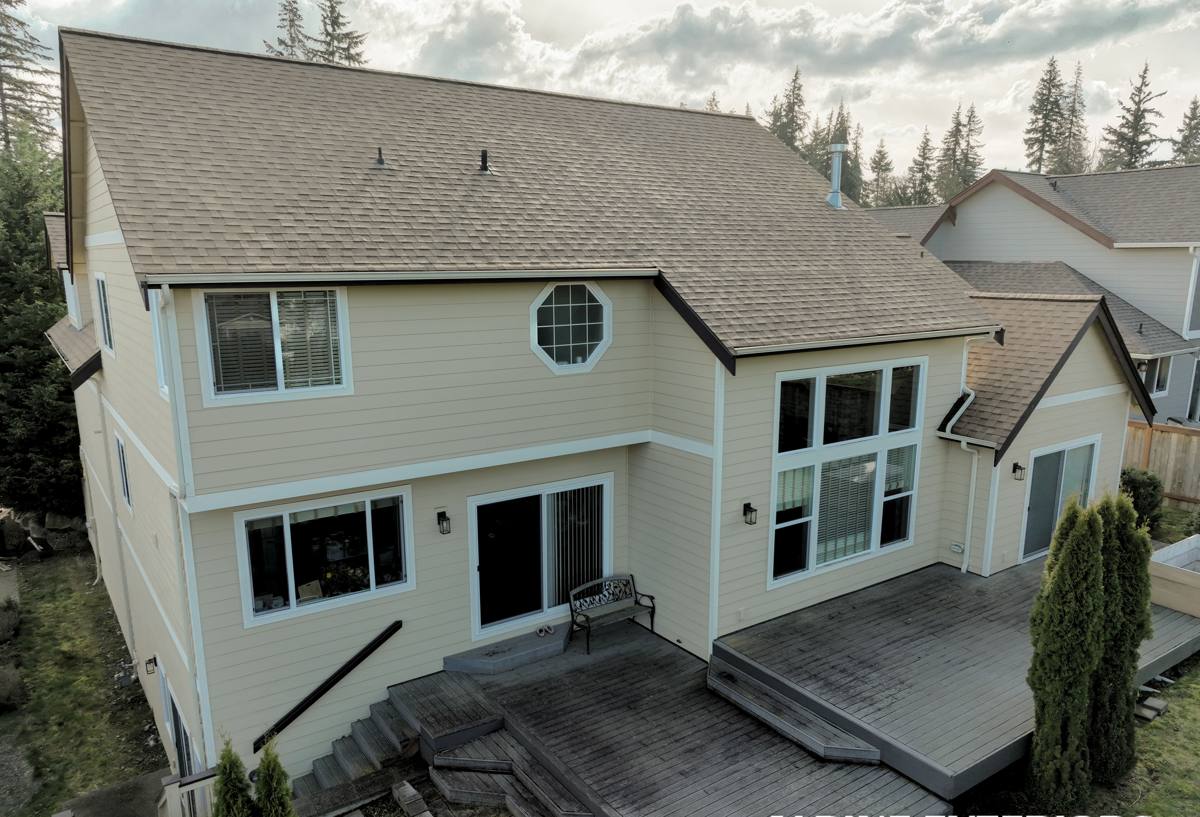
Why Fiber Cement Is the Right Material for This Area
Fiber cement earns its place on Whatcom County homes because of what it doesn't do. It doesn't absorb water the way untreated wood does. It doesn't warp, cup, or rot when it stays damp for days at a time. It doesn't provide the kind of surface that moss and algae latch onto as readily as bare wood grain does. And because it's non-combustible, it doesn't carry the wildfire-adjacent concerns that have become a bigger conversation in the Pacific Northwest in recent years, even in areas that aren't classic fire country.
Vinyl siding avoids some of wood's moisture problems but introduces its own weaknesses in this climate — it expands and contracts more than fiber cement across our temperature swings, it can crack or become brittle with age, and it doesn't hold factory-finish color as well under constant UV and moisture cycling. Wood siding, even when well-maintained, is fighting a losing battle against a climate that stays wet for months at a stretch. Fiber cement sits in the middle: dimensionally stable, moisture-resistant, and durable enough to be a genuinely long-term answer rather than a product you're re-treating or patching every few years.
What "Correct" Fiber Cement Installation Actually Means
Fiber cement siding is only as good as the installation behind it. The product itself resists moisture well, but a poorly installed job can still trap water against the sheathing, and in a climate like ours that trapped moisture doesn't dry out quickly. A correct install includes several details that are easy to skip and expensive to fix later:
- A drainage plane and rain screen gap behind the siding so any moisture that does get past the surface has somewhere to go, and air can move to dry things out
- Proper fastener placement and spacing, driven to the manufacturer's specified depth — not too deep, not too shallow
- Correct clearance at the bottom of the siding from grade, decks, and roof lines, so splash-back and standing water don't sit against the bottom course
- Factory-cut or properly sealed field cuts, since an unsealed cut edge is the single most common place fiber cement siding fails early
- Flashing and caulking at every window, door, and penetration, done with materials rated for our wet season rather than whatever caulk was on the truck
Skip any one of these and the siding can look fine for a year or two while moisture quietly does damage behind it. This is the part of the job that separates a siding installation that lasts three decades from one that starts causing problems in five.
James Hardie: The Only Fiber Cement We Install
We install James Hardie products exclusively. We don't install Cemplank, Allura, LP SmartSide, vinyl, or untreated wood siding, and that's a deliberate standard, not a lack of options. Other fiber cement brands make a reasonable product on paper, but James Hardie is engineered specifically by climate zone through its HZ5 and HZ10 product lines, backs its siding with a factory-applied ColorPlus finish that's warrantied against fading and peeling in a way field-painted siding can't match, and carries a transferable limited warranty that holds real value if the home ever sells. When we're putting siding on a home that has to survive Whatcom County winters for the next 30-plus years, we want the product with the strongest track record and the clearest manufacturer accountability behind it — not the cheapest fiber cement board on the truck that day.
How Hardie's Fiber Cement Compares
| Factor | James Hardie (HZ5) | Generic Fiber Cement |
|---|---|---|
| Climate engineering | Formulated specifically for Pacific Northwest moisture and temperature cycling | Often a single national formulation, not climate-zoned |
| Factory finish | ColorPlus baked-on finish, warrantied against fading/peeling | Varies by manufacturer; some rely on field-applied paint |
| Warranty structure | Long-term limited warranty, transferable to future owners | Terms and transferability vary widely by brand |
| Installer network | Certified installer standards and training programs | Less standardized across installers |
| Track record in wet climates | Decades of documented performance in coastal/marine-influenced regions | Shorter or less region-specific history |
Our Process for Everson Siding Projects
Every job starts with an honest look at the existing siding and sheathing, not just a measurement for new boards. We want to know what's happening underneath before we start, because covering up existing moisture damage with new siding just delays and hides the problem.
Assessment and Prep
We check for soft sheathing, existing water intrusion around windows and trim, and any areas where past siding was installed without proper flashing. This is also when we talk through color and profile choices from Hardie's lineup and confirm the scope with the homeowner before any material is ordered.
Tear-Off and Sheathing Repair
Old siding comes off and we address anything compromised underneath — replacing damaged sheathing, correcting old flashing mistakes, and building in the drainage plane the new siding will rely on for its working life.
Installation
Hardie boards go up to manufacturer spec: correct fastening, correct clearances, sealed cuts, and flashed penetrations at every window, door, vent, and light fixture. This is the stage where the details from the section above actually get executed, not just described.
Final Inspection
We walk the finished job looking specifically for anything that could become a moisture path — a missed caulk line, a fastener that's proud of the surface, a clearance issue at grade — before we call it finished.
Maintenance in a Moss-Prone, Wet Climate
Fiber cement siding is low-maintenance compared to wood, but "low" isn't "none," especially in an area with a real moss season. A little seasonal attention keeps a correctly installed Hardie exterior performing the way it's designed to for decades.
- Rinse siding down at least once a year to clear pollen, dust, and early moss or algae growth before it establishes
- Keep gutters clear so water isn't overflowing and running down the siding face during heavy rain
- Trim back plants and shrubs so foliage isn't holding moisture against the siding surface
- Check caulking around windows, doors, and trim every couple of years and touch up anywhere it's cracked or pulled away
- Watch north-facing and shaded walls specifically — they dry out slower and are where moss tends to establish first
Cost Factors for a Fiber Cement Project in Everson
Every home is different, so we don't quote broad numbers without seeing the job, but the following factors are what typically move a project's cost up or down:
| Factor | How It Affects the Project |
|---|---|
| Tear-off scope | Removing old wood, vinyl, or damaged siding adds labor beyond a straightforward re-side |
| Sheathing condition | Rot or moisture damage found during tear-off requires repair before new siding goes up |
| Home size and complexity | Multiple stories, dormers, and cut-up wall lines take more time than simple rectangular walls |
| Siding profile and trim choice | Lap siding, panel siding, and trim details from Hardie's lineup vary in material and labor cost |
| Accessibility | Steep grades, tight lot lines, or limited staging area can add time and equipment needs |
Why Hiring a Crew That Already Works Everson Matters
A siding job isn't just the install day — it's permitting, material lead times, weather sequencing, and knowing how a specific area's homes are typically built. A crew based in Ferndale that regularly works Everson and the surrounding Whatcom County communities already understands local permitting expectations, has a working relationship with Hardie material suppliers in the region, and knows how to sequence a job around our wet-season weather windows rather than learning that on your project. That familiarity shows up in fewer surprises, tighter scheduling, and an installation crew that isn't guessing about how the local climate should shape the details of the job.
If you're weighing siding options for a home in Everson or elsewhere around Ferndale, we're happy to take a look and walk you through what a correct James Hardie installation would involve for your specific house — no pressure, no obligation. Reach out using the form below to set up a free estimate.