 Ferndale
 Why Everson Homes Wear Out Siding Faster Than the Brochure Says
Everson sits inland from Bellingham Bay but still gets the same wet, marine-influenced weather pattern that defines Whatcom County: long stretches of low-intensity rain, wind-driven moisture that gets pushed sideways into wall assemblies, and a cool, shaded microclimate on north- and east-facing walls that never fully dries out between storms. Add the salt-tinged air that drifts up the valley off the Puget Sound and Georgia Strait, and you have a combination that's hard on almost every siding material except the ones specifically engineered for it.
Homeowners who call us about siding replacement in Everson usually describe one of a few patterns: paint that's failing years ahead of schedule, soft or crumbling material at the bottom courses, moss and algae staining that comes back within a season of cleaning, or siding that looks fine from the street but is soft to the touch near downspouts and roof-wall intersections. None of that is bad luck — it's what happens when a siding product's weaknesses line up with this region's weather.
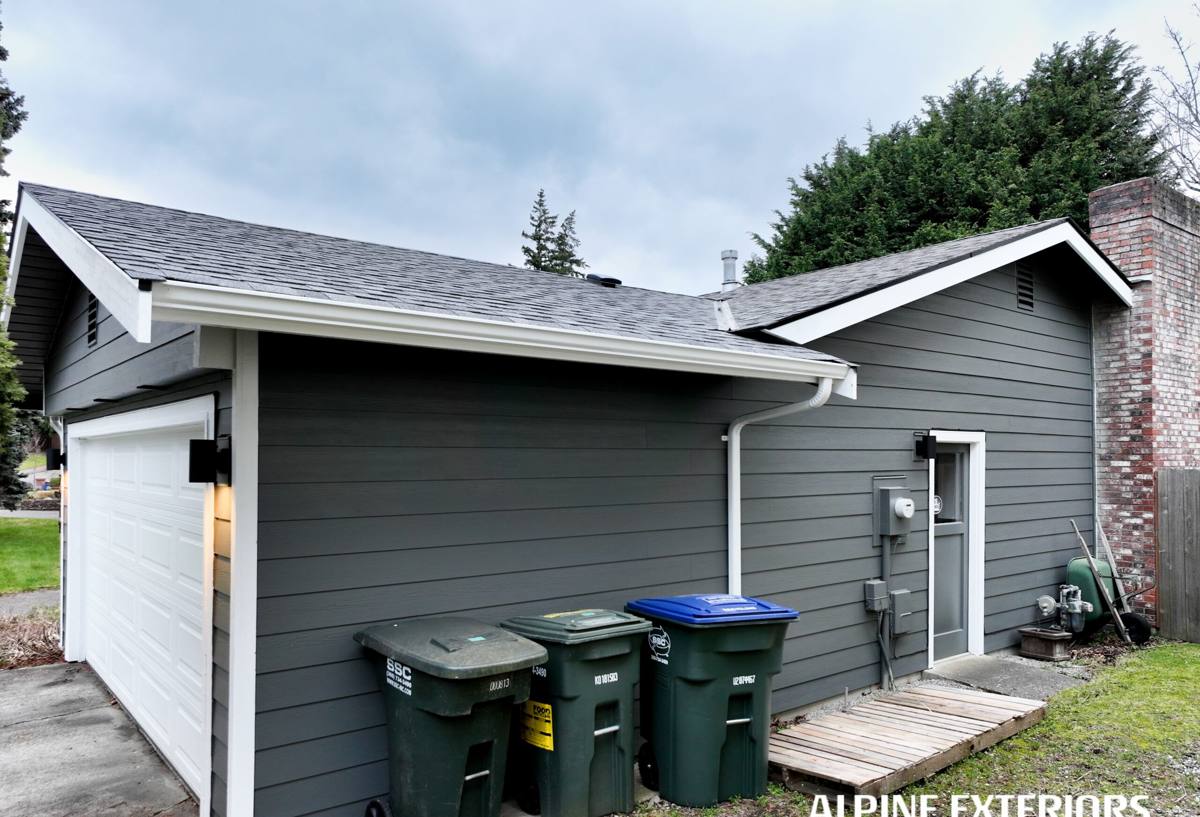
What "Correct" Siding Replacement Actually Involves
Replacing siding is not a cosmetic swap. Done right, it's a chance to fix the water-management details that were probably wrong the first time, especially on homes built or re-sided during the decades when house wrap and flashing practices were looser than current code. A proper tear-off and reinstall in this climate should include:
- Full removal of old siding and inspection of the sheathing underneath for rot, soft spots, or prior water intrusion
- Repair or replacement of any damaged sheathing before anything new goes back on
- A new, continuous weather-resistive barrier (house wrap) installed shingle-style so water sheds outward at every seam
- Correct flashing at windows, doors, deck ledgers, and any wall penetration — this is where most real-world leaks start, not in the field of the siding itself
- Proper rain-screen or drainage gap detailing where the product and wall assembly call for it, so incidental moisture can drain and the wall can dry
- Manufacturer-spec fastening, clearances, and caulking — not "close enough," but the actual documented spec
Skipping any one of these steps is how a ten-year-old siding job ends up with rot behind it that nobody sees until a wall starts to feel spongy. We treat the water-management layer as the real job; the visible siding is what protects it.
Why We Don't Cut Corners on Tear-Off
It's tempting for some contractors to side over existing material to save a day of labor. In a dry climate that's a judgment call. In Whatcom County, siding over unknown wall conditions means you're sealing up whatever moisture problems already exist. We pull old siding, look at the sheathing, and tell you honestly what we find — good or bad — before anything new goes up.
Why We Install Only James Hardie Fiber Cement
We made a standing decision as a company to install James Hardie fiber cement siding exclusively, and we don't deviate from that for Everson jobs. It's worth explaining why, because the reasoning is specific to what this climate does to a house over 20-plus years, not just a brand preference.
James Hardie's HZ5 product line is engineered for climate zones like ours — cold, wet, and prone to freeze-thaw cycling in the coldest weeks. The material is non-combustible fiber cement, which doesn't feed a fire the way wood-based products can, and it holds up to sustained moisture exposure without the swelling, delamination, or edge softening that plagues wood-composite and engineered-wood sidings when they're chronically damp. The factory-applied ColorPlus finish is baked on under controlled conditions and backed by its own finish warranty, which matters here specifically because field-applied paint on siding in this climate tends to fail early — UV plus persistent moisture is a hard combination on paint film.
We also value that Hardie's warranty structure is transferable and well-documented, which protects homeowners at resale, and that the installation specs are precise and well-published, so there's no ambiguity about what "correct" looks like on inspection.
Why We Won't Install LP SmartSide, Vinyl, Cemplank, Allura, or Wood Siding
We get asked about all of these, so we'll be straightforward about each one rather than vague.
| Product | What it does well | Why we don't install it here |
|---|---|---|
| LP SmartSide (engineered wood) | Lightweight, easy to work with, reasonable upfront cost | Wood-strand core is vulnerable to swelling and edge failure if moisture reaches cut ends or seams — a real risk in a climate with this much sustained dampness |
| Vinyl siding | Low upfront cost, minimal maintenance in mild climates | Can warp or crack in temperature swings, doesn't hold paint if you ever want to change color, and offers little impact or fire resistance compared to fiber cement |
| Cemplank / Allura (other fiber cements) | Similar base material to Hardie, competitively priced | We standardized on one manufacturer's engineering, warranty terms, and installation documentation so every crew member installs to the same spec every time — mixing systems dilutes that consistency |
| Primed spruce / cedar | Natural appearance, traditional look many homeowners want | Requires ongoing repainting and moisture vigilance that most homeowners underestimate; in this climate, maintenance intervals shrink and repainting costs add up over a decade |
None of these are "bad" products in every context — they're just not what we're willing to put our name behind on a house that has to survive Whatcom County winters and wet shoulder seasons for the next 30 years.
The Everson Siding Replacement Process, Step by Step
1. On-Site Assessment
We walk the exterior with you, note problem areas (moss-heavy walls, soft trim, failed caulk joints), and check for signs of moisture behind the current siding wherever we can access it.
2. Written Scope and Estimate
You get a clear breakdown of what's being replaced, what Hardie product line and profile we're recommending, and why — no vague allowances.
3. Tear-Off and Sheathing Inspection
Old siding comes off, sheathing gets inspected, and any rot or damage is documented and repaired before we move forward.
4. Weather Barrier and Flashing
New house wrap goes on correctly lapped, and flashing is installed at every window, door, and penetration point.
5. Hardie Installation to Spec
Fastening, clearances, and joint treatment follow James Hardie's published installation guide exactly — this is what preserves your warranty coverage and keeps the wall performing as designed.
6. Final Walkthrough
We go over the finished work with you, point out anything worth knowing for future maintenance, and make sure you're satisfied before we consider the job done.
What Salt Air and Moss Season Mean for Maintenance Afterward
Even with the right product installed correctly, Everson homes benefit from a little seasonal awareness:
- Rinse siding annually, especially on shaded north- and east-facing walls where moss and algae take hold first
- Keep gutters clear so water isn't sheeting down the siding face during heavy rain events
- Trim back vegetation that keeps a wall section shaded and damp longer than the rest of the house
- Inspect caulk joints at trim and penetrations every couple of years — caulk is a maintenance item on any siding system, including Hardie
None of this is heavy lifting, but it's the difference between a siding job that looks good for 30 years and one that starts showing its age at year ten.
Cost Factors for a Siding Replacement Project
Every Everson home is different, but the line items that actually move the price are consistent:
| Factor | Why it matters |
|---|---|
| Sheathing condition underneath old siding | Hidden rot repair is the most common reason estimates change after tear-off begins |
| Home size and wall complexity | More corners, gables, and trim details mean more labor and material cuts |
| Hardie product line and profile chosen | Lap siding, shingle-style panels, and board-and-batten carry different material and labor costs |
| Trim and accessory scope | Replacing trim, fascia, or soffit at the same time affects both cost and how well the finished job performs |
| Access and site conditions | Steep grades, tight setbacks, or landscaping that limits staging area can add labor time |
We'd rather walk you through these variables in person and give you real numbers than throw out a broad range that doesn't match your house.
Why a Crew That Already Works Everson Matters
Whatcom County's building conditions aren't uniform — wind exposure, tree cover, and moisture patterns shift block by block. A crew that regularly works Everson and the surrounding Ferndale-area communities has already seen how local wall assemblies typically fail, which flashing details tend to get missed on older homes here, and how the region's freeze-thaw pattern actually behaves against fiber cement versus how it behaves on paper. That local pattern recognition shortens the assessment phase and reduces surprises once tear-off starts.
If you're weighing a siding replacement for a home in Everson, we're glad to walk the exterior with you, point out what we see, and put together a straightforward, no-pressure estimate — no obligation, just a clear look at what your house actually needs.