 Ferndale
 Lynden sits inland from Ferndale but still lives inside the same Whatcom County weather pattern — wet Pacific systems that push in off Bellingham Bay and the Strait of Georgia, drop weeks of steady rain, and leave everything green with moss by late winter. Homes here take a different kind of beating than a house in a dry climate. It's not one big storm that causes damage; it's months of sustained moisture, wind-driven rain hitting siding at an angle, and salt-tinged air working on fasteners and finishes year after year. Siding in Lynden has to handle all of that without trapping water behind it, without feeding mold, and without fading or chalking out in a few seasons.
This page is specifically about installing James Hardie fiber cement siding on Lynden homes — what the climate demands, what a correct installation actually involves, and why we only install this one product system rather than offering a menu of options.
What Lynden's Climate Actually Does to Siding
Whatcom County gets a lot of rain, but the bigger issue for siding is duration and direction. Storms here tend to arrive with sustained wind, which drives rain sideways into wall assemblies instead of letting it run straight down and off. That means every seam, joint, and butt edge on a home's exterior is a potential entry point, and every material reacts differently to sitting damp for days at a stretch.
Three climate factors that matter most
- Driving rain: Wind-blown moisture gets forced into laps, corners, and trim joints that would stay dry in a calmer climate.
- Extended moss and algae season: Shaded north and east walls, tree cover, and long damp stretches give moss and algae months to establish themselves on any surface that holds moisture at its face.
- Salt-influenced air: Proximity to the Sound and bay means airborne salt accelerates corrosion on fasteners, flashing, and any metal components in the wall assembly.
None of this is exotic — it's just persistent. The siding and the installation both need to be built for years of this pattern, not just able to survive a single wet week.
Why James Hardie Fits This Climate
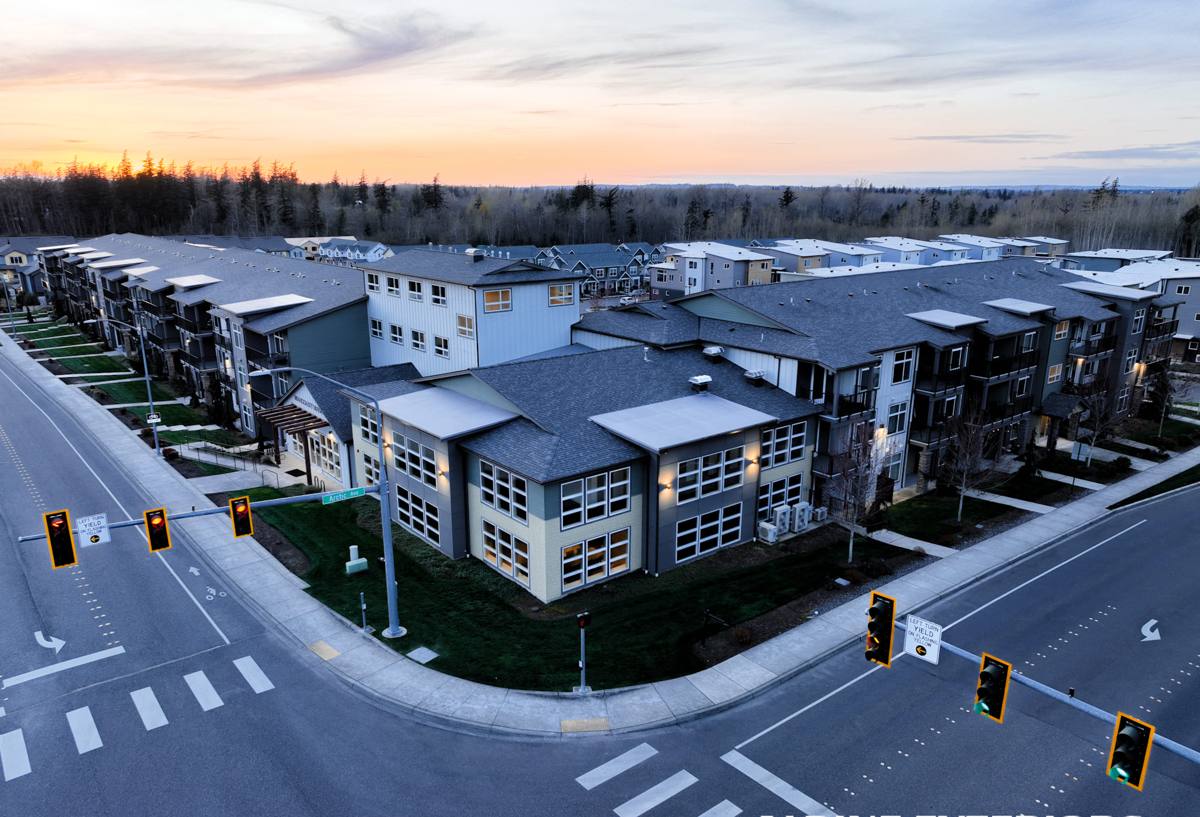
James Hardie fiber cement is engineered from portland cement, sand, and cellulose fiber — an inorganic composition that doesn't feed mold or rot the way wood-based products can when they stay damp. Hardie also produces siding in climate-specific HZ formulations; the HZ5 line is engineered for regions like the Pacific Northwest that see prolonged moisture exposure, with attention to how the product handles freeze-thaw cycling and sustained wet conditions.
The factory-applied ColorPlus finish is the other half of the equation. It's baked on in a controlled environment rather than rolled or sprayed on site, which gives it more consistent coverage and adhesion than field-applied paint — and a color that's engineered to resist fading from UV and weather cycling over time. On a home that gets Lynden's mix of gray, wet stretches and intense summer sun, that finish stability matters more than it would somewhere drier.
None of this makes a home immune to moss. Moss will grow on almost any exterior surface — siding, roofing, fencing, concrete — if it gets shade and moisture and isn't kept clean. What Hardie does is give you a surface that doesn't degrade from that exposure the way some other materials do, so routine cleaning keeps it looking right instead of also being a race against material breakdown.
What a Correct Installation Involves
Fiber cement siding is only as good as the water management system behind it. This is where most callbacks and premature failures actually originate — not from the siding material itself, but from installation shortcuts in the parts you can't see once the job is done.
The details that determine whether siding performs for decades
- Weather-resistive barrier and drainage plane: A correctly lapped house wrap or building paper behind the siding, with a drainage gap where the wall assembly calls for one, so any moisture that gets past the siding face has somewhere to go.
- Flashing at every penetration: Windows, doors, hose bibs, light fixtures, and vents all need proper flashing integrated with the water-resistive barrier — not just caulk.
- Correct fastener pattern and type: James Hardie specifies fastener placement, embedment, and type by product line and climate zone. Using the wrong fastener or over-driving it can void warranty coverage and create failure points.
- Proper clearances: Minimum gaps from grade, roofing, decks, and other transitions keep water from wicking up into the bottom edge of the siding.
- Caulked and sealed joints where required, open where required: Hardie's installation instructions specify exactly where joints should be sealed and where they should be left to drain — getting this backwards traps water instead of shedding it.
Every one of these steps is spelled out in James Hardie's published installation instructions, and following them precisely is what keeps the manufacturer's warranty valid. A beautiful ColorPlus finish over a flashing mistake still ends in a wet wall cavity.
Our Process for a Lynden Job
The work generally follows the same sequence on every project, adjusted for what we find once the old siding comes off.
1. Assessment and estimate
We walk the exterior, look at trim, window flashing, existing sheathing condition, and any areas showing past moisture problems — common on shaded or north-facing walls in this area. We give you a straightforward estimate based on what we actually see, not a generic square-footage number.
2. Tear-off and sheathing check
Removing the old siding is also when hidden problems show up — soft sheathing, missing flashing, past water intrusion. We address what we find before anything new goes up, because covering a problem with new siding doesn't fix it.
3. Water-resistive barrier and flashing
This is the step that matters most for a climate like Lynden's. We install and lap the barrier correctly, flash every penetration, and set up the drainage plane before a single piece of siding goes on.
4. Hardie installation to spec
Panels, lap siding, or trim are installed following James Hardie's fastening and clearance specifications for the product line and HZ zone, with joints sealed or left open exactly as specified.
5. Final walkthrough
We go over the finished exterior with you, check caulking and trim details, and make sure everything lines up with what was quoted.
Why We Only Install James Hardie
We don't offer vinyl, LP SmartSide, Cemplank, Allura, or unfinished wood siding as options, and that's a deliberate standard, not an oversight. Vinyl can warp and fade under UV and temperature swings, and it doesn't hold up structurally the way fiber cement does. Engineered wood products like LP SmartSide use wood strand cores that, while treated, are still organic material — in a climate that stays wet for months at a time, that's a trade-off we're not comfortable installing our name behind. Other fiber cement brands may perform reasonably, but we've standardized on one product, one set of installation specs, and one warranty structure so every job we do is consistent and every crew member knows the system cold.
That focus also means we're not guessing at install details across five different manufacturers' instructions. We know James Hardie's fastening schedules, clearance requirements, and HZ product lines because it's the only system we touch.
Comparing Siding Options for a Wet Climate
| Factor | James Hardie Fiber Cement | Vinyl | Engineered Wood (e.g. LP SmartSide) |
|---|---|---|---|
| Core material | Cement, sand, cellulose fiber — inorganic | PVC plastic | Treated wood strand composite |
| Moisture behavior | Does not rot or feed mold | Water-resistant but can trap moisture behind panels if installed poorly | Treated to resist moisture, but still an organic wood-based product |
| Finish stability | Factory-baked ColorPlus finish, engineered fade resistance | Color molded through, but can fade and chalk over time | Factory-primed or finished, but finish life varies by product |
| Fire resistance | Non-combustible | Combustible | Combustible |
| Typical lifespan (installed to spec) | Multiple decades | Shorter, especially in harsh sun/wind exposure | Shorter than fiber cement in sustained wet climates |
Cost Factors Homeowners Should Understand
We don't publish flat per-square-foot pricing because every home is different, but a few things reliably move the number:
| Factor | Why it affects cost |
|---|---|
| Sheathing condition | Rot or moisture damage found during tear-off needs repair before new siding goes on |
| Home size and wall complexity | More corners, gables, and trim details mean more labor and material cuts |
| Product line and profile | Lap siding, panel systems, and specialty trim carry different material costs |
| Existing siding removal | Multiple layers or difficult tear-off (e.g. old stucco or masonry) adds labor |
| Trim and accessory scope | Fascia, soffit, and trim replacement alongside siding changes total project cost |
A Practical Checklist Before You Hire
- Ask whether the crew is following James Hardie's published fastening and clearance specifications, not just "standard practice."
- Confirm what happens to your water-resistive barrier and flashing during tear-off — this is the part you won't see again once siding is up.
- Ask how sheathing issues found mid-project are handled and priced.
- Get a clear answer on warranty coverage — both the manufacturer's product warranty and the contractor's labor warranty.
- Ask whether the crew regularly works in Whatcom County's climate, or if this is an occasional job for them.
Why a Crew That Already Works Lynden Matters
A contractor who works this area regularly already knows what shows up during tear-off on a Lynden home — where moisture tends to collect, which wall orientations need extra attention to flashing, and how the local moss and algae cycle behaves through the year. That's not something you can fully substitute with a generic installation manual. It shows up in small decisions on site: where to add extra flashing attention beyond the minimum, how to sequence work around a wet forecast, and what clearance details matter most for a wall that faces prevailing wind and rain.
If you're planning a siding project in Lynden and want to talk through what James Hardie siding would look like on your home, we're happy to walk the exterior with you and give you a straightforward, no-pressure estimate — just fill out the form below.