 Ferndale
 Lummi Island Roofs Take a Different Kind of Beating
A roof on Lummi Island isn't working the same job as a roof twenty miles inland. Sitting out in Puget Sound, homes here get salt-laden air off the water, wind-driven rain that pushes up under standard flashing details, and a moss season that runs longer than almost anywhere else in Whatcom County because so many lots sit under fir and cedar canopy with limited afternoon sun. Any one of those on its own is manageable. Together, over ten or fifteen years, they shorten the life of a roofing system that would otherwise perform fine somewhere drier and more open.
Salt air accelerates corrosion on exposed metal — nails, flashing, drip edge, vent boots — well before the shingles themselves give out. Driving rain off the water doesn't fall straight down; it drives sideways into eaves, gable ends, and any low-slope transition, which means a roof detailed for average rainfall can still leak on Lummi Island even if it holds up fine on the mainland side of Ferndale. And moss doesn't just look bad — it holds moisture against the roofing material, lifts shingle edges, and works its way into fastener penetrations over time.
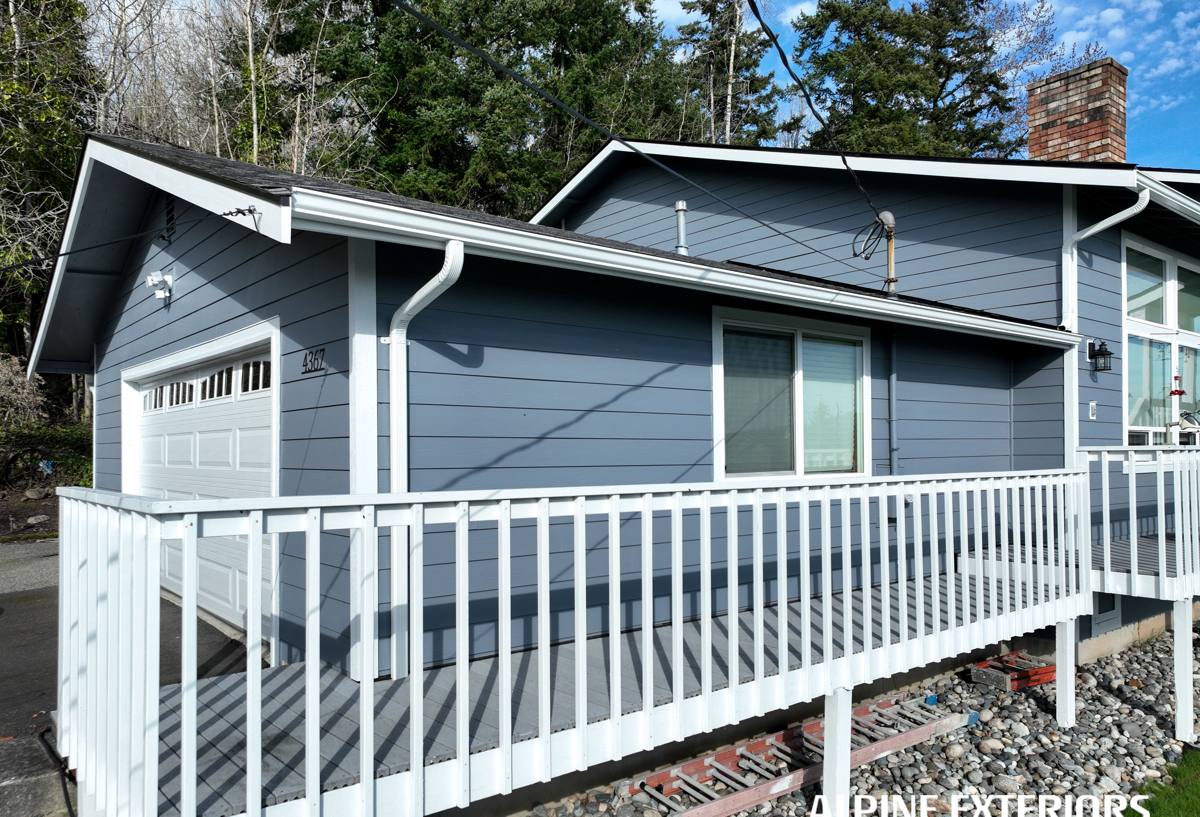
What a Correct Roof Replacement Actually Involves
A roof replacement done right for this environment isn't just stripping old shingles and nailing down new ones. It's a full-system approach:
- Complete tear-off to bare decking so we can actually see what's underneath — not a layover, which traps moisture and hides rot.
- Deck inspection and repair, replacing any sheathing that's gone soft from long-term moisture intrusion, especially around old vent boots and valleys.
- A full synthetic underlayment (not felt alone) rated for high-moisture exposure, with extra ice-and-water-shield-type membrane at eaves, valleys, and any low-slope section — the areas driving rain hits hardest.
- Corrosion-resistant flashing and fasteners at every penetration and transition, since standard galvanized hardware degrades faster in salt air than it would a few miles inland.
- Proper intake and exhaust ventilation, sized to the attic, so moisture from cooking, showers, and simple humidity doesn't get trapped under the deck and accelerate rot from the inside.
- Correctly lapped and sealed vent boots, since these are the single most common leak point we find on tear-offs out here.
Skip any one of these steps and you've got a roof that looks new for a couple of years and then starts showing the same problems the old one had — just sooner, because the underlying causes were never addressed.
Choosing a Roofing Material for This Environment
There's no single "best" roofing material for Lummi Island — it depends on the home, the budget, and how much maintenance the owner wants to take on. Here's how the common options actually compare once salt air and moss are part of the equation:
| Material | Salt-air behavior | Moss resistance | Maintenance |
|---|---|---|---|
| Architectural asphalt shingle | Good with corrosion-resistant fasteners and flashing; standard hardware degrades faster | Moderate — benefits from zinc/copper strips and periodic cleaning | Low to moderate |
| Standing seam metal | Excellent when finished and fastened correctly; sheds salt spray and rain fast | Very good — smooth surface gives moss little to grip | Low |
| Composite/synthetic shake | Good; doesn't absorb moisture like real wood shake | Good with proper venting underneath | Low to moderate |
| Cedar shake | Requires more upkeep in salt air and moisture | Poor without regular treatment — moss loves the texture and grain | High |
We don't install traditional cedar shake on most Lummi Island homes as a matter of professional standard, not because it's a bad-looking product — it's a maintenance and moisture-behavior issue. Between the shade cover common on the island and the extra moisture in the air, shake needs more frequent treatment and inspection than most owners want to keep up with, and neglect shows up fast as rot and heavy moss. If a homeowner wants that look, we'll talk through composite shake alternatives that give a similar appearance with far less upkeep.
A Note on Metal Roofing Near Salt Water
Not all metal roofing is equal this close to the water. Fastener quality and finish coating matter more here than they would twenty miles inland. We spec corrosion-rated fasteners and finishes appropriate for coastal exposure, and we're upfront when a lower-grade metal system isn't a good fit for a specific site.
Ventilation and Moisture Control Deserve Extra Attention Here
On a lot of Lummi Island homes, especially older ones, the attic ventilation was designed decades ago for a drier assumption than what the island actually delivers. When we replace a roof, we treat balanced intake and exhaust ventilation as part of the job, not an upsell. Trapped moisture under the deck is what turns a cosmetic moss problem into a structural one — soft sheathing, mold on the underside of the roof deck, and shortened shingle life from the inside out. Getting airflow right the first time is far cheaper than fixing rot later.
The Logistics of Working on the Island
Roofing on Lummi Island isn't the same logistical job as roofing in downtown Ferndale, and pretending otherwise leads to blown schedules and unhappy homeowners. Material deliveries, dumpster drop-off and pickup, and crew scheduling all need to account for ferry access, which means:
- Ordering materials with enough lead time that a missed ferry slot doesn't stall the whole job.
- Staging everything needed for a tear-off-to-dry-in cycle in one trip whenever possible, rather than making multiple round trips mid-project.
- Watching the marine weather forecast closely, since a stripped roof caught in an unexpected squall off the Sound is a bigger problem here than it would be on a more sheltered inland lot.
- Coordinating disposal so debris doesn't sit on-site any longer than necessary, especially given limited road access.
A crew doing its first-ever Lummi Island job is learning these logistics on the homeowner's dime. A crew that already works the island has this routine down before the first shingle comes off.
Our Process, Start to Finish
1. On-Site Assessment
We walk the roof and the attic, not just one or the other. That's where we catch soft decking, undersized ventilation, and flashing issues that a curbside look-up would miss entirely.
2. Straight-Talk Estimate
You get a written scope and price that spells out tear-off, decking, underlayment, material, flashing, and ventilation — not a vague lump sum that leaves room for surprise add-ons later.
3. Scheduling Around Ferry and Weather
We build the ferry crossing and a realistic weather window into the schedule up front, rather than discovering the constraint mid-project.
4. Tear-Off and Deck Repair
Full removal down to the deck, replacement of any compromised sheathing, and a clean surface before anything new goes down.
5. Installation
Underlayment, flashing, ventilation, and the finish roofing material installed to manufacturer specification and to the coastal-durability standard described above.
6. Final Walkthrough and Cleanup
We walk the finished roof with you, confirm ventilation and flashing details, and make sure the site — and the ferry landing area, if materials or debris passed through it — is left clean.
What Affects the Cost
| Factor | Why it matters on Lummi Island |
|---|---|
| Roof size and complexity | More valleys, dormers, and transitions mean more flashing detail — the parts most exposed to driving rain |
| Deck condition | Hidden rot from years of moisture and moss is common on older island roofs and isn't visible until tear-off |
| Material choice | Metal, composite, and asphalt carry different upfront costs and different long-term maintenance costs in this climate |
| Ventilation upgrades | Older homes often need intake/exhaust improvements, which adds labor but reduces future moisture damage |
| Access and logistics | Ferry scheduling and limited staging space can affect crew time compared with a mainland job of the same size |
We won't quote a number here that means anything without seeing the actual roof — anyone who does is guessing. What we can tell you honestly is that skipping deck repair or ventilation to hit a lower number almost always costs more in the long run out here than it would inland, because the moisture and salt exposure punish shortcuts faster.
Keeping a New Roof Performing After Installation
A correctly installed roof still needs some ordinary upkeep in this environment. A short annual routine goes a long way:
- Clear overhanging branches to cut down on the shade and debris that feed moss growth.
- Keep gutters and downspouts clear so water isn't backing up under the eaves during driving rain.
- Have moss growth treated before it thickens — light growth is a quick fix, heavy growth means lifted shingles.
- Check vent boots and flashing every couple of years for early signs of corrosion or cracking sealant.
- Confirm attic ventilation isn't blocked by insulation or storage that's crept over the vents since installation.
Why Hiring a Crew That Already Works Lummi Island Matters
Roofing fundamentals don't change from one zip code to the next, but the details that make a roof actually last do. A crew based in Ferndale that regularly works Lummi Island already knows to spec corrosion-resistant hardware without being asked, already builds ferry logistics into the schedule instead of discovering it mid-job, and already recognizes what heavy moss under fir canopy does to a roof deck over time. That familiarity shows up as fewer surprises, a schedule that holds, and a roof detailed for the conditions it will actually face — not the conditions of a job across the county line.
If you're weighing a roof replacement on Lummi Island, we're happy to come take a look and give you a straightforward, no-pressure estimate. Use the form below to get started.