 Ferndale
 Why Roofs Near Lummi Nation Wear Out Differently
A roof in Lummi Nation is doing a harder job than the same roof would do fifty miles inland. Sitting close to Bellingham Bay and the Strait of Georgia means homes here take on salt-laden air almost year-round, and that salt doesn't just sit on the surface — it works into exposed fasteners, flashing seams, and any metal component that isn't rated to handle it. Add in the driving, wind-blown rain that comes through Whatcom County in the fall and winter storm cycle, and you've got water being pushed sideways under shingle edges and into laps that a calm-weather roof would never have to deal with. Then there's moss. Western Washington's mild, wet, shaded conditions give moss a season that runs most of the year, not just a few weeks, and a roof that isn't detailed to shed water and resist growth will show it within a few seasons.
None of this means roofing here is exotic or requires anything unusual — it means the details that get skipped on a rushed job are exactly the details that fail first in this climate. That's the difference between a roof that looks fine at year three and starts leaking at year eight, and one that's still tight at year twenty-five.
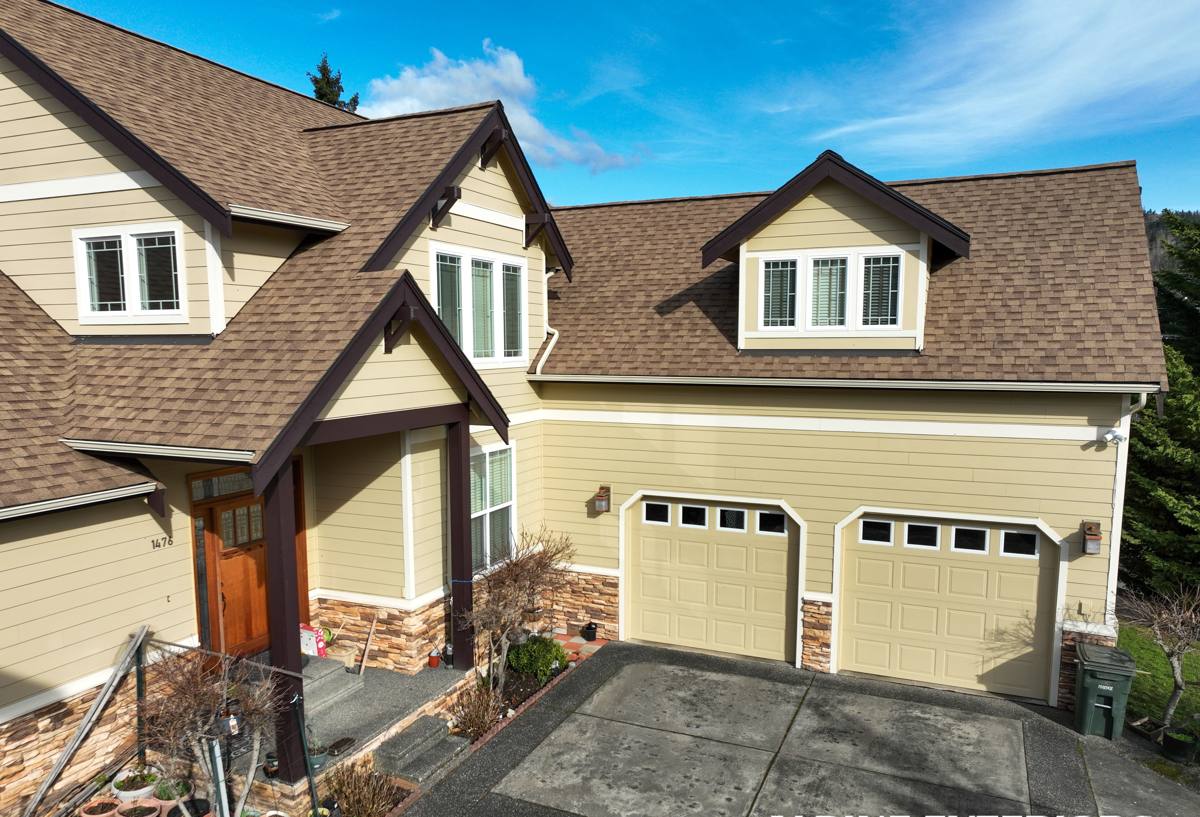
Signs a Roof Replacement — Not Another Repair — Is the Right Call
Not every roof problem means starting over. But in a climate that punishes shortcuts, there's a point where patching becomes false economy. Before we recommend full replacement, we look for:
- Granule loss heavy enough to expose the black asphalt mat on shingles, especially on south- and west-facing slopes
- Moss mats thick enough to be lifting shingle tabs, not just staining the surface
- Soft spots or spring in the decking when walked, which usually means moisture has already reached the sheathing
- Multiple past repairs in different spots, meaning the underlayment system as a whole is failing rather than one isolated leak
- Rusted or corroded flashing around chimneys, vents, and valleys — common here given the salt content in the air
- Daylight visible through the roof deck from the attic, or water staining on attic sheathing and insulation
- A roof already at or past the manufacturer's expected service life for this climate, even if it "looks okay" from the ground
If a roof only shows one or two of these and the decking underneath is sound, targeted repair can still make sense. We'll tell you that honestly rather than push a replacement a roof doesn't need yet.
What a Correct Roof Replacement Actually Involves Here
Tear-Off and Deck Inspection
We remove the existing roofing down to the deck rather than layering over it. That's the only way to actually see what's underneath — and in this climate, what's underneath matters. Any decking that's soft, delaminated, or stained from long-term moisture gets replaced before anything new goes down. Skipping this step is the single most common shortcut we see, and it's the one that causes the most expensive problems later.
Underlayment and Water Barrier
Given how much driving rain this area gets, underlayment isn't a formality — it's a second line of defense that has to actually work. We use self-adhered ice-and-water membrane at the eaves, valleys, and around every roof penetration (chimneys, vent stacks, skylights), since these are the spots where wind-driven rain gets pushed backward under the roof covering. The rest of the deck gets synthetic underlayment, which holds up better than older felt products under repeated wet-dry cycling.
Flashing and Fasteners Rated for Salt Exposure
This is where a lot of roofs near the water fail early. Standard galvanized fasteners and flashing can start corroding well before the roofing material itself is worn out. We spec corrosion-resistant flashing and fastener systems for homes in this area specifically because of the salt air — it costs a little more up front and saves a full flashing replacement down the road.
Ventilation Built Into the System, Not Added Later
A roof deck that can't breathe traps moisture, and trapped moisture is what accelerates both rot and moss growth. Balanced intake (soffit) and exhaust (ridge) ventilation is part of the replacement, not an afterthought bolted on if there's a problem later.
Choosing a Roofing Material for Salt Air and a Long Moss Season
There isn't one "correct" material for every home — it depends on budget, roof pitch, and how much long-term maintenance you're willing to take on. Here's how the common options actually compare in this specific climate:
| Material | How It Handles Salt Air | How It Handles Moss & Moisture | Maintenance Reality |
|---|---|---|---|
| Architectural asphalt shingle | Good, when paired with corrosion-resistant flashing | Algae-resistant (copper/zinc granule) versions slow growth but don't stop it without ventilation and periodic cleaning | Lowest upfront cost, most common choice, 20-30 year service life range |
| Standing seam metal | Excellent when properly coated; check finish warranty specifics for coastal exposure | Sheds water and moss very effectively due to smooth, steep-shedding surface | Higher upfront cost, very low ongoing maintenance, long service life |
| Cedar shake/shingle | Traditional PNW look, but wood is more sensitive to constant moisture cycling | Needs the most active maintenance to resist moss and rot in a climate this wet | Highest maintenance burden; we're upfront that this isn't the low-effort option some homeowners expect |
We'll walk through these trade-offs honestly for your specific roof — pitch, sun exposure, tree cover, and budget all change which option makes sense. There's no material that eliminates moss entirely in this climate; the goal is picking one that resists it well and pairing it with ventilation and drainage details that don't fight against it.
Moss Isn't Just Cosmetic
Moss holds moisture against the roof surface long after rain stops, which is exactly what shortens shingle life and invites rot at the deck. Zinc or copper strips near the ridge, proper ventilation, and trimming back overhanging branches all reduce moss pressure — but none of it replaces the need to physically remove built-up moss every couple of years on shaded roofs.
Local Permitting and Working Within Lummi Nation
Homes and buildings within Lummi Nation can fall under different permitting and inspection processes than the surrounding county, since the Lummi Nation is a sovereign tribal government with its own land-use authority. We don't guess on this — before work starts, we confirm what's required for your specific property and handle that paperwork as part of the job, rather than leaving it for you to sort out mid-project. If your property sits right at a jurisdictional boundary, that's exactly the kind of detail worth confirming before a contract is signed, not after.
Cost Factors Homeowners Should Understand
Roof replacement pricing varies by roof size, pitch, number of layers being removed, decking condition, and material choice — we won't quote a number without seeing the roof. But these are the factors that most often move a price up or down:
| Factor | Why It Matters |
|---|---|
| Roof pitch and complexity | Steep or cut-up roofs (multiple valleys, dormers) take longer and need more flashing detail |
| Layers to remove | Tear-off of two layers costs more in labor and disposal than one |
| Decking repair | Rot found during tear-off adds material and labor that can't be known until the old roof is off |
| Material selection | Asphalt, metal, and cedar carry very different material and labor costs |
| Access and site conditions | Tree cover, tight lots, or difficult staging areas affect labor time |
Our Process, Start to Finish
- On-site inspection — we get on the roof (not just a ground look) and check decking, flashing, ventilation, and attic conditions
- Written estimate — material options and pricing explained in plain terms, no pressure to decide on the spot
- Permitting — confirmed and handled based on your property's specific jurisdiction
- Tear-off and deck inspection — old roofing removed, deck checked and repaired as needed
- Underlayment, flashing, and ventilation installed — the parts that determine whether the roof performs in this climate, not just looks good
- Final roofing material installed to manufacturer specification
- Cleanup and walkthrough — site cleared, magnetic sweep for stray fasteners, and a final review with you before we call it done
Why a Crew That Already Works This Area Makes a Difference
A roofing crew that only shows up in Lummi Nation occasionally is learning the local conditions on your dime. A crew that already works this stretch of Whatcom County knows which flashing details actually hold up against the salt air here, how much moss pressure to expect on a shaded north slope, and what driving-rain exposure does to a poorly lapped valley over a few winters. That's not a marketing line — it shows up in fewer callbacks and a roof that's still doing its job a decade later, not just at the final walkthrough.
If you're weighing repair versus replacement, or just want a straight answer on what your roof actually needs, we're happy to take a look and give you an honest assessment — no pressure, no inflated urgency. Fill out the form below for a free estimate.