 Ferndale
 Lynden Roofs Take a Different Kind of Beating
Lynden sits far enough inland to feel like it should be sheltered, but it isn't spared from what makes Whatcom County roofing its own animal. Marine air off the Salish Sea rides inland on the prevailing winds, and that means a faint but constant load of salt-laden moisture settling onto shingles, flashing, and fasteners year-round. Add driving rain that comes in sideways during fall and winter storms, and you've got water finding every seam, nail head, and valley that isn't sealed correctly the first time.
Then there's moss. Whatcom County's wet season runs long — often eight months or more of intermittent rain with limited direct sun on north-facing and tree-shaded slopes. That combination is exactly what moss and algae need to take hold. Once moss gets a foothold under shingle tabs, it lifts them, holds water against the roof deck, and accelerates rot from underneath, often before a homeowner sees any sign of a problem from the ground.
None of this means asphalt shingle roofing is a bad fit for Lynden — it's still the most practical, cost-effective option for most homes here. It means the installation details that get skipped on an easier job in a drier climate are exactly the details that matter most on a roof that has to survive a Whatcom County winter.
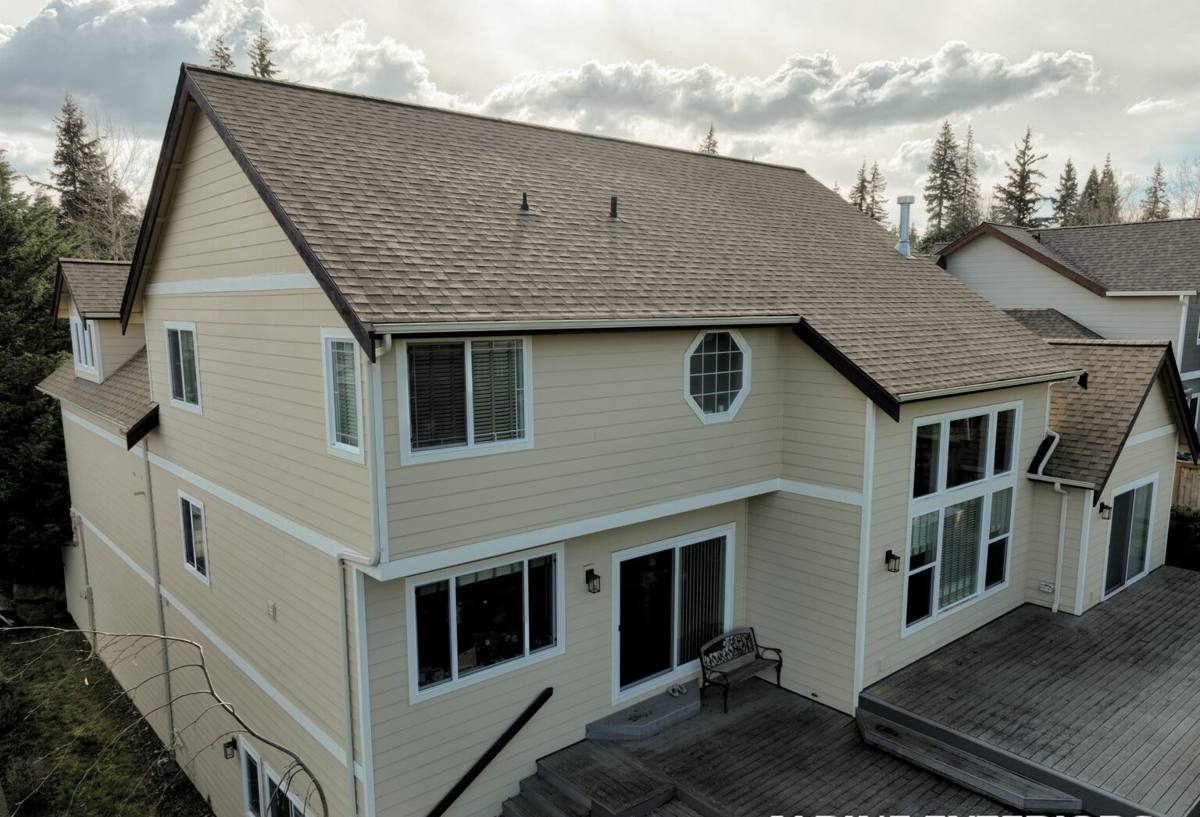
What a Correct Asphalt Shingle Roof Actually Involves
A shingle roof is a system, not a single product. Each layer does a specific job, and skipping or shortcutting any one of them is where premature leaks and moss problems start.
Tear-Off, Not Overlay
Roofing over existing shingles is faster and cheaper, but it traps moisture, hides deck damage, and voids many manufacturer warranties outright. On any roof with more than one existing layer, or any sign of soft or damaged decking, a full tear-off to bare sheathing is the only honest way to do the job. It's also the only way to actually inspect the plywood or board sheathing underneath for rot, which is common on older Lynden homes with roofs original to the house.
Underlayment and Ice-and-Water Membrane
Synthetic underlayment goes down over the whole deck, but the eaves, valleys, and any roof penetration — chimneys, skylights, plumbing vents — get a self-adhering ice-and-water membrane underneath as a second line of defense. In a region with sustained driving rain rather than dramatic freeze-thaw cycles, this membrane is less about ice damming and more about wind-driven rain that works its way under standard felt at low-slope transitions.
Flashing and Valleys
Metal flashing at chimneys, sidewalls, and valleys has to be step-flashed and counter-flashed correctly, not just caulked and hoped for. Valleys carry a disproportionate amount of runoff during a heavy Pacific storm, so a properly sized open metal valley or correctly woven valley matters more here than in a drier climate where a smaller valley gets away with more.
Nailing and Fastening
Manufacturer nailing patterns exist for a reason, and wind exposure in open parts of Lynden and the surrounding farmland can justify the six-nail pattern rather than the standard four, especially on steeper pitches or more exposed elevations. Underdriven or overdriven nails are one of the most common causes of early shingle failure, and it's not something a homeowner can easily catch after the fact.
Choosing the Right Shingle for This Climate
Not every shingle line is built the same, and the right choice depends on budget, roof exposure, and how much maintenance a homeowner wants to take on later.
| Shingle Type | Typical Lifespan | Best For |
|---|---|---|
| 3-tab | 15–20 years | Budget-conscious re-roofs, simple rooflines |
| Architectural / laminate | 25–30 years | Most Lynden homes — better wind rating, dimensional look |
| Algae-resistant (copper-infused granules) | 25–30 years | Shaded lots, north-facing slopes, moss-prone properties |
| Impact-rated / heavier class | 30+ years | Homes wanting maximum durability and longer warranty coverage |
For most Lynden properties, an architectural shingle with algae-resistant granules is the practical middle ground — it costs more than 3-tab up front but resists the moss and streaking problems that are almost guaranteed on a shaded roof in this climate, and it carries a wind rating that holds up better to open exposure.
Ventilation and Moisture: The Part You Don't See
A roof can be installed perfectly on the outside and still fail early if the attic underneath isn't ventilated correctly. Balanced intake at the soffits and exhaust at the ridge keeps moist, warm air from condensing against the underside of the decking. In a marine climate like this one, that trapped moisture doesn't need a hard freeze to cause damage — it just needs time, and Whatcom County gives it plenty of that. Poor ventilation shows up as premature shingle aging from underneath, mildew smell in the attic, and, indirectly, more moss growth because the roof surface stays cooler and damper longer than it should.
Ridge vent length, soffit vent condition, and any bathroom or kitchen exhaust fans that were improperly vented into the attic instead of outside are all things worth checking during a re-roof, not just leaving alone because "the roof is what's being replaced."
Moss and Algae: Managing It Long-Term
No shingle roof in this part of Whatcom County is completely moss-proof, but the maintenance burden can be kept manageable.
- Keep gutters and downspouts clear — standing water and trapped debris are what feed moss growth along eaves
- Trim back overhanging branches to cut down on shade and organic debris landing on the roof
- Use a soft-wash approach or manual removal for moss rather than a pressure washer, which strips protective granules and shortens shingle life
- Zinc or copper strips installed near the ridge let rain carry trace metal down the roof face, which suppresses new moss growth over time
- Address moss early — a light coating brushed off is a five-minute job; moss that's been left for a season or more often takes shingles with it when it comes off
Our Process, Start to Finish
We keep the process straightforward because a re-roof is disruptive enough without added confusion about what's happening and when.
- On-site inspection — we get on the roof, check the decking where accessible, look at flashing, ventilation, and the overall condition, not just the shingles
- Written estimate — a clear scope of work and price, with materials specified, before anything is scheduled
- Material order and scheduling — we build the timeline around a realistic weather window, since asphalt shingles need to be installed in dry conditions to seal properly
- Tear-off and disposal — full removal of old roofing, hauled off the property, decking inspected and any damaged sections replaced
- Installation — underlayment, ice-and-water membrane at vulnerable areas, flashing, shingles, and ridge caps installed to manufacturer spec
- Cleanup and magnetic sweep — property cleared of debris and stray fasteners before we consider the job done
- Final walkthrough — we go over the finished roof with the homeowner and explain warranty coverage in plain terms
Cost Factors on a Lynden Re-Roof
Every roof is priced on its own specifics, but the variables that move the number are consistent. Broad ranges are useful for planning purposes; the written estimate after inspection is what actually matters.
| Factor | Why It Matters |
|---|---|
| Roof pitch and complexity | Steeper roofs and multiple valleys/dormers take more labor and material |
| Number of existing layers | Tear-off of two layers costs more than one, but is often required by code or warranty |
| Decking condition | Rotted sheathing found during tear-off adds material and labor to replace |
| Roof size (squares) | The most direct driver of material and labor cost |
| Access and site conditions | Trees, tight driveways, or a farmhouse setback affect staging and dumpster placement |
| Shingle grade selected | 3-tab, architectural, and algae-resistant lines carry different material costs |
Why a Local Crew Matters for a Lynden Roof
A roofing crew that already works in and around Ferndale and Lynden knows the practical realities that don't show up in a spec sheet — how quickly a storm rolling in off the water can shut down a workday, which weeks of the year actually give a reliable dry stretch for installation, and what the Whatcom County permitting process requires before work starts. That local knowledge affects scheduling decisions and material choices in ways a crew driving in from outside the area typically doesn't account for.
Being local also means accountability after the job is finished. If a question comes up during the next wet season, it's a short drive back out, not a call to an out-of-town number that may or may not get returned. For a roof that has to perform through years of this region's rain and moss cycles, that ongoing relationship is worth as much as the installation itself.
Warranty, Permits, and What to Ask Before You Sign
A re-roof is a significant investment, and a few questions up front save headaches later.
- Is the estimate a full tear-off, or does it include overlaying existing shingles?
- What underlayment and ice-and-water membrane are included, and where specifically will they be installed?
- Does the quote include replacing any decking found to be damaged, or is that billed separately as discovered?
- What does the manufacturer's material warranty cover versus the contractor's workmanship warranty, and for how long?
- Is the contractor licensed and insured to work in Washington, and will they pull the required permit?
- What is the realistic timeline given the weather window, and what happens if rain delays the schedule?
A contractor who answers these clearly and in writing, without hedging, is one worth trusting with a roof that has to hold up to Lynden's weather for the next few decades.
If you're weighing a re-roof or just want an honest read on how much life is left in your current one, we're happy to take a look. The estimate is free, there's no pressure attached to it, and you can start with the form below.