 Ferndale
 Why Lynden Roofs Wear Differently Than the Brochures Suggest
Lynden sits inland from the water, out among the farmland and river bottoms of Whatcom County, which makes it easy to assume the roof rules that apply to a coastal town like Ferndale don't apply here. They mostly do, just with a different mix of causes. When the wind comes out of the west, salt-tinged marine air still pushes up the valley from Bellingham Bay and settles into the low ground around the Nooksack River. Add the region's driving rain, the fog that sits over open fields on fall and winter mornings, and a moss season that can run eight months or longer in shaded, north-facing roof sections, and you have a climate that's genuinely hard on roofing — just not in the dramatic way a windstorm is hard on a roof. It's slow, cumulative wear: trapped moisture, granule loss, soft decking under a roof that looks fine from the ground.
A roof installed correctly for this part of Whatcom County accounts for all of that from the start — not just the shingle brand, but the deck, the underlayment, the ventilation, and the flashing details that keep water moving off the roof instead of sitting on it.
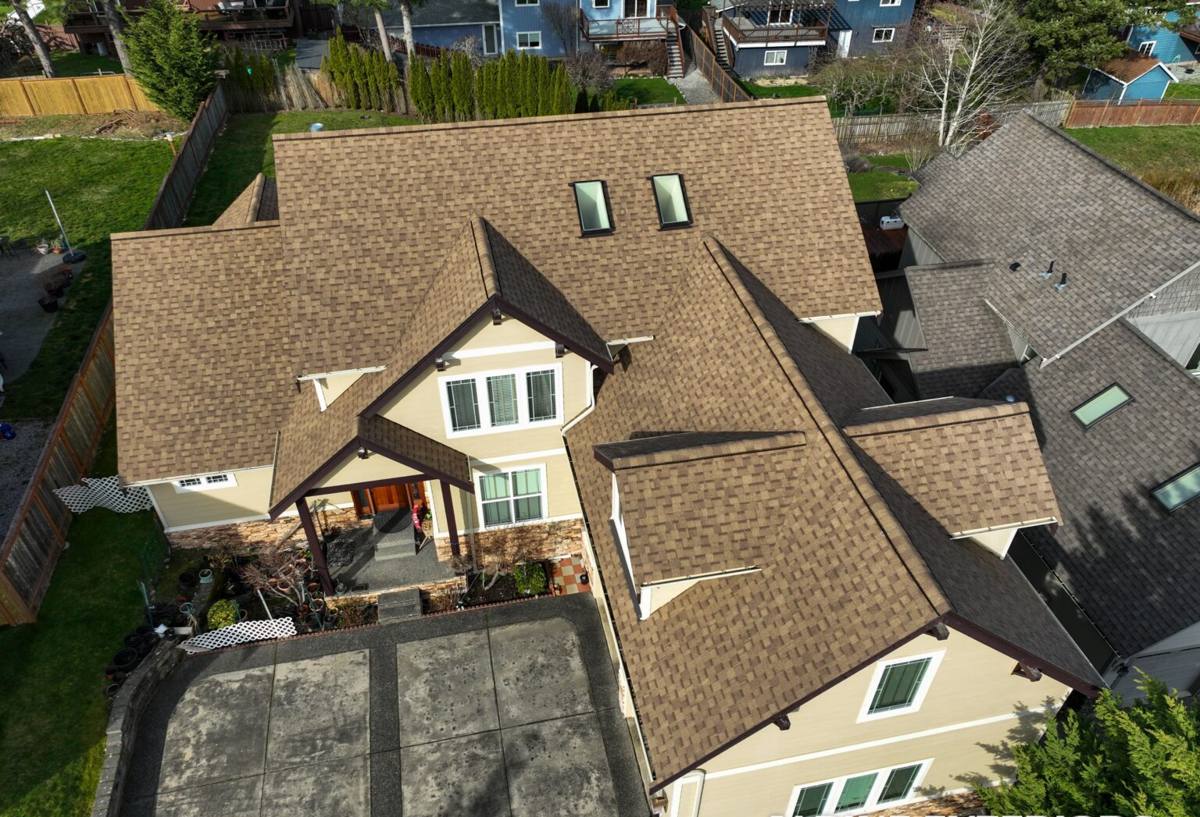
Signs Your Lynden Home Needs a New Roof, Not Just a Repair
Homeowners often call us thinking they need a patch, and sometimes that's true. But a few signs usually mean the roof has reached the point where a repair is just delaying the same conversation:
- Shingles that are cupping, curling at the edges, or missing granules in visible patches
- Moss that keeps coming back within a season or two of cleaning, especially on the shaded slopes
- Soft or spongy spots when walked on, or sagging visible from the street
- Daylight, water stains, or a musty smell in the attic near the roof deck
- A roof that's 20+ years old and has never had its underlayment or flashing replaced
- Granules building up in gutters season after season
Any one of these on its own might be manageable. Two or three together, especially on an older roof, usually means the underlying materials are past the point where patching makes financial sense.
What a Correct Roof Replacement Actually Involves
"New roof" covers a lot of ground, and the difference between a roof that lasts and one that fails early almost never comes down to the shingle alone. It comes down to what's underneath it.
Tear-Off and Deck Inspection
We remove the old roofing down to the deck rather than laying new material over old. That's the only way to actually see what's there — soft plywood, rot around old vent boots, or framing that's been quietly absorbing moisture for years. Any damaged decking gets replaced before anything new goes down; nailing new shingles to a compromised deck just guarantees a repeat problem.
Underlayment and Ice-and-Water Protection
Given how much of the year Whatcom County spends under sustained rain, we treat underlayment as more than a formality. Synthetic underlayment across the full roof, with self-adhering ice-and-water membrane at the eaves, valleys, and any low-slope transitions, gives the deck a real second line of defense if wind-driven rain ever gets past the shingles — which it will, eventually, on any roof.
Ventilation
Poor attic ventilation is one of the most common hidden problems we find on older Lynden roofs. Without enough intake at the eaves and exhaust at the ridge, warm moist air from the house gets trapped against the underside of the deck, which accelerates rot from the inside and feeds the moss and algae growth we already see plenty of from the outside. Balanced ventilation is part of the installation, not an upsell.
Flashing and Penetrations
Chimneys, skylights, vent pipes, and roof-to-wall transitions are where the vast majority of leaks actually start — almost never in the open field of shingles. We install new flashing at every penetration and valley rather than reusing old pieces, since flashing is inexpensive compared to the water damage a failed piece causes.
Choosing the Right Roofing Material for Lynden's Climate
There's no single "best" roofing material — the right choice depends on your roof's exposure, your budget, and how long you plan to stay in the home. Here's how the common options actually compare for a property dealing with sustained rain, moss pressure, and occasional wind:
| Material | Typical Lifespan | Moisture & Moss Behavior | Relative Cost |
|---|---|---|---|
| Architectural (dimensional) asphalt shingle | 20–30 years | Good drainage profile; needs periodic moss treatment on shaded slopes | Moderate |
| Standing seam metal | 40–50+ years | Sheds water and moss very well; minimal maintenance | Higher upfront |
| Cedar shake | 20–30 years with upkeep | Attractive but holds moisture longest; needs regular maintenance to resist rot | Higher |
| 3-tab asphalt shingle | 15–20 years | Lower profile sheds debris less effectively; more moss retention | Lowest |
For most Lynden homes, we recommend architectural shingle as the practical middle ground — it handles this climate well and the cost is predictable. Metal earns its higher price tag on homes with steep, heavily shaded roof faces where moss and moisture are a constant fight. We don't push cedar shake as a low-maintenance option here; it can look great, but in a climate with this much sustained dampness, it demands upkeep most homeowners underestimate, and we'd rather be upfront about that trade-off than sell a product that creates callbacks.
Our Installation Process
- On-site inspection and honest assessment — we get on the roof, check the deck where accessible, and tell you plainly whether you need a full replacement or a repair.
- Written estimate — material, labor, ventilation, and flashing scope spelled out, no vague line items.
- Material selection — walking through the options above against your budget and how the roof is exposed to sun, wind, and shade.
- Scheduling — timed around Whatcom County weather patterns rather than guessed at.
- Tear-off and deck repair — old roofing removed, deck inspected, damaged sections replaced.
- Underlayment, flashing, and ventilation installed — the parts that determine whether the roof actually performs.
- New roofing installed — per manufacturer specification, not shortcuts.
- Cleanup and final walkthrough — magnetic sweep for stray nails, gutters checked, questions answered on-site.
Scheduling Around Whatcom County Weather
Roofing can be done for much of the year here, but timing still matters. Spring and summer give the most predictable stretches of dry weather for tear-off days, which is when you want the deck exposed the least amount of time possible. Fall and winter jobs are absolutely doable — we do them regularly — but they require tighter scheduling around storm systems and more conservative daily tear-off sections, since an open deck in a Whatcom County downpour is not a risk worth taking. We plan around the forecast, not the calendar, and we'll tell you honestly if a stretch of weather isn't a good window to start.
Why Local Experience in Lynden Matters
A roofing crew that already works Whatcom County knows things a traveling or out-of-area contractor has to learn on your dime: which roof orientations in this area hold moss the longest, how local permitting and inspection actually works, what ventilation setups perform in homes built during different building-code eras in the county, and how to sequence a job around this region's rain rather than a generic weather assumption. That local pattern recognition is the difference between a crew that's guessing and one that's seen the same problem on the next street over.
It also matters for accountability — a company based nearby in Ferndale isn't disappearing after the final payment. If something needs a follow-up look after the first hard rain of the season, we're a short drive away, not a phone number that stops answering.
What to Ask Before You Hire a Roofing Contractor
Whether you call us or someone else, these are the questions that separate a legitimate roofing company from a risk:
- Are you licensed and bonded to work in Washington, and can you provide proof?
- Do you carry liability insurance, and does it cover my property if something goes wrong?
- Is the estimate written and itemized, or a vague lump-sum number?
- Does the quote specify underlayment type, ventilation work, and flashing replacement — or just "new roof"?
- What's the manufacturer's warranty, and is it tied to certified installation?
- Will you inspect and replace damaged decking as part of the job, or only if I ask?
- Can you provide local references or point to other work in the area?
Any contractor unwilling to answer these plainly is telling you something.
Get a Straight Answer About Your Roof
If your roof in Lynden is showing its age, or you just want an honest opinion on whether it's a repair or a replacement, we're happy to take a look. There's no pressure and no sales script — just a real assessment and a written estimate you can take your time deciding on. Use the form below to schedule a free estimate.