 Ferndale
 Why Lynden Homes Need a Roof That Handles More Than Rain
Lynden sits far enough inland from the coast that people sometimes assume salt air isn't a factor here the way it is in Ferndale proper or along Birch Bay. It still is. Whatcom County's marine air moves inland on the wind, and combined with the valley's fog, heavy dew, and long wet stretches from October through May, every exterior surface in Lynden spends most of the year damp. Add in the moss and lichen that thrive under the Douglas fir and cedar canopy common on Lynden properties, and you've got a roofing environment that punishes anything with seams, granules, or a short warranty.
Metal roofing holds up to that combination better than almost any other option, but only when it's installed correctly for this specific climate. A metal roof panel bought off a truck and screwed down without attention to underlayment, fastener pattern, and drainage detail will fail here faster than in a drier climate — the moisture never really lets up long enough for small mistakes to dry out and go unnoticed.
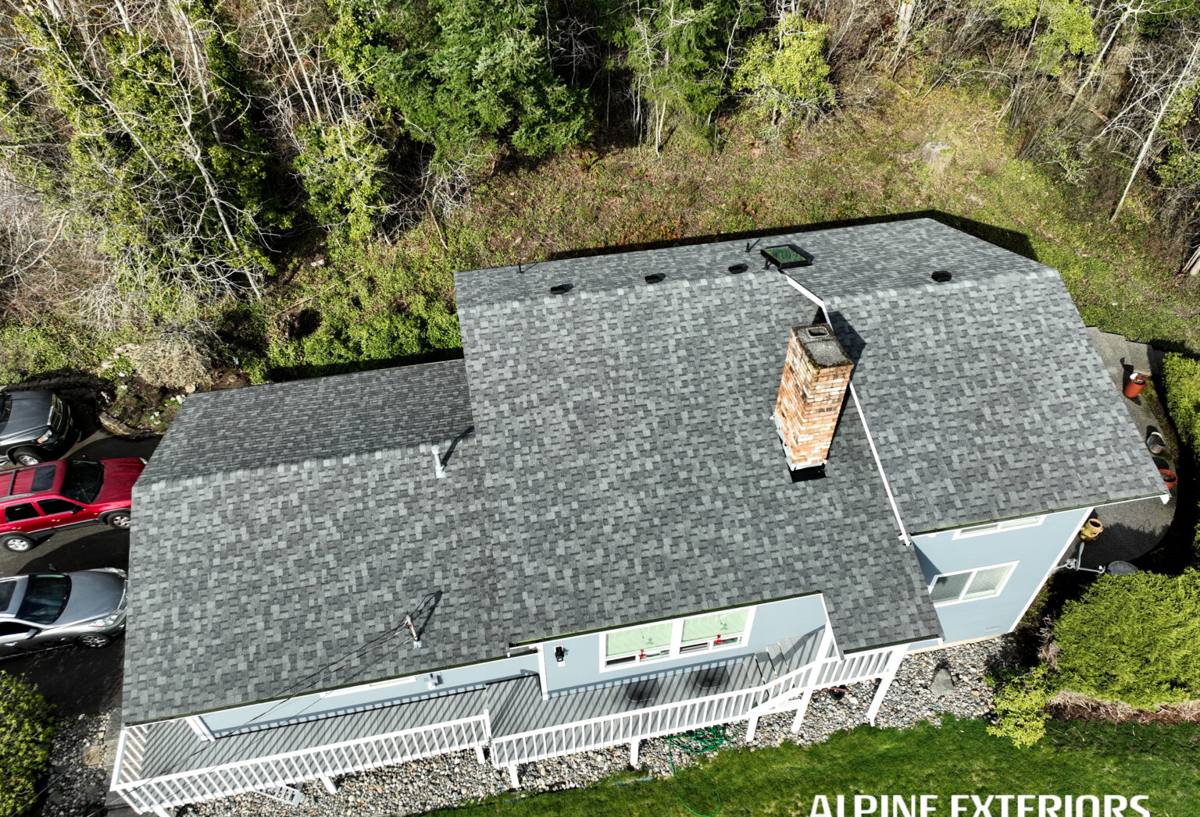
What Driving Rain and Moss Season Actually Do to a Roof
Driving Rain
Whatcom County storms often come with real wind behind them, pushing rain sideways instead of straight down. That means water gets tested at every lap, fastener, valley, and penetration — not just the open field of the roof. A roof that would shed water fine in a calm rain can leak in a Lynden windstorm if the underlayment and flashing details weren't built for wind-driven moisture.
Moss Season
Moss doesn't just look bad — it holds water against the roof surface for weeks at a time, works its way under lapped edges, and on the wrong material can trap moisture long enough to cause rot in the deck below. Metal sheds moss far better than composition shingle because there's no rough granule surface for spores to grab onto, and a properly pitched, properly detailed metal roof drains fast enough that moss struggles to establish itself in the first place. It's not moss-proof, but it's a dramatically better starting point.
Salt Air
Even set back from the water, Lynden gets enough marine influence that fastener and flashing material choice matters. Cheap fasteners and mismatched metals corrode faster in this air than people expect, and that corrosion is usually the first visible failure point on an underspecified metal roof.
What a Correctly Installed Metal Roof Looks Like Here
A metal roof isn't just "metal instead of shingles" — the whole assembly changes. For Lynden's climate, the pieces that matter most are:
- High-temp, self-adhered underlayment at eaves, valleys, and penetrations — standard felt breaks down under a metal roof's temperature swings and won't seal around fasteners the way a self-adhered membrane does
- Full synthetic underlayment across the field, not just the vulnerable spots, so the deck has a real second line of defense during the wettest months
- Correct fastener type and spacing for the panel profile, with corrosion-resistant fasteners matched to the panel metal so you're not setting up galvanic corrosion at every screw
- Proper panel overlap and end-lap sealant at every horizontal joint, since a long Lynden roof plane often needs more than one panel run
- Closed or vented ridge detail that keeps wind-driven rain out while still letting the attic breathe — critical in a climate where trapped attic moisture leads to mold and sheathing rot
- Ice-and-water shield at valleys even though hard freezes are rare here, because valleys are where wind-driven rain concentrates and where most metal roof leaks actually start
Skip any one of these and the roof will probably still look fine for a season or two. The failures show up later, as leaks at a valley, rust streaking at a fastener line, or rot discovered when the roof is finally opened up for a repair.
Panel Profiles: What We Recommend for Lynden Roofs
Not every metal roofing style suits every home, and honestly not every style suits this climate equally well. Here's how the common options compare for a Lynden property:
| Profile | Best for | Climate notes |
|---|---|---|
| Standing seam | Most Lynden homes, especially lower-pitch roofs | Concealed fasteners mean no exposed screw heads for water or corrosion to find; best moss and wind-driven rain performance |
| Exposed-fastener panel (5V, corrugated) | Shops, barns, budget-conscious re-roofs | Lower upfront cost, but exposed fasteners need re-torquing or replacement over time as gaskets age in wet climates |
| Stone-coated steel | Homes wanting a shingle or shake look | Good moss resistance, but more seams and fastener penetrations than standing seam — installation quality matters even more |
| Metal shingles/shakes | Historic-style or HOA-restricted properties | Aesthetic match to traditional roofing; needs careful underlayment work since it has more individual pieces than a panel system |
For most Lynden homes we talk to, standing seam ends up being the right call once people understand what the concealed-fastener design actually buys them over 30-plus years of coastal Washington weather. It costs more upfront than exposed-fastener panel, but it also has the fewest long-term maintenance points on a roof that's going to sit under fir needles, moss spores, and driving rain for decades.
Our Process for a Lynden Metal Roof Install
- On-site assessment — we look at pitch, existing decking condition, ventilation, tree cover, and drainage paths specific to your lot, not a generic checklist
- Tear-off and deck inspection — Whatcom County's wet cycles mean we routinely find soft or rotted decking under old roofing that wasn't obvious from the outside; we address it before anything new goes down
- Underlayment installation — self-adhered membrane at critical zones, synthetic underlayment across the field
- Flashing and valley work — this is where most roof failures actually originate, so it gets the most attention, not the least
- Panel installation — correct fastener spec, proper overlap, and manufacturer-specified clearances for thermal movement
- Ridge, trim, and penetration detailing — vents, chimneys, and skylights sealed and flashed to shed wind-driven rain from every direction
- Final walkthrough — we check the whole roof plane and go over maintenance basics with you before we consider the job done
Why Local Experience in Lynden and Ferndale Matters
A crew that only occasionally works in Whatcom County will default to generic install specs — the same underlayment and fastener choices they'd use in a dry inland climate. A crew that works Lynden and Ferndale regularly already knows which valleys collect moss first, which roof orientations take the worst of the wind-driven rain off the Strait, and which older Lynden homes tend to have deck issues hiding under the existing roofing before tear-off even starts. That local pattern recognition is the difference between a roof that's engineered for this specific weather and one that's just "roofing" in a general sense.
It also matters for warranty support and follow-up. If a fastener needs attention in year twelve, or a windstorm knocks a branch into a panel, you want a contractor who's still working in the area and can get to your property without a special trip.
Maintenance: What Actually Keeps a Metal Roof Performing Here
Metal roofing is genuinely low-maintenance compared to composition shingle, but "low" doesn't mean "none" in a climate like this. A short seasonal checklist:
- Clear needles and debris from valleys and gutters before the fall rains set in — trapped debris is what gives moss and standing water a foothold even on metal
- Check for moss or algae buildup at shaded roof sections once a year and remove it gently — don't pressure-wash, which can drive water under laps
- Inspect exposed fasteners (if you have an exposed-fastener panel) every few years and re-seat or replace any that show gasket wear
- Look at flashing around chimneys, vents, and skylights after major windstorms, since these are the first points to show stress
- Trim back overhanging branches — Lynden's tree cover is part of the charm, but branch contact scratches coatings and feeds moss growth
Cost Factors for a Lynden Metal Roof
Every roof is different, but the main variables that move the price on a Lynden metal roofing project are:
| Factor | Why it matters |
|---|---|
| Panel profile | Standing seam runs higher than exposed-fastener panel due to labor and concealed-fastener hardware |
| Roof complexity | Valleys, dormers, and multiple pitches add flashing labor and material — a simple gable roof installs faster and cheaper than a cut-up roofline |
| Deck condition | Rot discovered during tear-off adds cost, which is why an honest assessment upfront matters more than a quick estimate |
| Tear-off vs. overlay | Removing old roofing lets us properly inspect and treat the deck, which we generally recommend given how wet this region stays |
| Metal gauge and coating | Heavier gauge and better factory coatings cost more but hold up longer against salt air and repeated wet-dry cycling |
We give straightforward, written estimates based on what we actually find on your roof — not a phone-quote guess. If a tear-off reveals deck problems, we tell you before we touch it, not after.
Get an Honest Look at Your Lynden Roof
If your current roof is showing moss buildup, granule loss, or you're just tired of dealing with the maintenance cycle that comes with composition shingle in Whatcom County's climate, a metal roof is worth a serious look. We'll walk your roof, tell you what we actually see, and give you a straight answer on what it needs — no pressure, no upsell. Use the form below to request a free estimate for your Lynden property.