 Ferndale
 Marietta's Roofs Work Harder Than Most
Marietta sits close enough to the water that homes here deal with a mix most inland Whatcom County neighborhoods don't have to think about as much: salt-laden air drifting off the bay, driving rain that comes in sideways during winter storms, and a shaded, damp growing season that gives moss months to get established on anything that holds moisture. A roof in Marietta isn't just shedding water — it's fending off corrosion, wind-driven infiltration, and biological growth all at once, often in the same season.
That combination is exactly why metal roofing gets asked about so often out here. Done right, it handles all three of those stresses better than most other roofing materials. Done wrong — wrong fastener, wrong coating, wrong underlayment for a marine environment — it can fail faster than the material it replaced. This page is about what "done right" actually means for a Marietta roof, not metal roofing in general.
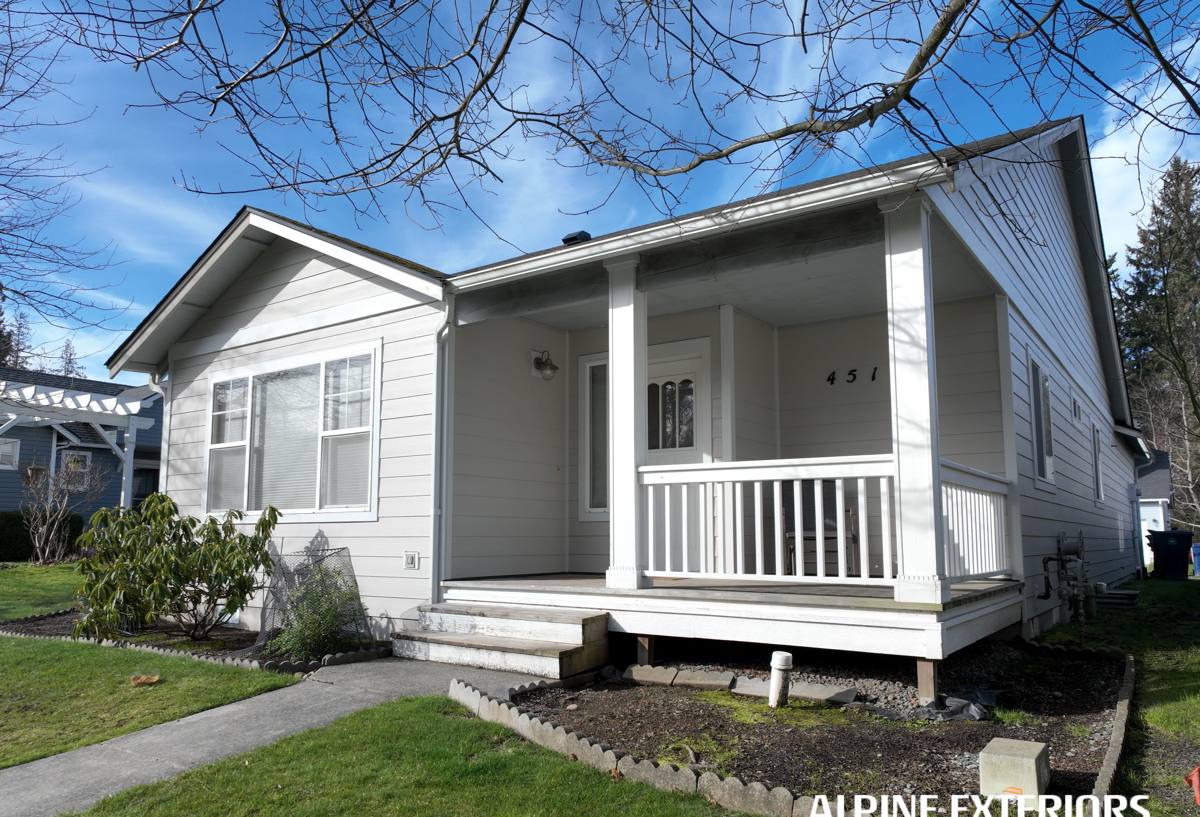
What Salt Air and Moisture Actually Do to a Roof Over Time
It helps to understand the specific mechanisms at work before picking a roofing system, because they point directly to the decisions that matter later.
Salt Air and Corrosion
Airborne salt is conductive and slightly acidic. On uncoated or poorly coated metal, it accelerates oxidation, especially at cut edges, fastener heads, and anywhere two dissimilar metals touch. It also works its way into gaps in cheaper coatings, which is why the coating system and finish quality matter more here than they would twenty miles inland.
Driving Rain and Wind-Driven Water
Whatcom County storms often bring rain in at an angle rather than straight down. That means water can get pushed uphill under lapped materials or through fastener penetrations that would stay dry in a calmer climate. Underlayment quality and flashing detail work carry more weight here than the roofing material itself.
Moss and Prolonged Dampness
Shaded roof sections, north-facing slopes, and areas near mature trees stay damp long after a storm passes. Moss and algae take hold in that moisture and, over years, can lift shingle edges, hold water against a roof deck, and shorten the life of organic roofing materials. Metal doesn't give moss the same foothold, but panel design and slope still affect how well a roof resists it.
Why Metal Roofing Fits This Particular Climate
Metal roofing isn't the right answer for every house or every budget, but for Marietta's specific combination of salt exposure, wind-driven rain, and moss pressure, it addresses each problem directly:
- A continuous, hard, low-porosity surface gives moss and algae far less to attach to than shingle granules do
- Properly coated steel and aluminum resist salt-air corrosion far longer than untreated or minimally coated materials
- Standing seam profiles shed wind-driven rain without relying on granule adhesion or aging asphalt to stay watertight
- Steep or moderate slopes shed both rain and the moss spores that settle on flatter, slower-draining surfaces
- A correctly installed metal roof typically outlasts two or more composition roof replacement cycles, which matters on a coastline where re-roofing crews and material costs both trend upward
None of that is automatic, though — it depends entirely on matching the panel, coating, and fastening system to the site.
Choosing the Right Metal Roofing System for a Marietta Home
Not all metal roofing is built for a marine-influenced climate. The panel profile, base metal, and coating all affect how the roof performs against salt air specifically.
| Factor | Better fit for Marietta | Why it matters here |
|---|---|---|
| Panel profile | Standing seam (concealed fasteners) | No exposed fastener heads for salt air and driving rain to attack over time |
| Base metal | Aluminum or Galvalume-coated steel | Aluminum resists salt corrosion inherently; Galvalume's aluminum-zinc coating outperforms plain galvanized in coastal air |
| Finish | PVDF (Kynar-type) paint systems | Holds color and chalk-resistance far longer under UV and salt exposure than lower-grade paint finishes |
| Fastener hardware | Stainless steel or matched-metal fasteners | Prevents galvanic corrosion where two different metals contact each other |
| Underlayment | Self-adhered, high-temp synthetic underlayment | Provides a second line of defense against wind-driven rain that gets past the panel laps |
Exposed-fastener panel systems can still be a reasonable, lower-cost option on secondary structures like shops or garages, but for a primary residence this close to the water, we generally steer homeowners toward concealed-fastener standing seam. It's not that exposed-fastener panels are a bad product — it's that every exposed screw is a maintenance point, and maintenance points multiply in salt air.
What a Correct Installation Involves
The panel itself is only part of the system. A metal roof is only as good as the details underneath it, and this is where a lot of corner-cutting happens on jobs that look fine for the first year or two.
Deck and Underlayment
We check the existing roof deck for rot or soft spots before anything goes down — this is common on older Whatcom County homes where a previous roof trapped moisture for years without anyone noticing. A full underlayment layer goes down next, with extra attention at valleys, eaves, and any low-slope transitions where wind-driven rain is most likely to test the system.
Flashing and Penetrations
Chimneys, vents, skylights, and wall transitions are where the majority of roof leaks actually originate, metal or not. Flashing gets custom-formed and properly lapped rather than relying on sealant alone to do the work — sealant is a backup, not the primary defense.
Fastening and Panel Layout
Panels are laid out to account for prevailing wind and rain direction where the site allows it, with seams and laps oriented so water is directed off the roof rather than into it. Fastener spacing and clip systems are sized for the wind exposure of the specific site — a shop with tree cover behind it doesn't need the same wind rating as an open, exposed roofline closer to the water.
Ventilation
Metal roofs need proper attic or roof-deck ventilation to prevent condensation from forming on the underside of the panels, especially given how much moisture is already in the local air. We address this as part of the install rather than treating it as an afterthought.
How Our Process Works
- On-site inspection of the existing roof, deck condition, slope, and exposure to wind and salt air
- A written recommendation covering panel profile, metal type, coating, and underlayment suited to that specific roof
- A clear, itemized estimate before any work begins — no vague allowances
- Deck repair as needed, full underlayment installation, and custom flashing at every penetration and transition
- Panel installation with attention to seam orientation, fastening for local wind exposure, and clean edge and trim work
- Final walkthrough covering how the roof was built and what maintenance, if any, it will need going forward
Maintenance in a Marine and Moss-Heavy Climate
One of the real advantages of a correctly installed metal roof is how little ongoing maintenance it needs compared to composition shingles — but "little" isn't "none." A short annual checklist covers most of it:
- Clear debris and needle buildup from valleys and against any wall or chimney flashing
- Rinse off accumulated salt residue and grime, especially on roofs closer to the water or exposed to prevailing wind
- Check gutters and downspouts for blockages that can back water up under eave edges
- Look for any scuffed or scratched coating after storms or fallen branches, since exposed bare metal is where corrosion can start
- Confirm sealant at penetrations still looks intact during a visual check, even though it's a backup rather than the primary seal
Why Hiring a Crew That Already Works Marietta Matters
A lot of what separates a metal roof that performs for decades from one that develops problems in five or six years isn't the panel brand — it's whether the installer understood the site conditions before the first panel went down. A crew that regularly works in Marietta and along this part of the Whatcom County coastline already knows which slopes catch the worst wind-driven rain, which tree-covered sections need extra attention for moss, and which fastener and coating combinations actually hold up against the salt air here rather than in a drier inland climate. That local familiarity shows up in decisions a homeowner never sees directly — panel orientation, flashing details, fastener choice — but absolutely feels in how the roof performs ten and twenty years down the road.
If you're weighing metal roofing for a home in Marietta, we're happy to take a look at your specific roof, talk through what it's dealing with, and put together a straightforward, no-pressure estimate. There's no cost and no obligation — just use the form below to get started.