 Ferndale
 Siding That Has to Work in Nooksack's Climate, Not Just Look Good on Day One
Nooksack sits close enough to Bellingham Bay and the Strait of Georgia that homes here deal with a version of coastal weather most siding products were never designed around. You get salt-laden air moving in off the water, long stretches of driving rain through fall and winter, and short winter days that never quite dry a north wall out before the next system rolls through. Add the shade from mature Douglas fir and cedar that a lot of Whatcom County properties are built around, and you get months where a wall simply stays damp. That combination is what actually determines how a siding job holds up around here — not the label on the box, but how the material and the installation handle sustained moisture and salt exposure over years, not weeks.
We install James Hardie fiber cement exclusively, and we've built our process around this specific stretch of Whatcom County. This page walks through what Nooksack homes actually need from their siding, what a correct Hardie installation involves in this climate, and how our process is built around the conditions your house is actually facing.
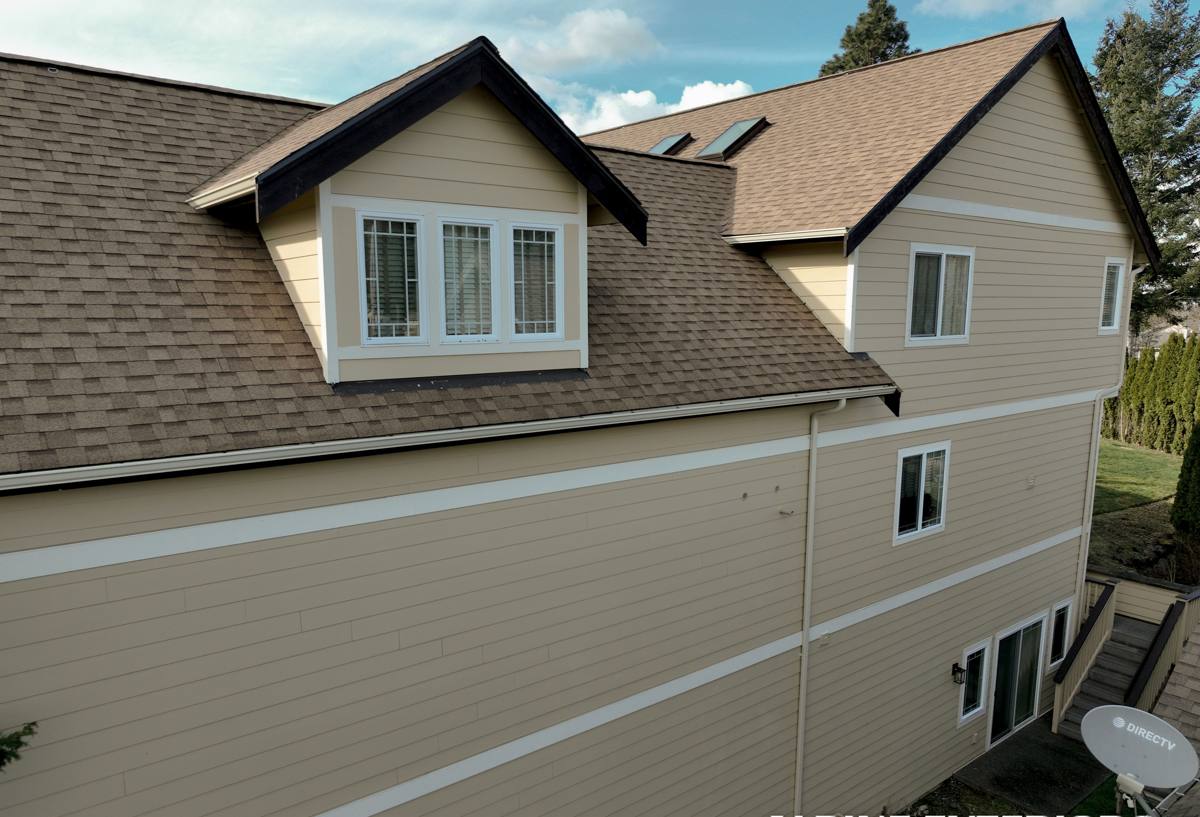
What Salt Air, Rain, and Moss Actually Do to a House
Salt Air
You don't have to be beachfront to feel it. Airborne salt travels inland on wind and settles on every exterior surface, including siding, trim, and fasteners. Over time it accelerates corrosion on anything metal that isn't properly rated, and it can degrade coatings that weren't formulated to resist it. Fasteners, flashing, and even the factory finish on your siding all need to be chosen with this in mind — not swapped in because they were on the truck.
Driving Rain
Whatcom County doesn't just get rain, it gets wind-driven rain that hits walls at an angle instead of falling straight down. That matters because it pushes water into laps, seams, and butt joints that would stay dry in a calmer climate. A siding system that isn't installed with the right overlaps, clearances, and flashing details will eventually let that water behind the cladding, where it causes damage you can't see until it's expensive.
Moss and Sustained Dampness
Shaded walls, north-facing elevations, and anything under tree cover stay damp longer here than in drier parts of the state. That's exactly where moss and mildew take hold on siding surfaces and in the joints between boards. Left alone, sustained moisture at the surface degrades paint film and, on the wrong substrate, softens or swells the material underneath.
None of these three forces are dramatic on their own. It's the combination — salt exposure, sideways rain, and weeks of damp shade — repeated year after year, that separates siding that looks fine at year three from siding that's still doing its job at year twenty.
Why We Standardized on James Hardie for This Climate
James Hardie fiber cement is engineered from cement, sand, and cellulose fibers — it's non-combustible and doesn't rely on a plastic or wood substrate that can absorb water and swell. Hardie's HZ5 product line in particular is engineered for climates with more moisture exposure, which fits the Pacific Northwest coastal belt Nooksack sits in. The ColorPlus finish is baked on at the factory under controlled conditions, which gives you more consistent, more fade- and moisture-resistant color than field-applied paint, and it comes with its own finish warranty separate from the product warranty on the board itself.
We don't install LP SmartSide, vinyl, Cemplank, Allura, primed spruce, or cedar. That's not a knock on every homeowner who has one of those on their house — it's that we've made a professional call about what holds up correctly in this specific climate when installed to spec, and what doesn't leave enough margin for the kind of weather Nooksack sees every winter. Fiber cement that's properly manufactured and correctly installed gives us a system we're willing to warranty and stand behind on a coastal Whatcom County property.
What a Correct James Hardie Installation Involves Here
The product is only half the equation. Most siding failures we get called out to inspect — regardless of brand — trace back to installation shortcuts, not the material itself. In a climate like this, the details matter more than they would somewhere drier.
- Weather-resistive barrier and rain screen gap: A properly lapped water-resistive barrier behind the siding, with a drainage gap where the wall assembly calls for one, gives incidental moisture a way out instead of trapping it against the sheathing.
- Correct fastener spec: Given the salt exposure here, fasteners need to be rated for it — not whatever happened to be in the gun that day. This is one of the most commonly skipped details on lower-bid jobs.
- Manufacturer-specified clearances: Hardie's install specs call for minimum clearance from grade, roofing, decks, and horizontal surfaces. Skip these and you create the exact standing-moisture conditions that cause problems down the line.
- Butt joint and seam treatment: Every horizontal seam is a potential entry point for driving rain. Correct flashing or manufacturer-approved joint treatment behind every butt joint isn't optional trim work, it's the difference between a seam that sheds water and one that collects it.
- Caulking and sealant discipline: Used correctly at penetrations and terminations, not as a substitute for proper flashing.
- Factory-cut edges preserved where possible: Field cuts expose raw fiber cement edges that need to be primed and sealed per Hardie's spec before they're closed up, especially on a job that's going to face this much rain.
Any one of these done wrong won't necessarily show up in the first year. It shows up in year five or seven, usually as a stain, a soft spot, or paint failure concentrated right where the shortcut was taken.
Our Process for Nooksack Jobs
1. On-Site Assessment
We walk the whole exterior, not just the sides you're worried about. We're looking at which elevations get the most driving rain, which stay shaded and damp longest, where moss is already established, and where your current siding or trim is already showing moisture damage.
2. Product and Line Selection
Based on that walk-through, we spec the Hardie product line and ColorPlus finish that fits your exposure — a shaded, moss-prone north wall and a wide-open south wall facing prevailing wind and rain aren't necessarily treated identically.
3. Written Scope Before Any Work Starts
You get a scope that spells out the weather barrier approach, fastener spec, flashing details, and clearances before a single board goes up — not decisions made on the fly mid-project.
4. Installation to Manufacturer Spec
Installed to Hardie's published installation guidelines, not a generic fiber cement approach. This is what keeps the product warranty intact if you ever need to use it.
5. Final Walkthrough
We go over the finished job with you, including where flashing and clearances were addressed, so you know what's behind the finish, not just what it looks like.
Cost Factors for a Nooksack Siding Job
We're not going to quote a number here — every house is different, and anyone who gives you a firm price before walking your property is guessing. What we can tell you is what actually moves the number:
| Factor | Why It Matters Here |
|---|---|
| Wall exposure and shading | Shaded, moss-prone walls may need additional prep or a different product line than open, sun-exposed elevations |
| Condition of existing sheathing | Sustained coastal moisture sometimes means hidden sheathing damage that has to be repaired before new siding goes on |
| Trim and flashing scope | Whatcom County's driving rain makes correct flashing detail non-negotiable, and it's a real line item, not an afterthought |
| ColorPlus vs. field-applied finish | Factory-applied finish costs more upfront but holds color and resists this climate's moisture better over time |
| Access and site conditions | Mature tree cover, tight lots, and slope can all affect labor time on a given property |
Questions Worth Asking Before You Hire Anyone
Whether you go with us or someone else, a Nooksack siding job is a long-term investment in a demanding climate. These are the questions that actually separate a crew that knows this area from one that's guessing:
- What fastener spec do you use, and is it rated for salt-air exposure?
- Do you install a rain screen gap, and under what conditions do you skip it?
- How do you treat butt joints and field-cut edges before they're closed up?
- Will the installation meet the manufacturer's spec closely enough to keep the product warranty valid?
- Have you worked on homes in this specific area, with this specific mix of shade, wind, and rain exposure?
Why Hiring a Crew That Already Works Nooksack Matters
A lot of siding problems we get asked to look at weren't caused by bad material — they were caused by a crew applying a generic install approach to a climate that doesn't forgive shortcuts. A contractor who's worked this stretch of Whatcom County already knows which elevations on a typical Nooksack lot take the worst of the driving rain, where moss tends to establish first, and how much clearance actually holds up once winter sets in. That's not something you learn from a manufacturer's installation manual alone — it's something you learn from doing the work here, on houses that face the same weather yours does.
We'd rather walk your property, tell you honestly what your siding actually needs, and give you a scope you can hold us to than sell you on a product that isn't going to hold up in this climate. If you're weighing a siding project on a Nooksack home, we're happy to come take a look, no pressure and no obligation, and give you a straight assessment of what your house needs and what it would take to do it right.