 Ferndale
 Siding Built for Nooksack's Specific Climate
The Nooksack area sits in a stretch of Whatcom County where three things work on a house's exterior at the same time: salt-laden air moving in off the Strait, long stretches of driving rain that come sideways more often than straight down, and a moss season that can run eight months or longer in shaded, north-facing spots. Any one of those is manageable. Together, they're why siding choice and installation quality matter more here than in a drier inland climate.
Salt air is corrosive to exposed metal fasteners and trim, and it accelerates the breakdown of coatings that aren't formulated to resist it. Driving rain finds every gap in flashing, caulking, and butt joints that a calmer climate would never expose. And moss doesn't just look bad — it holds moisture against the siding surface for weeks at a time, which is exactly the condition that rots wood-based products and stains poorly-sealed ones. A siding installation done for Nooksack has to account for all three, not just one.
Why We Only Install James Hardie Fiber Cement
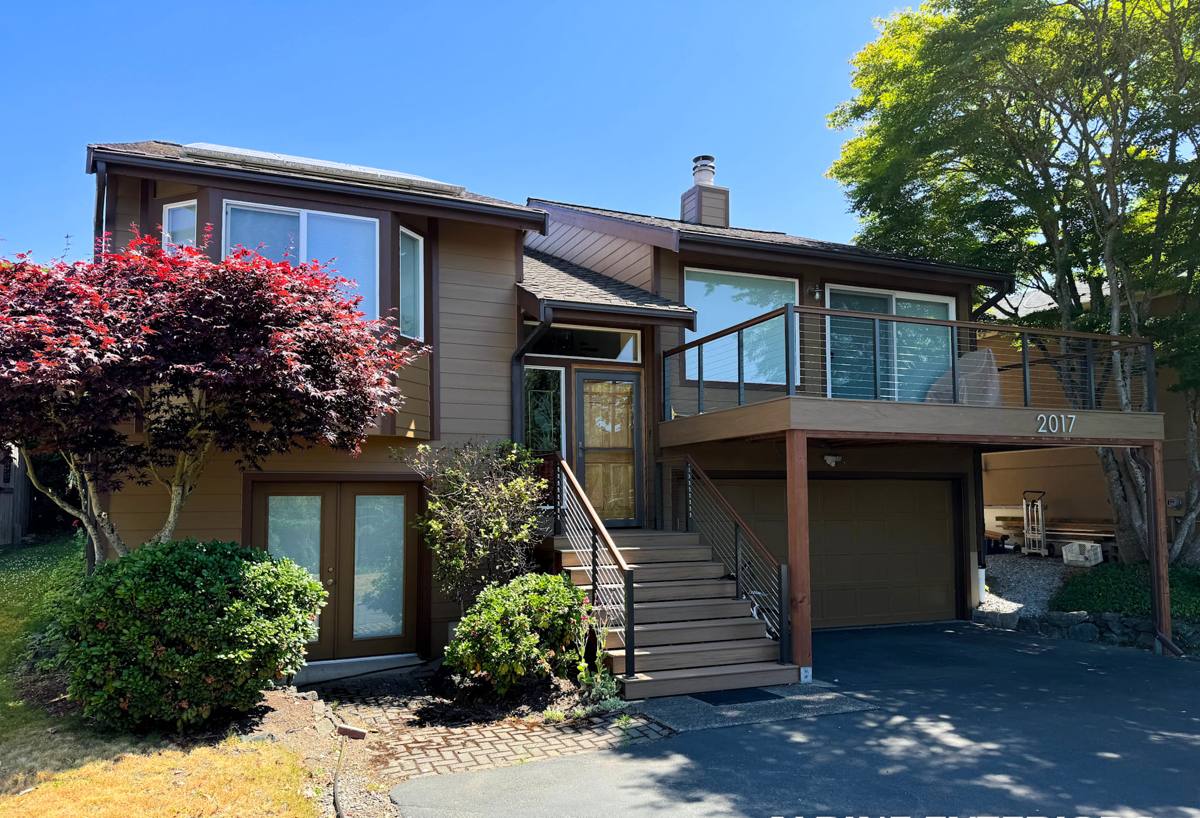
We don't install LP SmartSide, vinyl, Cemplank, Allura, or primed wood siding — not because those products have no place in the market, but because we've standardized our crew, our detailing, and our warranty backing around one system we trust to perform in this exact climate. James Hardie fiber cement is non-combustible, dimensionally stable when wet, and finished at the factory with ColorPlus technology rather than field-applied paint. That last point matters a lot in a salt-air, high-moisture environment: factory-cured finishes resist fading and moisture intrusion far better than coatings applied on-site under variable weather.
Hardie's HZ5 product line is engineered specifically for climates with freeze-thaw cycling and sustained moisture exposure — which describes most of western Whatcom County, including Nooksack. Fiber cement doesn't swell, rot, or delaminate the way wood-based and some engineered wood products can when they take on repeated moisture. It also carries a strong transferable warranty, which matters if you sell the house — a real consideration in a market where buyers ask pointed questions about siding age and condition.
What Correct Installation Actually Involves
Fiber cement is only as good as the install behind it. A correct James Hardie job in this area includes:
- Proper rainscreen or drainage gap behind the panels so incidental moisture can escape instead of sitting against the wall assembly
- Stainless or hot-dip galvanized fasteners rated for coastal exposure — not standard interior-grade fasteners
- Correct nailing pattern and blind-nailing where Hardie's install specs call for it, to avoid surface cracking
- Flashing at every horizontal joint, window head, and roofline intersection, lapped correctly for water to shed outward
- Factory-cut and factory-primed edges kept intact; field cuts sealed per Hardie's specification
- Minimum clearance from grade, decks, and roof lines so the bottom edge of the siding never sits in standing water or snow
Skipping any one of these doesn't usually show up as a problem in year one. It shows up in year five or six, as staining, soft trim, or fastener bleed — right when a homeowner assumes the siding should still look brand new.
What "Local Crew" Actually Buys You Here
Nooksack isn't a generic zip code to us — it's an area we've worked in enough to know the specific failure points. Homes tucked under tree cover hold moss and moisture longer than homes in open exposure a mile away. Properties closer to open water or exposed to prevailing wind take salt spray differently than homes further inland. A crew that already knows which lots need extra attention to drainage detailing, or which sides of a house typically take the worst weather, makes better on-the-spot decisions than a crew seeing the property for the first time.
That local knowledge also shows up in smaller ways: knowing which flashing details tend to fail first on older Whatcom County homes, understanding the typical wall assemblies used in this area's housing stock from different build eras, and having a realistic sense of how long a project should take given this region's rain patterns rather than a generalized schedule that assumes dry weather.
Reading Your Home's Current Siding Condition
Before we talk installation, it's worth understanding what we're looking for when we evaluate an existing exterior. This matters whether you're replacing failing siding or re-siding a home that's simply aged out of its original material.
| What We Check | What It Tells Us |
|---|---|
| Soft spots when pressed (especially near the bottom courses) | Moisture has gotten behind the siding or into the substrate — common with wood-based products in this climate |
| Moss and algae concentration by wall orientation | Identifies which sides of the house need better drainage detailing or trim clearance in the new install |
| Paint or coating failure patterns | Shows whether the old finish was ever rated for coastal/high-moisture exposure |
| Fastener staining or corrosion | Indicates non-rated fasteners were used originally — a detail we won't repeat |
| Trim and flashing condition at windows and rooflines | Often the real source of a "siding" problem, not the panels themselves |
This inspection is part of every estimate we give — not an upsell, just the information needed to scope the job accurately.
Our Installation Process, Start to Finish
1. On-Site Assessment
We walk the exterior, check the current siding and trim condition, note drainage and grade issues, and measure for material. We'll flag anything — rot, old flashing, structural sheathing concerns — that needs to be addressed before new siding goes on, since covering a problem instead of fixing it just delays it.
2. Scope and Estimate
You get a written scope covering product line (typically HZ5 for this area), color, trim package, and a clear breakdown of what's included — tear-off, house wrap or weather barrier, flashing, fasteners, and finish work.
3. Tear-Off and Substrate Check
Old siding comes off and we inspect the sheathing underneath. This is the point where hidden moisture damage, if any, gets found and addressed — not discovered years later.
4. Weather Barrier and Drainage Plane
A proper water-resistive barrier goes on before any siding, along with the drainage gap detailing that lets incidental moisture escape rather than pool behind the panels.
5. Flashing and Trim
All flashing at windows, doors, and rooflines gets installed or replaced before siding panels go up — this is the step most likely to get shortcut on a rushed job, and it's the step that determines whether the house stays dry in ten years.
6. Panel Installation
Hardie panels go on per manufacturer spec: correct fastener type, correct nailing pattern, correct gap and caulk detailing at joints.
7. Final Walkthrough
We walk the finished exterior with you, point out anything you should know about maintenance, and answer questions before calling the job done.
Cost Factors Specific to a Nooksack Job
Every home is different, but a few things consistently move the price on a job in this area:
| Factor | Why It Matters Here |
|---|---|
| Existing siding removal complexity | Multiple layers or moisture-damaged sheathing add tear-off and repair time |
| Home orientation and tree cover | Shaded, moss-prone sides may need extra drainage detailing |
| Trim and architectural detail | Corner boards, window trim, and fascia work add labor beyond flat panel runs |
| Access and staging | Steep grades, fencing, or limited driveway access affect equipment and crew logistics |
| Product line and color | HZ5 and premium ColorPlus finishes vary in material cost |
We don't quote off square footage alone — a walk of the property is what makes an estimate accurate rather than a guess.
What to Ask Any Siding Contractor Before You Hire
- Are you a certified installer for the product you're proposing, and can you explain why you recommend it for this specific property?
- What fastener type and flashing details will you use, specifically for this climate?
- Will you inspect the sheathing during tear-off, and what happens if you find moisture damage?
- What does the manufacturer's warranty actually cover, and is it transferable if I sell the house?
- Can you walk me through your drainage plane and rainscreen approach before panels go on?
A contractor who can answer these clearly, without hedging, is one who's actually installed enough siding in this climate to know what goes wrong when it's done poorly.
Maintenance After Installation
Correctly installed Hardie siding is low-maintenance, not no-maintenance. In the Nooksack area, that means an annual rinse to knock down moss and algae buildup before it takes hold, a walk-around after major storms to check caulking and trim, and keeping vegetation trimmed back from the siding so airflow and drying aren't blocked. None of this is heavy work — it's the difference between siding that looks good at year fifteen and siding that needed attention it never got.
If you're weighing a siding replacement or new install in the Nooksack area, we're glad to come take a look and give you a straightforward, no-pressure estimate — including an honest read on your current siding's condition, not just a sales pitch for new material.