 Ferndale
 James Hardie Siding for Point Roberts Homes
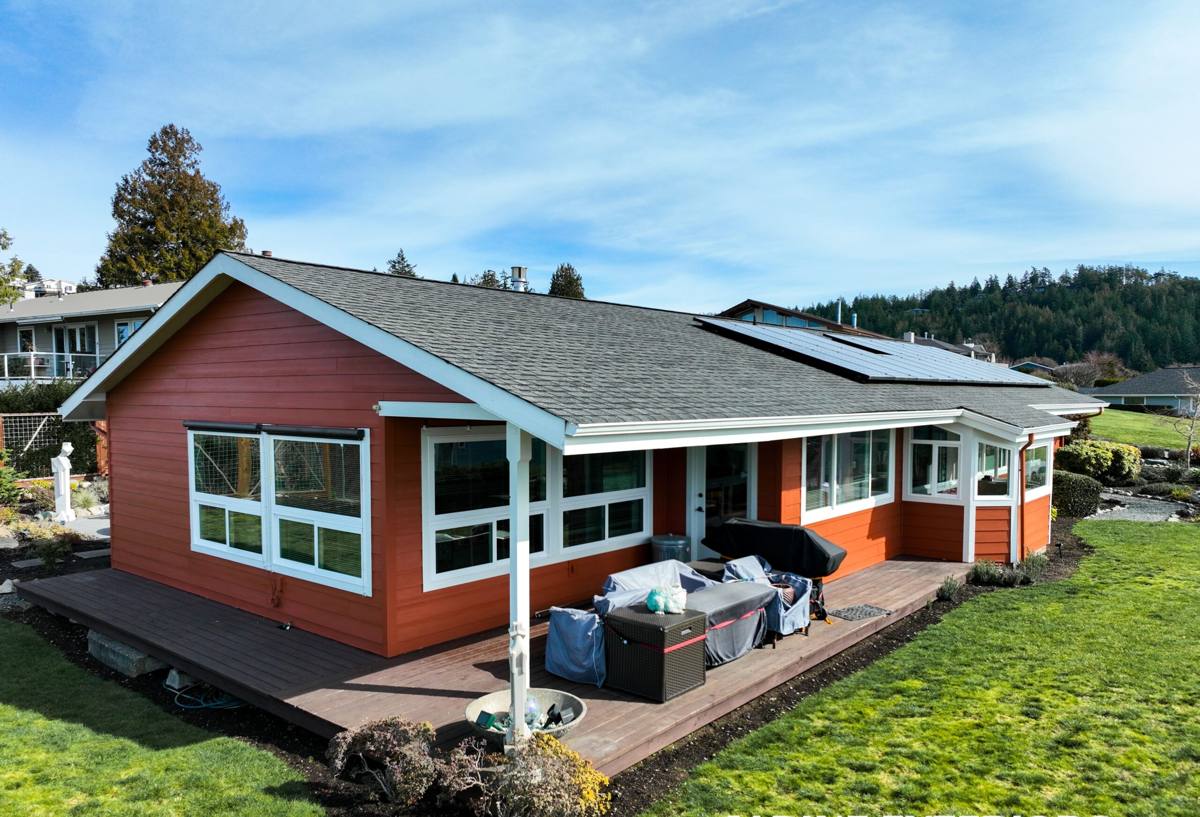
Point Roberts sits on its own point of land south of the 49th parallel, cut off from the rest of Whatcom County by water and by an international border that runs through the middle of the peninsula it shares with Canada. Getting siding materials and a crew here takes more planning than a job three miles down the road in Ferndale, and the exposure the house sits in once that crew arrives is more severe than almost anywhere else in the county — water on three sides, wide open to wind, with no real inland buffer. That combination is exactly why we're picky about what goes on the walls out here.
We install James Hardie fiber cement siding exclusively — no vinyl, no LP SmartSide, no Cemplank, Allura, primed spruce, or cedar. This page covers what Point Roberts homes specifically need from that siding, what a correct installation looks like given the local exposure, how the border and the isolation actually affect the job, and why a crew that already works this peninsula regularly gets a different result than one making its first trip out.
What Point Roberts' Exposure Does to a Home
Salt Air on Three Sides
Most of Whatcom County gets salt exposure in degrees — heavier near the water, lighter further inland. Point Roberts doesn't get that gradient. The peninsula is bordered by the Strait of Georgia and Boundary Bay, so salt-laden air reaches most properties here regardless of which direction a house faces. Salt accelerates corrosion in fasteners and flashing and breaks down lower-grade paints and finishes faster than a drier, more inland climate would. Siding and hardware chosen without that in mind tend to show it early — chalky finishes, rust bleeding from nail heads, trim that fails years ahead of schedule.
Wind-Driven Rain With Nothing to Break It
A narrow peninsula surrounded by open water has very little to slow wind before it hits a house. That turns ordinary rain into a sideways problem: water gets driven into lap joints, trim seams, and any spot where flashing isn't doing its job, rather than simply running down a wall and off. A siding system that performs fine on a sheltered inland lot can still fail here, not because the material itself is wrong, but because wind-driven rain finds every gap a calmer site would never expose.
A Long Moss and Mildew Season
Constant moisture and, on many lots, tree cover add up to a moss and mildew season that runs longer here than in the drier parts of the county. It shows up first on north-facing and shaded walls, and it's more than cosmetic — sustained organic growth holds moisture against the wall assembly, which is the condition that leads to rot behind the siding if it isn't cleaned off and addressed.
Seasonal Occupancy Adds Its Own Risk
A meaningful share of homes on this peninsula are part-time or seasonal residences. A vacant house doesn't get the day-to-day attention that catches a small leak, a failing seal, or an early moss patch before it becomes a bigger problem. Siding that's genuinely low-maintenance and doesn't depend on someone noticing a small issue right away matters more here than on a home somebody walks past every day.
Why We Standardized on James Hardie for This Peninsula
We used to install a wider range of siding products. We narrowed to one system after watching, repeatedly, which materials held up under sustained coastal exposure and which quietly didn't. For a property surrounded by water on three sides, the case for fiber cement over the alternatives is about as strong as it gets in our service area.
- Non-combustible core: Fiber cement doesn't feed a fire the way wood-based or wood-derived siding can, which matters for household safety and insurance underwriting alike.
- Factory-applied ColorPlus finish: The color is baked on under controlled conditions instead of brushed on in the field, so it holds up against salt exposure and UV far longer than site-applied paint — a real advantage on a home nobody may be checking on weekly.
- Climate-engineered HZ5 formulation: James Hardie's HZ5 product line is built for regions with heavy, sustained moisture exposure and freeze-thaw cycling, which is a close match for a Point Roberts property.
- Dimensional stability: Fiber cement doesn't swell, cup, or warp the way engineered wood siding can after repeated wet-season moisture cycles, and this peninsula's wet season runs long.
- Strong transferable warranty: Hardie backs its products with a robust warranty structure, provided the installation follows spec — real protection rather than a marketing line, and something worth having on a home that changes hands or gets used seasonally.
We don't install LP SmartSide, vinyl, Cemplank, Allura, primed spruce, or cedar. Every one of those has a place in the broader siding market and plenty of owners who are satisfied with it elsewhere. But on a peninsula with this much sustained salt and wind exposure and a real chance the house sits unattended for stretches at a time, we made a professional call that one material we trust completely is worth more than a cheaper option that quietly shifts maintenance risk onto a homeowner who may not be around to catch it early.
| Factor | James Hardie Fiber Cement | Vinyl / Engineered Wood |
|---|---|---|
| Salt air resistance | Inorganic material and factory finish resist salt-driven degradation | Vinyl chalks and can become brittle; engineered wood's coating is the only real barrier |
| Wind-driven rain | Rigid boards with engineered clearances and lapped joints | Vinyl panels can loosen or rattle under sustained wind; wood-fiber cores depend on every seal holding |
| Moisture tolerance during vacancy | Doesn't absorb water into the material itself | A missed small leak has more room to do damage before anyone notices |
| Fire behavior | Non-combustible | Vinyl can melt/deform; wood-based products can burn |
| Long-term finish | Factory ColorPlus, 15-year finish warranty | Field paint or factory coatings wear faster under salt and UV |
What a Correct Installation Involves Here
Material choice only gets a Point Roberts home halfway there. The rest comes down to installation detail, and on an exposed peninsula lot those details show up faster than they would on a sheltered inland site.
Fastening for Real Wind Exposure
Corrosion-resistant fasteners, driven to the correct depth and spacing, are non-negotiable on a lot this exposed. Overdriven nails, wrong fastener spacing, or face-nailing where the spec calls for blind nailing all reduce how the siding handles wind load — and this peninsula sees more sustained wind than most of the county's inland neighborhoods.
Clearances and Water Management
Fiber cement has to be held off grade, decks, roofs, and other horizontal surfaces by the manufacturer's specified clearances. A board butted too tight against a deck ledger or a roofline is a moisture trap that wicks water into the cut edge over years — a slow failure that's easy to miss until it isn't.
Flashing and the Water-Resistive Barrier
The siding is the visible layer, not the waterproofing. A properly lapped weather-resistive barrier, correctly integrated window and door flashing, and kick-out flashing at every roof-to-wall intersection are what actually keep wind-driven rain from reaching the sheathing. These details don't appear on a siding estimate as a line item, but they're the difference between a wall that performs through a winter storm season and one that rots quietly from the inside.
Cut-Edge Sealing and ColorPlus Touch-Up
Every field cut on ColorPlus-finished board has to be sealed or touched up with the manufacturer's approved product — not whatever's sitting in the truck. It's a small step, but it's exactly the kind of detail that separates a crew that lives in this material from one treating it like any other board.
The Border Factor: Why a Crew That Already Works Point Roberts Matters
Point Roberts has no land connection to the rest of Whatcom County — reaching it by road means driving through Canada. That's a fact of life for anyone who lives here, and it's also something a siding job has to plan around. A crew and its equipment cross an international border to get to the site and cross it again to leave, which means trip planning, vehicle and tool considerations, and border wait times all become real scheduling variables in a way they simply aren't for a job in Ferndale, Lynden, or Blaine.
Material logistics work the same way. Getting a full pallet of siding, trim, and flashing components to the peninsula on the timeline a job needs takes coordination that a contractor unfamiliar with the route figures out for the first time on your project — usually at the cost of delays or a scramble mid-job. A crew that already works Point Roberts regularly has that routine solved before your estimate is even scheduled: how far ahead materials need to be staged, which crossing windows work best for a loaded truck, and how to keep a multi-day install from stalling out because a delivery got held up.
None of this changes the codes involved — Point Roberts falls under the same Whatcom County permitting and Washington State building requirements as the rest of the county, despite the physical separation. What it changes is reliability: whether the crew shows up on the day they said they would, whether materials are on site when needed, and whether a job that should take a certain number of days doesn't quietly stretch out because nobody accounted for the border in the schedule.
Cost Factors for a Point Roberts Siding Project
| Factor | What It Affects | Why It Matters Here |
|---|---|---|
| Material delivery logistics | Scheduling and staging | Materials have to be planned and moved across the border ahead of the crew, not ordered last-minute |
| Tear-off vs. overlay | Labor scope and substrate access | Tear-off reveals hidden moisture damage that's common under older siding on exposed lots |
| Substrate condition | Repair costs before new siding goes on | Long-term trapped moisture can rot sheathing and framing, especially behind poorly flashed sections |
| Wind exposure and fastening spec | Fastener type, spacing, and labor time | Open peninsula lots often call for tighter fastening attention than sheltered inland sites |
| Occupancy status | Scheduling flexibility and access | Seasonal or vacant homes may need different coordination for site access and material drop-off |
Exact numbers depend on the specific property, its exposure, and what tear-off reveals — which is why we walk the home in person before giving a real figure instead of quoting off a generic price sheet.
Signs Your Point Roberts Home's Siding Needs Attention
- Moss or dark staining that returns quickly after cleaning, especially on shaded or north-facing walls
- Soft or spongy siding low on the wall, around window trim, or near a deck ledger
- Rusting fasteners, corroding flashing, or chalky, faded finishes
- Cracked, chipped, lifted, or missing siding sections after a winter storm
- Visible gaps at seams, corners, or window and door trim
- Any of the above on a home you don't see regularly — seasonal properties often need a dedicated exterior check rather than relying on someone noticing
What to Expect When You Hire Us
Every project starts with a site visit and an honest look at the existing siding and what's likely underneath it, including a candid conversation about scheduling given the border and the material logistics involved. The written estimate spells out scope, product line, and warranty terms up front, with no surprise mid-job delivery delays because the routing was already worked out before we started. During installation, the crew follows James Hardie's published fastening, clearance, and flashing spec — not a shortcut version — and we document the flashing and moisture-barrier work before it's covered by siding. At the end, you get the manufacturer's warranty documentation along with our workmanship warranty in writing.
If you own a home on Point Roberts and you're weighing new siding, or you have an existing installation you'd like an honest second opinion on, we're glad to make the trip. The estimate is free, there's no pressure attached to it, and you can get started with the form below.