 Ferndale
 Why Siding Repair Looks Different Out Here Than in a Dry Climate
A siding repair call in the Nooksack area is rarely just about the one cracked or buckled board a homeowner noticed. Whatcom County's marine climate — driving rain that comes in sideways during fall and winter storms, salt-tinged air carried inland off Bellingham Bay and the Strait, and a moss season that can run eight or nine months out of the year — works on a house continuously, not just during the one afternoon a homeowner happens to be looking at it. By the time damage is visible from the ground, there's usually a smaller story underneath it: a nail popped loose, a caulk joint that gave up two winters ago, or a section of house wrap that's been letting water track sideways behind the cladding.
That's the mindset a repair job needs. Replace the damaged board and ignore the cause, and the same spot fails again in a year or two. Diagnose the cause and fix it along with the board, and the repair actually holds.
What driving rain does to a wall system over time
Wind-driven rain doesn't just wet the outer face of siding — it pushes moisture up under laps, into fastener holes, and along any gap in caulking or trim. On a well-built wall, that moisture is supposed to hit a drainage plane and run back out. On a wall where the water-resistive barrier has been compromised, punctured, or installed with shortcuts, water gets trapped against the sheathing instead. That's when you start seeing soft trim, staining that keeps coming back after cleaning, or siding that looks fine but flexes or feels spongy when you press on it.
Moss season and what it means for repairs, not just roofs
Homeowners usually think of moss as a roof problem, but it's a siding problem too. Moss and algae hold moisture directly against the cladding surface for months at a stretch, especially on north-facing walls and anywhere tree cover blocks sun and airflow. On materials that aren't dimensionally stable or that absorb water readily, that constant damp contact accelerates rot, delamination, and finish failure. A repair on a shaded wall in this area has to account for the fact that the wall will stay wet longer than a south-facing wall does — that changes what materials and details make sense for the fix.
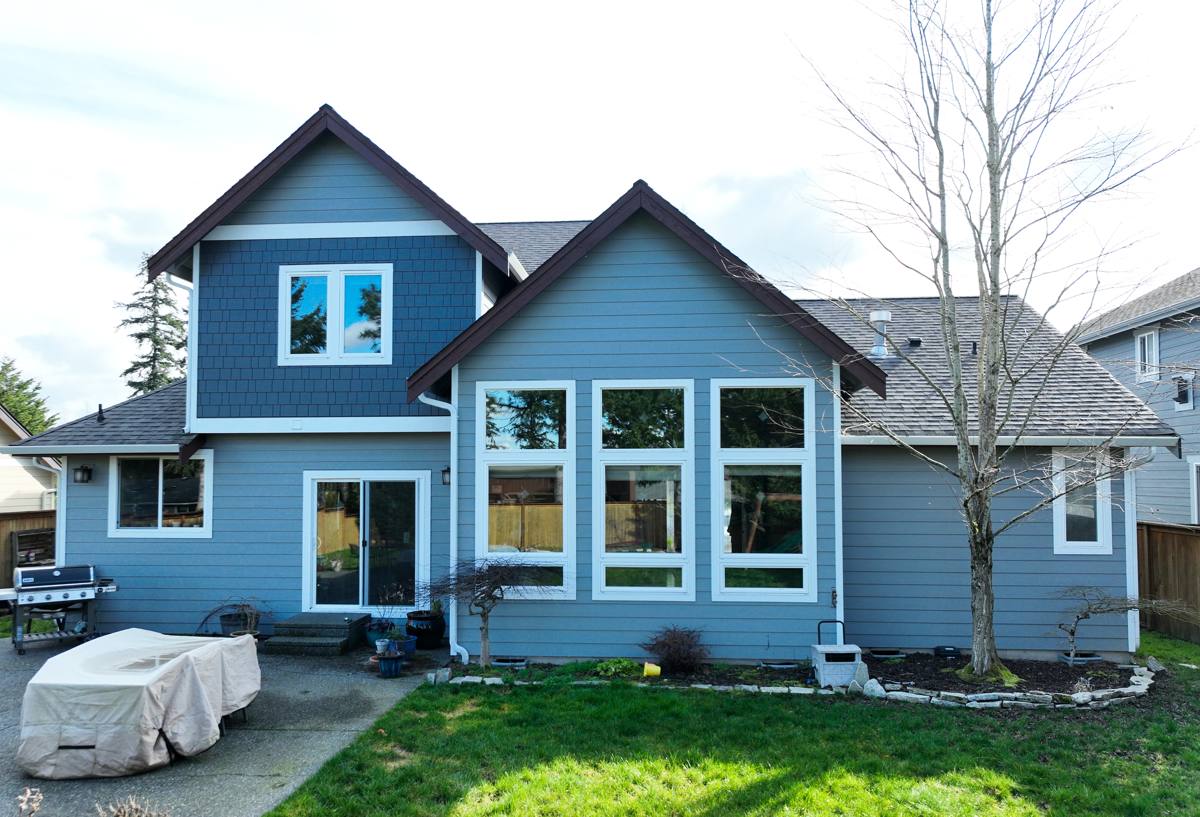
Signs a Repair — Not a Full Replacement — Is the Right Call
Not every siding problem means the whole house needs to come off. A lot of what we see in the Nooksack area is isolated damage that a correct, targeted repair can solve for a fraction of the cost of full replacement. The judgment call is figuring out whether the rest of the siding and the water management behind it are still sound.
- Damage is limited to one or two wall sections, not spread across multiple elevations
- The rest of the siding is still flat, tight, and free of soft spots when pressed
- Paint or factory finish elsewhere on the house is holding up, not chalking or peeling broadly
- There's no widespread evidence of moisture behind the cladding — no musty smell, no interior staining, no soft sheathing at multiple points
- The damage has an identifiable cause (impact, a failed flashing detail, a rotted trim board) rather than age-related failure across the whole wall
- The house is less than 15-20 years from its last full re-side, depending on the original material
If damage is scattered across several elevations, or if pulling one board reveals soaked sheathing behind it, that's usually a sign the whole wall system needs a closer look before we commit to patch-and-go.
What a Correct Siding Repair Actually Involves
A repair done right is more than swapping a board. It's a small version of the same water-management thinking that goes into a full installation.
Matching material behavior, not just color
Whatever is going back on the wall has to move, absorb, and weather the same way as what's already there — otherwise you get a patch that looks fine on install day and stands out (or fails differently) within a season or two. This is one of the reasons repair work on older cedar, vinyl, or LP-style siding gets complicated: matching an aged, weathered board with new material of the same type rarely looks or performs the same for long. In a lot of cases, especially where the damaged section already shows the kind of wear those materials are prone to in this climate, we'll walk the homeowner through replacing that section with James Hardie fiber cement instead of patching like-for-like — not because the original product is worthless, but because it's the more durable, honest fix for the section that's failing.
Water management: the parts you don't see
Every repair we do treats the house wrap, flashing, and fastening underneath the board as part of the job, not an afterthought. That means correcting the water-resistive barrier where it's torn or improperly lapped, re-flashing around windows, doors, or penetrations where the original detail failed, and re-fastening according to spec rather than just tacking the new piece up. Skipping this step is the single most common reason a "repaired" spot fails again.
Repair vs. Replace: Weighing the Real Cost Factors
| Factor | Favors Repair | Favors Full Replacement |
|---|---|---|
| Extent of damage | Isolated to one or two areas | Spread across multiple walls |
| Age of existing siding | Under 15 years, or Hardie already installed | Original siding near or past its service life |
| Condition behind the cladding | Sheathing and wrap intact | Rot or moisture found at multiple points |
| Material match | Newer Hardie ColorPlus boards, easy color match | Older cedar, vinyl, or faded/discontinued color |
| Upfront cost | Lower, targeted spend | Higher, but resets the clock on the whole wall |
| Long-term cost | Lower if root cause is fixed with the repair | Lower over 20+ years if existing siding is already failing broadly |
The honest answer for most homeowners in the Nooksack area falls somewhere on this table rather than at either extreme — which is exactly why a real inspection matters more than a phone estimate.
Why We Rebuild Damaged Sections in James Hardie Fiber Cement
We only install James Hardie fiber cement, on repairs and full re-sides alike. When a repair calls for new material, that's what goes on the wall — not a mismatched patch in the original product, and not a lower-cost substitute. Hardie is non-combustible, dimensionally stable in the kind of freeze-thaw and wet-dry cycling this region sees, and its ColorPlus factory finish is engineered to hold color and resist the moss, algae, and moisture staining that plague painted wood and softer materials out here. It also carries a strong transferable warranty when installed to spec, which matters on a repair as much as a full job — a patch is only as good as what backs it up years later.
That standard means we won't always give a homeowner the cheapest possible patch. What we will give them is a repair that's built to actually last through Whatcom County winters, not just look finished on the day we leave.
Our Process for a Nooksack-Area Repair Call
- Walk the affected wall (and the rest of the exterior) to find the visible damage and check for signs it's connected to a larger moisture issue
- Pull back the damaged section to inspect the house wrap, flashing, and sheathing underneath before quoting anything
- Give the homeowner a straight answer on repair vs. replacement, with the reasoning, not just a number
- Correct any water-management issue found — torn wrap, bad flashing laps, missing kick-out flashing — as part of the repair, not a separate change order
- Install matched or color-coordinated James Hardie material, fastened and finished to manufacturer spec
- Walk the finished repair with the homeowner and explain what to watch for going forward
Why a Crew That Already Works This Area Matters
Repair work rewards local knowledge in a way full re-sides sometimes don't. Knowing which wall orientations in the Nooksack area hold moss longest, which detailing tends to fail first on homes exposed to wind off the river corridor, and how the local moss and rain pattern actually behaves season to season all shape how we diagnose a problem before we ever touch a board. A crew that's out here regularly also isn't guessing at drive time or treating a repair call as a one-off — we can get eyes on a problem, quote it honestly, and come back to finish it without the scheduling gaps that make small jobs drag on for months.
Keeping Repaired Siding Ahead of the Next Wet Season
A good repair buys time, but a little upkeep protects that investment. Homeowners in the Nooksack area get the most life out of repaired siding by rinsing off moss and algae buildup before it takes hold, keeping gutters and downspouts clear so runoff isn't dumping directly onto walls, trimming back vegetation that keeps a wall shaded and damp, and doing a quick visual check each fall for caulk lines or trim that have opened up before winter storms arrive. None of that requires a contractor — it just requires doing it before the wet season, not after.
If you're seeing damage, staining, or soft spots on your siding, we're happy to take a look and give you a straight answer on what it actually needs. Fill out the form below for a free, no-pressure estimate — there's no obligation, just an honest assessment from a crew that already works this area.