 Ferndale
 What Sumas Homes Are Actually Up Against
Sumas sits out toward the edge of Whatcom County, close enough to the water and the foothills that its houses take a different kind of beating than siding was designed for in a catalog photo. It isn't one big storm that wrecks siding out here — it's the accumulation of small things happening every single day of the year. Salt-laden air moves inland and settles on exterior surfaces. Driving rain, pushed sideways by wind rather than falling straight down, gets forced into every lap, seam, and fastener hole that isn't detailed correctly. And then there's the moss — a season that in this part of Washington isn't really a season at all, it's most of the year, and it turns any siding product with the wrong surface texture or drainage plane into a slow-growing green problem.
None of this is exotic. It's just relentless. The siding that holds up in Sumas isn't the siding that looks best on day one — it's the siding that's still doing its job in year fifteen without the homeowner having repainted, recaulked, or replaced boards twice in between.
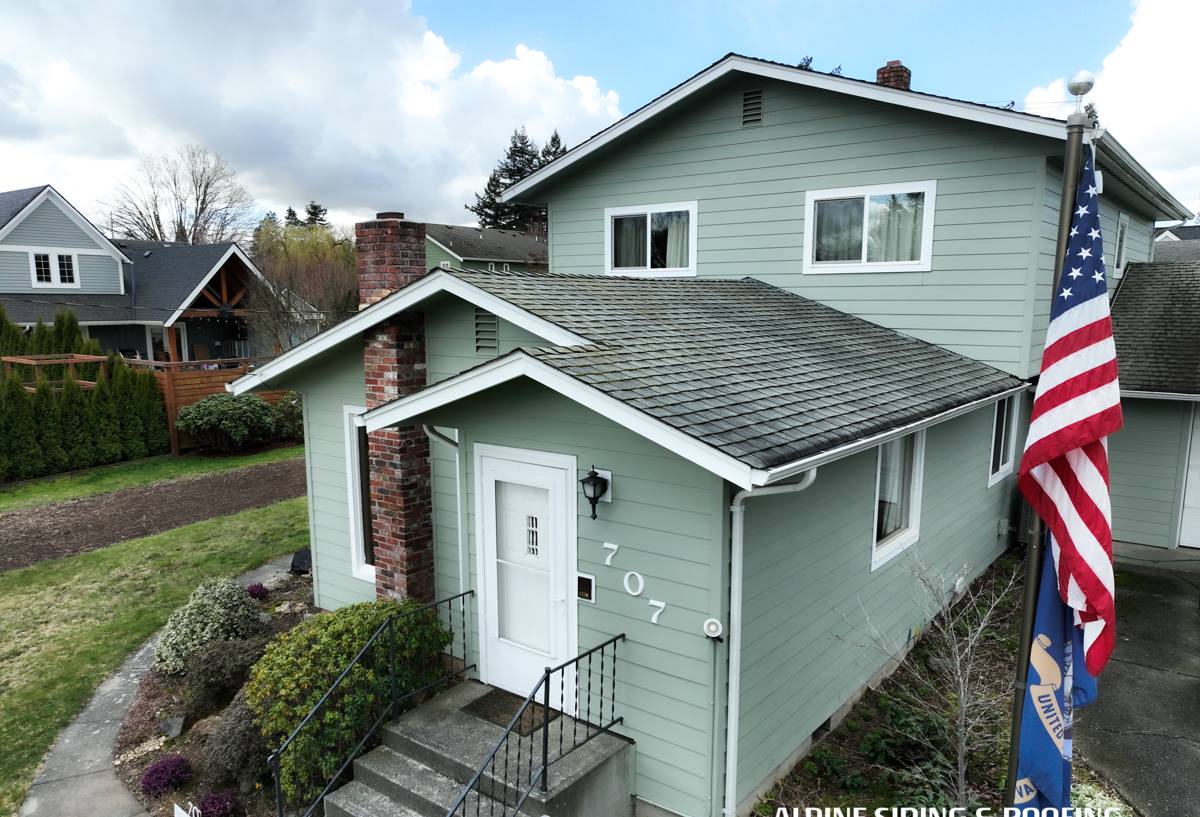
Why We Only Put James Hardie on Sumas Homes
We install James Hardie fiber cement siding exclusively. Not vinyl, not LP SmartSide, not cedar, not primed spruce. That's not a marketing position — it's a standard we set after seeing how differently these products age once they're actually exposed to a Pacific Northwest coastal climate for a decade or more.
Fiber cement is non-combustible and dimensionally stable, meaning it doesn't expand and contract with moisture the way wood-based products do, and it doesn't soften or deform under sustained damp the way some engineered wood products can if a seam ever fails. James Hardie's ColorPlus finish is baked on at the factory under controlled conditions, which gives it better adhesion and UV resistance than field-applied paint — a real advantage in an area that alternates between salt-humid air and long stretches of low winter sun. And Hardie backs its siding with a substantial, transferable limited warranty, which matters to anyone who might sell the home down the road.
What This Means Day to Day for a Sumas Homeowner
- No annual repainting cycle driven by peeling or fading — the factory finish is built to go much longer between touch-ups
- A hard, mineral-based surface that doesn't feed mold and mildew the way organic wood fiber can
- Panels that stay flat and true against the wall line instead of cupping or bowing after repeated wet-dry cycles
- A fire-resistant exterior, which matters given how often Washington summers now bring wildfire smoke and ember risk even on the west side of the state
The Right Hardie Product Line for This Climate
James Hardie makes climate-engineered product lines, and picking the right one for Whatcom County isn't optional. HZ5 formulations are engineered for regions with the freeze-thaw and moisture cycling common to the Pacific Northwest — different from the HZ10 lines built for hot, humid southern climates. Getting this wrong doesn't cause an immediate failure; it shows up years later as a product that wasn't quite matched to the moisture load it's carrying.
| Factor | What It Means for Sumas Homes |
|---|---|
| Climate zone formulation | HZ5-engineered Hardie products are matched to Pacific Northwest moisture and temperature swings |
| Salt air exposure | Factory-cured fiber cement resists the surface breakdown that salt-laden air accelerates on painted wood or vinyl |
| Driving rain exposure | Correct lap, flashing, and drainage-plane detailing matters more here than in sheltered inland areas |
| Moss and organic growth | Hardie's mineral composition doesn't feed mold/mildew growth the way wood-based sidings can |
| UV and winter light cycling | ColorPlus factory finish resists fading and chalking better than field-applied paint over many seasons |
Where a Siding Job Actually Fails
Almost every siding failure we get called out to inspect in this climate isn't a product failure — it's a detailing failure. Fiber cement siding, including James Hardie, is only as good as the water management system built behind and around it. In a driving-rain environment like this, the parts nobody sees are what determine whether the wall stays dry for the next thirty years.
What a Correct Installation Involves
- Proper weather-resistive barrier installed and lapped correctly before a single board goes up
- Flashing at every window, door, and roofline intersection — not caulk used as a substitute for flashing
- Correct minimum clearance from grade, decks, and roof lines so splashback and ponding water can't wick into the bottom course
- Fasteners placed per Hardie's published nailing pattern and driven flush, not overdriven, which cracks the board's edge and opens a moisture path
- Butt joints sealed or flashed per manufacturer spec rather than just caulked and painted over
- Rainscreen or proper air gap where the wall assembly calls for one, so bulk water has somewhere to drain and the wall can dry
A crew unfamiliar with coastal Whatcom County conditions can install Hardie siding that looks correct and still leaks in three years, because the visible board was never the weak point — the flashing detail behind it was.
Our Process on a Sumas Project
1. Walk the Home and Assess the Existing Wall
Before we talk about siding color or board profile, we look at what's underneath the current siding — sheathing condition, existing moisture damage, trim and window flashing condition. This tells us whether it's a straight re-side or whether repair work needs to happen first.
2. Product and Profile Selection
We walk through Hardie's plank, panel, and shingle-style options and colors, matched to the HZ5 climate formulation appropriate for this area, and to how exposed the specific elevation is to prevailing wind-driven rain.
3. Removal and Wall Prep
Old siding comes off, the sheathing gets inspected and repaired where needed, and the weather-resistive barrier and flashing details go in correctly before anything new is hung.
4. Installation to Manufacturer Spec
Boards are hung following James Hardie's published installation instructions for fastening, clearance, and joint treatment — not a generic siding install applied to a fiber cement product.
5. Final Walkthrough
We go over caulking, trim, and paint lines with the homeowner before calling the job done, and explain what little maintenance the finished product will actually need going forward.
Maintenance Through a Long Moss Season
One of the real advantages of correctly installed James Hardie siding in this climate is how little upkeep it demands compared to wood or vinyl. It won't feed moss and mildew growth the way organic materials can, but the broader exterior — gutters, downspouts, roofline, and any shaded north-facing walls — still needs the normal seasonal attention any home in Whatcom County requires.
- Rinse siding down once or twice a year to clear pollen, road film, and airborne salt residue — a garden hose is usually enough
- Keep gutters and downspouts clear so water isn't sheeting down the wall face during heavy rain events
- Trim back vegetation and tree cover that keeps any wall section shaded and damp longer than the rest of the house
- Recaulk trim joints on the manufacturer's recommended cycle, not on a "when it looks bad" basis
- Inspect after major windstorms for any impact damage or loosened trim, especially on exposed gable ends
Cost Factors on a Sumas Siding Project
| Factor | Why It Moves the Price |
|---|---|
| Home size and wall complexity | More corners, dormers, and cutouts mean more cut waste and labor time |
| Existing wall condition | Sheathing repair or rot remediation adds cost beyond straight re-siding |
| Product line and profile | Lap, panel, and shingle-style Hardie products carry different material costs |
| Trim and accessory work | Corner boards, window trim, and fascia detailing add labor and material |
| Access and site conditions | Steep grades, tight lot lines, or multi-story walls affect equipment and labor time |
Why Hiring a Crew That Already Works This Area Matters
James Hardie siding installed correctly in a mild inland climate and James Hardie siding installed correctly in Sumas aren't quite the same job. The product is the same; the detailing discipline around flashing, clearance, and drainage has to be more careful here because the consequences of getting it wrong show up faster in a driving-rain, salt-air environment. A crew based out of Ferndale that regularly works Whatcom County homes has already seen how local wall assemblies, roof lines, and exposure conditions behave over multiple wet seasons — that's knowledge that doesn't come from a manufacturer's install manual alone, it comes from being back out on these same streets for warranty checks and follow-up work over the years.
It also means we're not commuting in from out of the area to do a one-off job and then disappearing. If a question comes up two years after installation, we're still local and still reachable.
If your Sumas-area home is due for new siding, we're happy to walk the property, look at what's actually going on with the current exterior, and give you a straightforward, no-pressure estimate — no obligation, just an honest look at what the house needs.