 Ferndale
 Roofing on the Water Takes a Different Approach
Semiahmoo sits right up against the water, and that changes what a roof has to deal with compared to a house a few miles inland. Salt-laden air corrodes exposed metal faster, onshore wind drives rain sideways into laps and flashing that would otherwise stay dry, and the shade and dampness that come with a long Pacific Northwest moss season give algae and moss a head start they don't get in drier, sunnier spots. None of this means asphalt shingles are the wrong choice for a Semiahmoo home — they're still one of the most practical, cost-effective roofing systems available. It means the installation has to account for the environment instead of following a generic, one-size-fits-all approach.
We've worked roofs across Whatcom County, and waterfront and near-waterfront properties like the ones around Semiahmoo get a different level of attention from us on fasteners, flashing, and ventilation than a roof in a more sheltered part of Ferndale would. That's not upselling — it's just what holds up out here.
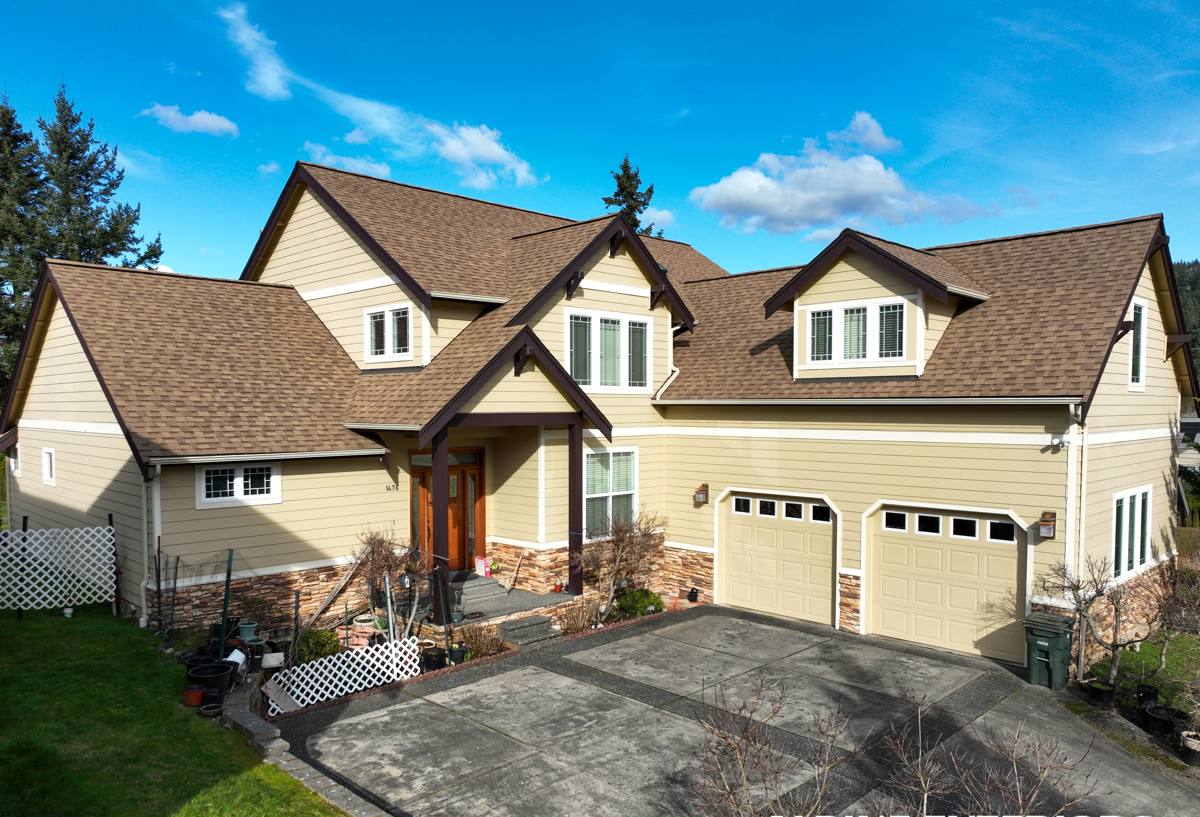
What Semiahmoo's Climate Actually Does to a Roof
Salt Air and Corrosion
Airborne salt accelerates corrosion on anything metal — nail heads, flashing, gutter fasteners, vent caps. On a standard roof a few miles from the water this is a minor factor. Close to Semiahmoo's shoreline, it's one of the first things we plan around, because a roof isn't just the shingles — it's dozens of small metal components that all have to survive the same conditions for the shingles above them to matter.
Driving Rain and Wind-Driven Water
Wind off the water pushes rain at angles a calm-weather roof never has to handle. Water gets forced sideways and upward under shingle edges, into valleys, and around any penetration — vent pipes, chimneys, skylights. A roof that's watertight in a still rain can still leak in a wind-driven one if the underlayment and flashing details weren't built for it.
Moss and Algae
Cooler, damp, shaded conditions in this part of Whatcom County give moss and algae a long growing season. Left unchecked, moss holds moisture against the shingle surface, works its way under shingle edges, and can lift them enough to let water in. Algae staining is mostly cosmetic, but a moss mat is a real cause of premature shingle failure.
What a Correctly Installed Roof Needs Here
A shingle roof that's going to hold up near Semiahmoo needs a few things done right that get skipped more often than they should on a rushed job:
- Corrosion-resistant fasteners and flashing metals suited to a marine-influenced environment, not the cheapest option on the truck
- A synthetic or ice-and-water underlayment at eaves, valleys, and around penetrations — not just felt paper across the whole deck
- Properly lapped and sealed flashing at every wall intersection, chimney, and vent, sized for wind-driven rain rather than straight-down rain
- Balanced intake and exhaust ventilation so moisture from inside the house doesn't condense against the roof deck
- A shingle line rated for algae resistance, since standard shingles will streak faster in this climate
- Attention to shingle nailing pattern and exposure — under-driven or over-driven nails are a leading cause of early failure in windy, wet climates
Skip any one of these and the roof might look fine for a couple of years before the shortcuts show up as a leak, a stain, or shingles lifting at the edges.
Choosing the Right Shingle for This Location
Not every asphalt shingle product is built the same way, and for a Semiahmoo home the differences that matter most are algae resistance, wind rating, and how forgiving the shingle is to install correctly in wet, breezy conditions. We steer homeowners toward algae-resistant, higher wind-rated shingle lines out here — not because cheaper three-tab shingles are bad products everywhere, but because they give up margin in exactly the conditions this location has the most of.
| Shingle Type | Typical Wind Rating | Algae Resistance | Best Fit for Semiahmoo |
|---|---|---|---|
| Standard 3-tab | 60-70 mph | Standard, without added granule treatment | Budget option; needs more frequent moss/algae upkeep |
| Architectural (laminate) | 110-130 mph | Available with algae-resistant granules | Best balance of durability, appearance, and value for this area |
| Premium/designer laminate | 130+ mph | Algae-resistant granules standard on most lines | Strongest option for full waterfront exposure |
For most Semiahmoo homes, a mid-to-upper architectural shingle with algae-resistant granules and a wind warranty matched to the site's exposure is the right balance of cost and long-term performance. We'll walk the roof and talk through the actual tradeoffs for your specific home rather than defaulting to one product for every job.
Our Process for a Semiahmoo Roofing Project
1. On-Site Assessment
We start by walking the roof, checking the deck condition, current ventilation, and existing flashing details, and looking at how the house sits relative to wind and water exposure. That assessment drives the material and detailing recommendations, not the other way around.
2. Tear-Off and Deck Inspection
Old roofing comes off down to the deck so we can actually see what's underneath — soft or water-damaged sheathing gets replaced before anything new goes down. Covering over a compromised deck is how a new roof ends up with old problems.
3. Underlayment and Flashing First
This is where most of the long-term protection actually comes from. We install synthetic underlayment across the field, ice-and-water membrane at eaves and valleys, and new flashing at every wall, chimney, and penetration — sized and lapped for wind-driven rain.
4. Shingle Installation
Shingles go down to manufacturer nailing specs, with attention to exposure and sealing in the coastal wind conditions common around Semiahmoo. Ridge and hip details and ventilation components are installed as part of the same system, not treated as an afterthought.
5. Final Walkthrough
We walk the finished roof with you, confirm ventilation and flashing details, and make sure gutters and downspouts are clear and functioning before we call the job done.
Ventilation and the Details Most Roofs Get Wrong
Ventilation gets overlooked constantly, and it matters more in a damp climate than a dry one. Warm, moist air from inside a house rises into the attic; without balanced intake (soffit vents) and exhaust (ridge or roof vents), that moisture condenses against the underside of the roof deck. Over a wet Whatcom County winter, that can rot sheathing from the inside while the shingles above look fine. Correct ventilation also keeps attic temperatures more even, which extends shingle life and reduces the ice-damming risk during cold snaps.
Flashing is the other detail that separates a roof that lasts from one that doesn't. Step flashing at wall intersections, counter-flashing at chimneys, and properly formed valley metal all have to be installed in the right sequence with the underlayment and shingles — not caulked over as a shortcut. Caulk is a maintenance item, not a flashing system.
What Drives the Cost of a Semiahmoo Roofing Project
| Factor | Why It Matters Here |
|---|---|
| Roof size and pitch | Steeper roofs and more complex rooflines take longer to flash correctly and increase material waste |
| Deck condition | Rot or soft sheathing found during tear-off adds repair cost but is far cheaper to fix now than later |
| Shingle line chosen | Algae-resistant, higher wind-rated architectural shingles cost more per square than basic 3-tab |
| Flashing scope | Homes with chimneys, skylights, or multiple roof planes need more custom flashing work |
| Ventilation upgrades | Adding or correcting intake/exhaust venting is inexpensive during a full re-roof, costlier after |
| Wind and salt exposure | Fully exposed sites near the water may justify higher-spec fasteners and flashing metal |
We give straightforward, itemized estimates so you can see exactly what you're paying for and where the money is going — not just a single lump-sum number.
Maintaining an Asphalt Shingle Roof Near the Water
A well-installed roof still needs periodic attention in this climate. A short seasonal checklist goes a long way:
- Clear moss and debris from the roof surface and valleys before it has a chance to mat down
- Keep gutters and downspouts clear so water isn't backing up under the shingle edge
- Check flashing around chimneys, vents, and skylights for gaps or lifted edges once a year
- Trim back branches that keep shade and moisture sitting on the roof surface
- Have a professional look at the roof after any major windstorm, not just when a leak shows up
Catching a lifted shingle or a small flashing gap early is a small repair. Left through a couple of wet seasons, it's a deck replacement.
Why Local Experience Matters for This Job
A roofing crew that hasn't worked this specific stretch of Whatcom County waterfront doesn't always know how much wind and salt exposure a Semiahmoo home actually sees, or which flashing and fastener choices hold up here versus a few miles inland. We've built our process around what actually fails on roofs in this area — and just as important, what doesn't need to be replaced or upsold. That's the difference between a roof that's technically installed to code and one that's actually built for where it sits.
If you're weighing a repair against a full replacement, or just want a straight answer on what your roof actually needs, we're glad to take a look. Reach out for a free, no-pressure estimate using the form below — we'll walk the roof, tell you what we see, and lay out your options plainly.