 Ferndale
 Why Point Roberts Homes Are Hard on Windows
Point Roberts sits out on its own peninsula, surrounded by water on three sides, which means every window in a home there is dealing with more than the average Whatcom County house. Salt-laden air off the Strait of Georgia and Boundary Bay works on metal hardware and finishes year-round. Driving rain off the water finds any weak seal or aging flashing detail. And the long, damp shoulder seasons that define this part of Washington keep window sills, frame corners, and north-facing glazing wet enough, long enough, for moss and mildew to take hold. None of this is dramatic on its own, but stacked together over years it is exactly what wears out a window system before its time.
Energy-efficient windows done right in this environment aren't just about lower heating bills, though that matters. They're about a frame, seal, and glazing package that can actually stand up to what a coastal Whatcom County winter throws at a house, without turning into a maintenance headache or a moisture problem behind the wall.
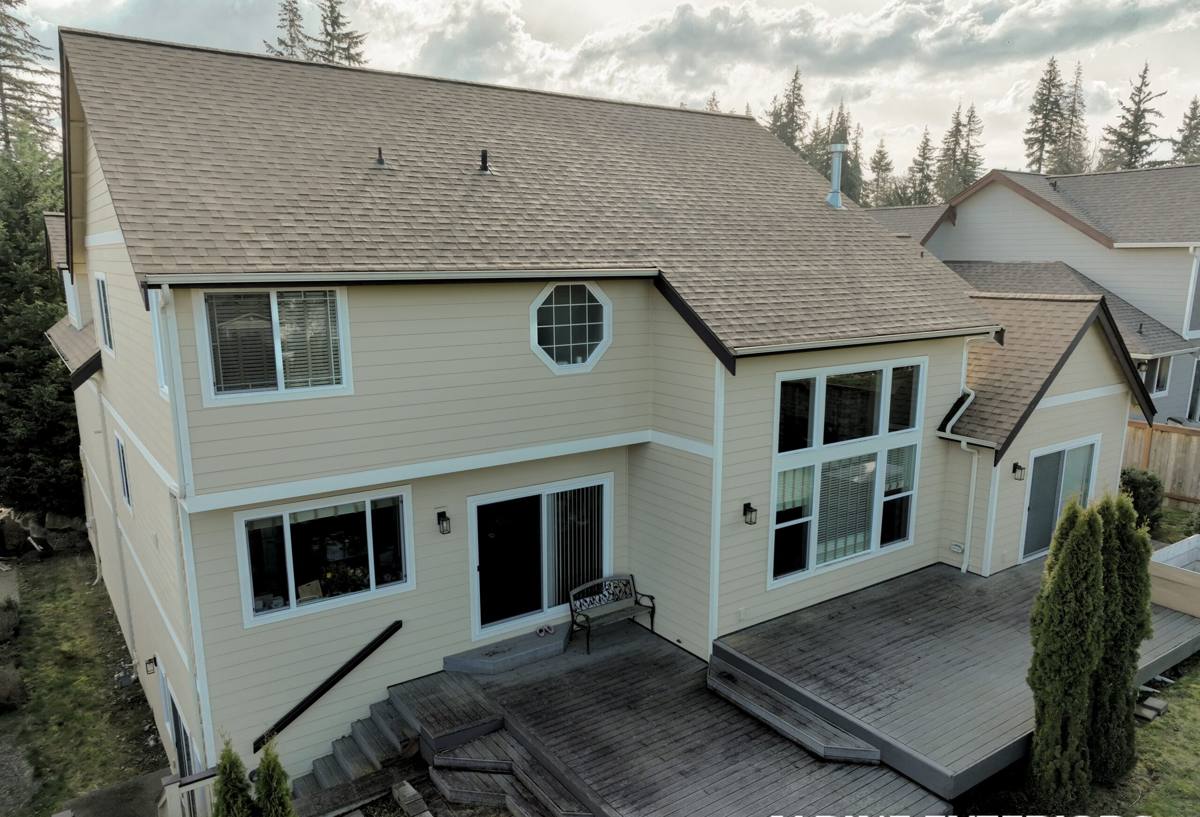
What "Energy-Efficient" Actually Means for This Climate
A lot of window marketing leans on U-factor and SHGC ratings, and those numbers matter, but they're only half the story for a place like Point Roberts. The other half is how well the window resists wind-driven rain and salt exposure without the seals, hardware, or finish degrading faster than the glass package itself.
Glazing and Gas Fill
Double-pane windows with a low-emissivity (Low-E) coating and an argon gas fill are the baseline we work with for this area. The Low-E coating reflects radiant heat back into the room in winter and blocks solar heat gain in summer, and the argon fill slows heat transfer between panes. For homes with more direct exposure to wind and water, we'll talk through whether a higher-performance glazing package is worth the added cost, since the payback depends on how the home is oriented and how much of the exterior is exposed.
Frame Performance
Frame material matters as much as glass in a marine climate, because the frame is what's absorbing wind pressure, moisture cycling, and salt exposure day after day. We'll cover frame options in more detail below, but the short version is that not every frame material that performs well inland holds up the same way this close to salt water.
Frame Material Comparison for a Marine Climate
| Material | Salt Air / Moisture Behavior | Maintenance | Typical Fit for Point Roberts |
|---|---|---|---|
| Vinyl | Won't corrode or rot; UV-stable formulations hold up well over time | Low — occasional cleaning | Strong general-purpose choice for most homes |
| Fiberglass | Excellent dimensional stability, resists moisture-driven warping | Low | Good option for higher-exposure walls facing open water |
| Wood or wood-clad | Attractive but needs a well-maintained exterior cladding/finish to keep moisture out of the core | Higher — finish upkeep required | Workable with a disciplined maintenance plan, more exposure risk near the water |
| Aluminum | Prone to corrosion and condensation in salt air without a marine-grade finish | Moderate to high | We steer most clients away from this on high-exposure walls here |
We're not tied to one brand or one material for every job. The right call depends on which side of the house the window is on, how much direct weather it takes, and what the homeowner wants to maintain over the next 15-20 years. Our job is to lay out the honest trade-offs, not push whatever's easiest to install.
Signs Your Current Windows Are Underperforming
Homeowners in Point Roberts often notice a problem long before they can name it. Some common signs worth a closer look:
- Cold drafts near the window frame even when it's fully latched
- Condensation building up between panes, which usually means a failed seal
- Visible moss, algae, or black staining on the sill or lower frame corners
- Wood trim or sills that feel soft or spongy to the touch
- Hardware (latches, cranks, hinges) that's stiff, corroded, or won't fully seat
- A noticeable jump in heating costs compared to similar homes nearby
- Noise from wind or rain that seems louder than it should be
Any one of these on its own might not mean much. Several together, especially on the water-facing side of a house, usually means it's time for a real assessment rather than another round of caulk.
What a Correct Installation Involves
Window performance lives or dies on the installation, not just the product. This is where a lot of cut corners show up years later as rot, drafts, or a soft spot in the wall that nobody notices until it's a bigger repair.
Flashing and Moisture Management
Every window opening needs a flashing sequence that sheds water down and out, not into the wall assembly. In a driving-rain environment like Point Roberts, we pay particular attention to head flashing and the sill pan detail, since those are the two spots most likely to let water track backward under wind pressure.
Sealant and Fastening
We use exterior-grade sealants chosen for their performance in salt-air, UV-heavy conditions, not whatever's cheapest at the supply house. Fasteners and hardware are selected with corrosion resistance in mind, since standard hardware can start showing rust streaks within a couple seasons this close to the water.
Insulation Around the Frame
The gap between the window frame and the rough opening gets filled with a low-expansion foam or backer rod and sealant rather than packed too tight or left with gaps. Overfilled or underfilled gaps are both common causes of bowed frames and drafts down the road.
Our Process
We keep the process straightforward because most homeowners just want to know what's happening and when.
- On-site assessment: we look at every window being considered, note exposure direction, current condition, and any moisture or rot already present around the openings.
- Product walkthrough: we go over frame and glazing options based on what that specific wall is exposed to, with honest pricing ranges and trade-offs for each.
- Scheduling: we plan around weather windows where possible, since a calm, dry stretch makes for a cleaner install and a better seal.
- Installation: proper flashing, sealing, and insulation detail at every opening, not just swapping glass into an existing frame.
- Walkthrough and cleanup: we check operation on every window before we consider the job done, and clean up the site fully.
Why a Crew That Already Works Point Roberts Matters
Point Roberts is geographically separated from the rest of Whatcom County — getting there means crossing into Canada and back out, which is a logistics detail a lot of contractors based elsewhere simply aren't set up to handle on a regular basis. A crew that already routes jobs through Point Roberts has that scheduling and border-crossing logistics figured out, so it doesn't turn into a delay or an added cost passed on to the homeowner.
Beyond logistics, there's real value in a crew that's seen how houses on this peninsula actually age. Which walls take the worst of the weather, where moss tends to establish first, which older window installations in the area are starting to show their limits — that kind of pattern recognition comes from doing the work here repeatedly, not from a one-time trip out.
Cost Factors to Expect
| Factor | Why It Affects Price |
|---|---|
| Frame material | Vinyl is generally the most budget-friendly; fiberglass and wood-clad run higher |
| Glazing package | Standard Low-E/argon double-pane vs. higher-performance glazing options |
| Number and size of openings | More or larger windows mean more material and labor |
| Condition of the existing opening | Rot or flashing repair needed before a new window goes in adds time and material |
| Exposure and access | Water-facing walls or hard-to-reach openings can add complexity |
We give straightforward, itemized pricing so homeowners can see exactly what's driving the number, rather than a single lump figure.
Protecting Your Investment After Installation
New windows still need a little seasonal attention in this climate, especially through the long wet stretch of fall and winter. A short annual routine goes a long way:
- Rinse salt residue off exterior frames and glass a couple times a year, more often on water-facing sides
- Check and clear weep holes so water can drain out rather than pool in the frame
- Look for early moss or algae growth on sills and clean it off before it spreads
- Test hardware operation each season and apply a light lubricant if latches or cranks start sticking
- Inspect exterior caulk lines yearly and touch up any spots that have cracked or pulled away
If you're noticing drafts, fogged glass, or moss creeping onto your window sills, or you're simply planning ahead for a home on this stretch of coastline, we're happy to come take a look. We offer free, no-pressure estimates for Point Roberts homeowners — just fill out the form below and we'll get in touch to schedule a time to assess your windows.