 Ferndale
 Bellingham's Climate Is Harder on Siding Than It Looks
Bellingham sits close enough to the water that salt-laden air is a daily fact of life, not an occasional weather event. Add Whatcom County's long wet season, driving rain off the Strait, and the shade and dampness that let moss and algae take hold on north-facing walls, and you have a climate that quietly tests every seam, joint, and coating on a house year-round. Siding that would hold up fine in a drier inland climate can start failing within a decade here if it wasn't built, or installed, with this specific environment in mind.
This isn't a scare story — it's just what the material has to deal with. Wood-based products absorb moisture and swell. Vinyl can go brittle and warp with UV and temperature swings, and its seams are a weak point against wind-driven rain. Paint film on traditional siding breaks down faster under near-constant humidity and salt exposure. Homeowners in Bellingham need a siding system that was engineered for this kind of weather, and installed by people who understand why the details matter here.
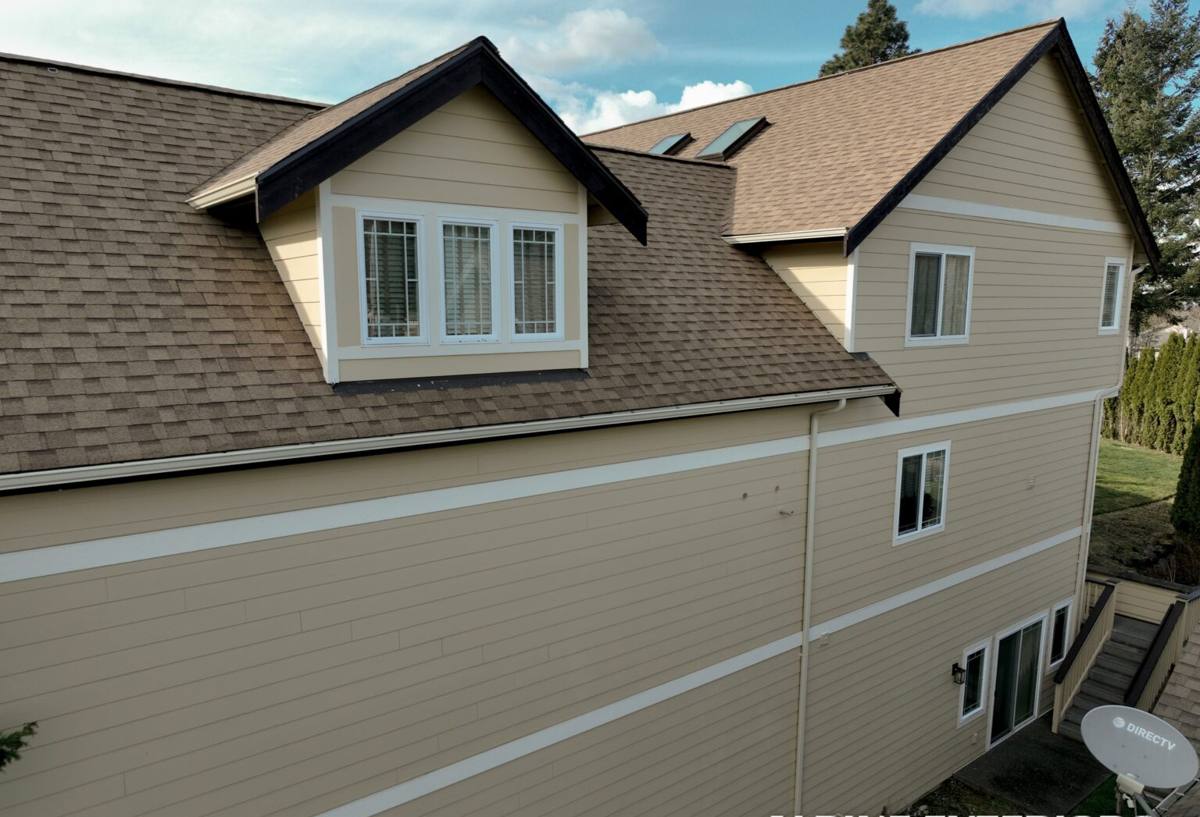
Why We Only Install James Hardie
We install James Hardie fiber cement siding exclusively. We don't install vinyl, LP SmartSide, Cemplank, Allura, primed spruce, or cedar, and that's a deliberate professional standard, not a sales pitch. Each of those alternatives has real strengths, but each also comes with a maintenance burden, moisture vulnerability, or long-term durability trade-off that we're not willing to put our name behind on a house that has to survive Bellingham's marine climate for decades.
James Hardie's fiber cement is non-combustible, dimensionally stable, and manufactured in climate-specific HZ formulations. For our zone, that generally means HZ5 products, engineered for regions with sustained moisture and freeze-thaw cycling rather than hot, dry climates. The factory-applied ColorPlus finish is baked on under controlled conditions, which gives it far better resistance to fading and moisture intrusion at the coating layer than a field-applied paint job ever gets. That matters directly here: a coating that holds up against salt air and constant damp is the difference between repainting in eight years and not touching the exterior for two decades.
What HZ5 Actually Buys You
The HZ5 engineering isn't a marketing label — it changes the product's moisture and freeze resistance formulation to suit wetter regions. For a Bellingham home exposed to salt spray and near-constant winter rain, that's the correct baseline product, not an upgrade.
What a Correct James Hardie Installation Actually Involves
The product is only half the equation. Fiber cement siding installed wrong will still trap moisture, crack at fasteners, or fail early — regardless of how good the material is. A correct installation on a Bellingham home includes:
- A drainage plane or rainscreen gap behind the siding so any moisture that does get past the surface has somewhere to go besides the sheathing
- Correct fastener type, spacing, and depth — over-driven or under-driven nails are one of the most common causes of early cracking
- Proper flashing at every window, door, and roof-to-wall intersection, since these are where wind-driven rain actually gets in
- Factory-cut and factory-primed edges wherever possible, with field cuts sealed per manufacturer spec
- Correct gaps and sealant at butt joints and trim, sized for the expansion and contraction the material will see through our wet winters and drier summers
- Minimum clearance from grade, decks, and roof lines so the siding isn't sitting in standing water or splash-back
Skipping any one of these doesn't usually show up as a problem in year one. It shows up in year five or six, as soft trim, staining, or siding that's cracked around fastener heads — after the workmanship warranty window has often already closed.
Our Process on a Bellingham Home
We start with a walk-around assessment of the existing siding and the wall assembly behind it, because you can't plan a correct install without knowing what condition the sheathing and moisture barrier are actually in. Homes near the water or in shaded, moss-prone spots often have hidden moisture damage that isn't visible until the old siding comes off.
From there:
- We remove the existing siding and inspect the sheathing, addressing any rot or moisture damage before anything new goes up — this step gets skipped by crews trying to move fast, and it's the single most important part of the job
- We install or verify a proper water-resistive barrier and rainscreen gap
- We install James Hardie panels, lap siding, or shingle-style siding per the manufacturer's fastening and clearance specs, with attention to every transition point — corners, trim, windows, roof lines
- We flash and seal penetrations and joints correctly the first time, rather than relying on caulk to cover for a gap in the flashing detail
- We do a final walkthrough with the homeowner, covering care and what to expect from the finish over time
Why Hiring a Crew That Already Works Bellingham Matters
Fiber cement installation is unforgiving of shortcuts, and the failure modes aren't obvious until years later. A crew that already understands Bellingham's exposure conditions — which walls take the worst of the salt air and driving rain, how much clearance moss-prone shaded areas actually need, how the local wet season affects cure times and sequencing — will make different, better decisions on your job than a crew installing Hardie for the first time in this specific environment.
That local experience shows up in small decisions: extra attention to flashing on a west-facing wall that catches the worst of the weather, added clearance on a north side that stays damp and shaded most of the year, or sequencing work around the wet season instead of rushing a caulk job in the rain. None of that is exotic knowledge, but it only gets applied consistently by a crew that's done it here before.
Color and Finish Considerations for This Climate
ColorPlus factory finish is worth prioritizing over field-painted fiber cement in a marine climate like ours, specifically because the factory process bonds the finish more consistently than a job-site paint application can, and it comes backed by its own finish warranty. In a location dealing with salt air and prolonged damp, that finish durability has a direct, practical payoff: fewer touch-ups, less fading, and a longer stretch before the exterior needs any attention at all.
Darker colors will show dust, pollen, and moss growth differently than lighter tones, and homes in shaded, damp spots benefit from periodically checking north-facing walls regardless of color — factory finish resists staining, but it doesn't eliminate the need to keep gutters clear and vegetation trimmed back from the siding.
What Affects the Cost of a Hardie Siding Project
| Factor | Why It Matters |
|---|---|
| Tear-off vs. install over existing wall prep | Full tear-off allows sheathing inspection and repair, which is important on older or moisture-exposed homes |
| Existing moisture or rot damage | Hidden damage found during tear-off has to be repaired before new siding goes on, adding time and material cost |
| Home size and wall complexity | More corners, dormers, and trim details mean more cutting, flashing, and labor time |
| Product line and profile | Lap siding, shingle-style, and panel systems carry different material and labor costs |
| Trim and accessory scope | Full trim replacement alongside siding costs more upfront but keeps the whole exterior on one consistent warranty and finish |
| Access and site conditions | Steep lots, tight setbacks, or difficult equipment access add labor time |
We won't quote a project without seeing the home, because tear-off condition alone can shift a bid meaningfully once the old siding is off the wall.
Maintenance Checklist for Hardie Siding in a Marine Climate
- Rinse siding annually to remove salt residue, especially on walls facing prevailing weather
- Keep gutters clean so overflow doesn't run down the siding face or pool at the base of a wall
- Trim back vegetation and keep mulch beds from piling up against the bottom course
- Check caulking at trim and window joints every year or two and re-seal if it's cracked or pulling away
- Watch shaded, damp areas for early moss or algae growth and address it before it spreads
- Repaint only if you notice genuine finish failure — ColorPlus-finished siding typically doesn't need repainting on the same schedule as field-painted wood
Warranty and Long-Term Value
James Hardie backs its siding with a substantial, transferable product warranty, and ColorPlus finishes carry their own separate finish warranty. Both are only as good as the installation behind them — improper fastening, missing flashing, or bad joint spacing can void manufacturer warranty coverage regardless of the product itself. Installing to spec the first time isn't just about performance; it's what keeps that warranty coverage intact if you ever need it.
If you're weighing a siding replacement on a Bellingham home and want a straight answer about what your walls actually need, we're happy to take a look and give you a free, no-pressure estimate — no obligation, just an honest read on the condition of your home and what a correct job would involve.