 Ferndale
 Bellingham sits close enough to the water and the foothills that its homes take a harder beating than most people realize. Salt-tinged air off Bellingham Bay, long stretches of driving rain that push moisture sideways into wall assemblies, and a moss season that can run eight months out of the year all work against exterior siding in ways that generic national advice doesn't account for. If you're planning a siding replacement for a Bellingham home, the climate here should shape almost every decision in the project — the product you choose, the way it's flashed and fastened, and the crew you trust to install it.
Why Bellingham's Climate Is Hard on Siding
Whatcom County's marine climate is mild compared to a lot of the country, but "mild" doesn't mean easy on a building envelope. Bellingham gets a long, wet fall and winter where rain doesn't fall so much as it arrives sideways off Puget Sound, driven by wind that finds every gap in a poorly sealed wall. That constant wetting cycle is what eventually breaks down siding that isn't dimensionally stable or properly detailed at the seams.
Salt air is the second factor. Homes closer to the bay see accelerated corrosion on fasteners, trim, and any hardware that isn't rated for coastal exposure. It's a slower process than storm damage, but it's relentless, and it shows up first at the fastener heads and metal flashing long before the siding face itself looks bad.
Then there's moss. Bellingham's combination of shade, moisture, and mild temperatures makes it excellent growing conditions for moss and algae on north-facing walls, under eaves, and anywhere airflow is restricted. Moss holds moisture against the siding surface for months at a time, which is a problem for any product that can absorb water or swell when saturated.
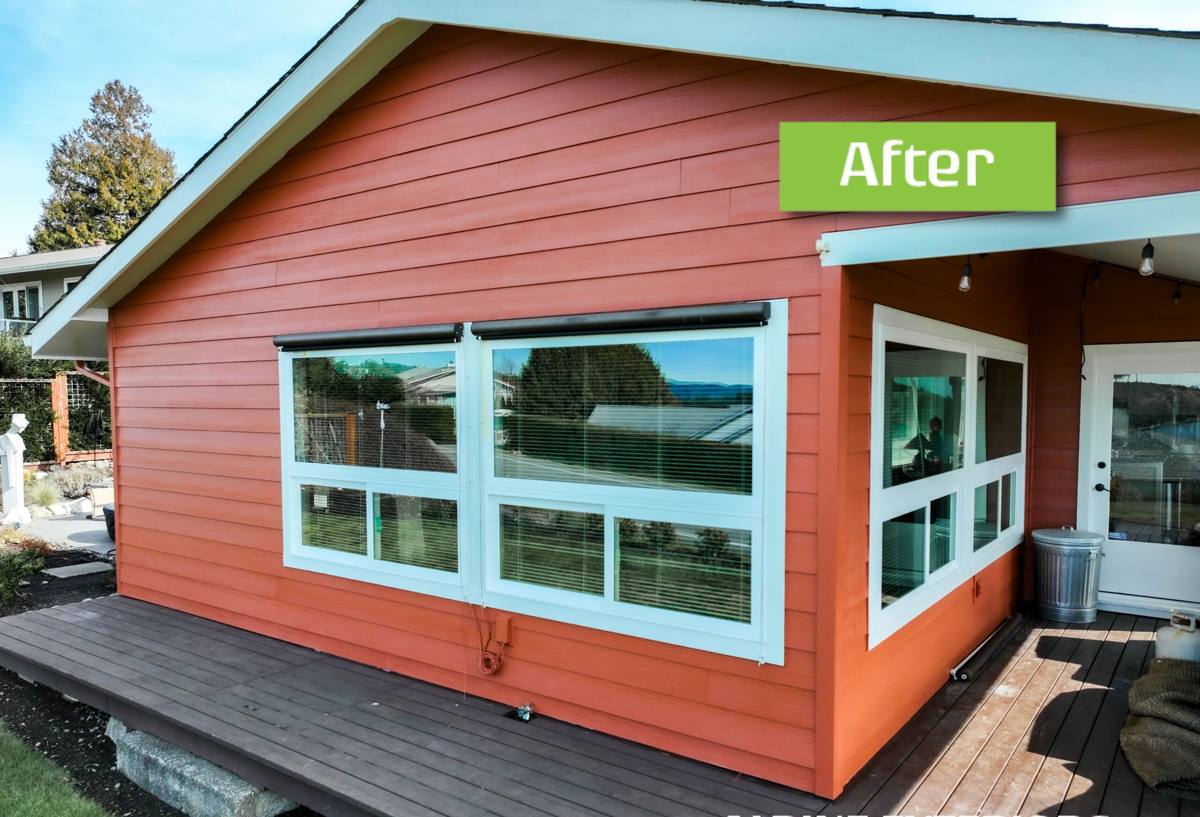
What a Correct Siding Replacement Actually Involves
Siding replacement isn't just pulling off old boards and nailing up new ones. Done correctly, it's a chance to fix what's underneath — the part of the wall you can't see once the new siding goes up, and the part that determines whether the new siding lasts 10 years or 40.
Inspecting What's Underneath
Once the old siding comes off, we look at the sheathing, framing, and any existing water damage before anything new goes on. In a wet climate like Bellingham's, it's common to find soft or stained sheathing around old window and door penetrations, especially on walls that took the brunt of years of wind-driven rain. Replacing damaged sheathing before re-siding isn't an upsell — it's the difference between a repair that lasts and one that fails again in five years for the same reason it failed the first time.
Weather-Resistive Barrier and Flashing
Behind every well-installed siding job is a continuous weather-resistive barrier (WRB) that's lapped correctly — upper layers over lower layers, so water sheds down and out rather than working its way behind the barrier. Window and door flashing gets integrated into that barrier in the correct sequence, and any penetrations (vents, hose bibs, light fixtures) get properly flashed and sealed. This is the detail work that separates a siding job that holds up to Bellingham's driving rain from one that lets water in behind the new siding within the first couple of winters.
Fastening and Clearances
Fastener spacing, embedment depth, and the gap left at the bottom of the siding above grade or a deck surface all matter more here than in a dry climate. Too little clearance, and the siding sits in standing moisture after every storm. Fasteners that aren't corrosion-resistant will eventually stain the face of the siding and lose holding power, which is a bigger issue for homes near the bay where salt air accelerates that corrosion.
Why We Install Only James Hardie Fiber Cement
We've made a deliberate choice not to install vinyl, LP SmartSide, Cemplank, Allura, primed spruce, or cedar. That's not a knock on every homeowner who has one of those products on their house — plenty of them perform fine for years under the right conditions. It's that after years of working on homes in this climate, James Hardie fiber cement is the product we're willing to stand behind for Bellingham's specific mix of moisture, salt air, and moss.
Fiber cement doesn't absorb water and swell the way engineered wood products can, and it doesn't soften or warp under sustained moisture exposure the way solid wood siding does if a coating fails. It's also non-combustible, which matters more each year as wildfire smoke and fire-season concerns move further into the Pacific Northwest's regional conversation, even in a wetter county like Whatcom.
The HZ5 Product Line for the Pacific Northwest
James Hardie engineers its siding by climate zone, and the HZ5 line is built for regions like ours — colder, wetter, and more humid than the HZ10 line used in the Southeast. HZ5 products are formulated for better performance against moisture cycling and cold-weather freeze-thaw stress, which lines up directly with what a Bellingham wall assembly goes through over a typical winter.
ColorPlus Finish and Long-Term Maintenance
James Hardie's ColorPlus finish is baked on at the factory under controlled conditions, rather than field-painted after installation. In a climate where moss and algae growth are a near-constant issue on shaded walls, a factory finish that resists fading and holds up to regular washing means less repainting over the life of the siding — a real maintenance advantage for homeowners tired of repainting every several years just to keep ahead of the weather.
Comparing What Drives Cost in a Bellingham Siding Replacement
Every siding replacement is different, but the factors that move the price are consistent. Understanding them helps you evaluate quotes honestly instead of just comparing bottom-line numbers.
| Cost Factor | Why It Matters Locally |
|---|---|
| Sheathing condition | Bellingham's wet winters mean hidden moisture damage behind old siding is common, especially around windows and doors |
| Wall complexity | Dormers, bay windows, and multiple roof lines increase flashing detail work, which is critical in a driving-rain climate |
| Siding profile and trim | Lap width, trim detailing, and corner treatments affect both material and labor cost |
| Access and site conditions | Sloped lots, mature landscaping, or tight setbacks common in older Bellingham neighborhoods can add labor time |
| Moisture mitigation | Added flashing, proper WRB integration, and drainage gaps behind the siding protect against our long rainy season |
Signs Your Bellingham Home Needs Siding Replacement Now
Some warning signs are easy to miss until they've caused real damage underneath. Watch for the following:
- Soft or spongy spots when you press on the siding, especially near the bottom courses or under windows
- Persistent moss or algae staining that keeps returning within weeks of cleaning
- Visible cracking, buckling, or gaps between siding panels
- Paint that's peeling or bubbling in patterns that follow seams or fastener lines
- Rust streaks running down from fastener heads or metal trim
- Musty smells or visible staining on interior walls that share an exterior wall with problem siding
- Siding that feels noticeably cooler or damp to the touch after a stretch of dry weather, which can indicate trapped moisture
If you're seeing more than one of these, it's worth having the wall assembly evaluated rather than just patching the surface symptom.
Our Process for Bellingham Siding Replacement Projects
We walk every Bellingham project through the same sequence, because skipping steps is how moisture problems get sealed in behind new siding instead of solved.
- On-site evaluation. We look at the existing siding, wall orientation, moss and moisture patterns, and any visible damage before quoting anything.
- Tear-off and sheathing inspection. Old siding comes off and we assess what's underneath before installing anything new.
- Repair and prep. Any damaged sheathing or framing gets addressed, and the weather-resistive barrier goes on correctly lapped and integrated with window and door flashing.
- James Hardie installation to manufacturer spec. Correct fastener type, spacing, clearances, and joint treatment — installed to the standard James Hardie's warranty actually requires.
- Trim, caulking, and final detailing. The details that keep water moving out and away from the wall rather than pooling or wicking in.
- Final walkthrough. We go over the finished work with you before calling the job done.
Why Local Experience in Bellingham Matters
A crew that already works Bellingham regularly knows how the wind comes off the bay on certain streets, which neighborhoods hold moisture longer under tree cover, and what kind of flashing details actually hold up through a full Whatcom County winter rather than just looking right on installation day. That local pattern recognition is hard to replace with generic training, and it's part of why we focus our work in this region instead of spreading thin across unfamiliar climates.
Local experience also means fewer surprises during permitting and inspection, since the process and expectations in this area are familiar territory rather than something we're learning on your project.
Caring for Your New Siding After Installation
James Hardie siding is low-maintenance, not no-maintenance. A yearly rinse to knock off pollen, moss spores, and grime — especially on shaded, north-facing walls — goes a long way toward keeping the ColorPlus finish looking new. Keep an eye on caulking at trim joints and penetrations over the years, since caulk is the one component that wears out well before the siding itself does. Trim back vegetation that's shading walls or trapping moisture against the siding, which slows moss growth considerably.
If your Bellingham home is showing signs it's time for new siding, or you just want an honest read on what shape your current siding is really in, we're happy to take a look. Request a free, no-pressure estimate using the form below.