 Ferndale
 Why Birch Bay Roofs Wear Differently Than Roofs Inland
Birch Bay sits right on the water, and that changes what a roof deals with day to day compared to a home a few miles inland in Ferndale or Lynden. Salt-laden air off the bay accelerates corrosion on any exposed metal — fasteners, flashing, vents, gutters — long before it would fail on a similar roof away from the shoreline. Add in wind-driven rain that comes off the water at an angle instead of falling straight down, and you get water intrusion at laps, valleys, and penetrations that a roof built to a generic spec sheet simply isn't ready for.
Then there's moss. Whatcom County's long wet season and heavy tree cover in and around Birch Bay give moss and algae months at a time to establish themselves on a roof surface. Once moss takes hold, it holds moisture against the roofing material, works into laps and fastener heads, and shortens the service life of almost anything you put up there. A roof installed without accounting for all three of these factors — salt exposure, wind-driven rain, and moss pressure — tends to show problems years before it should.
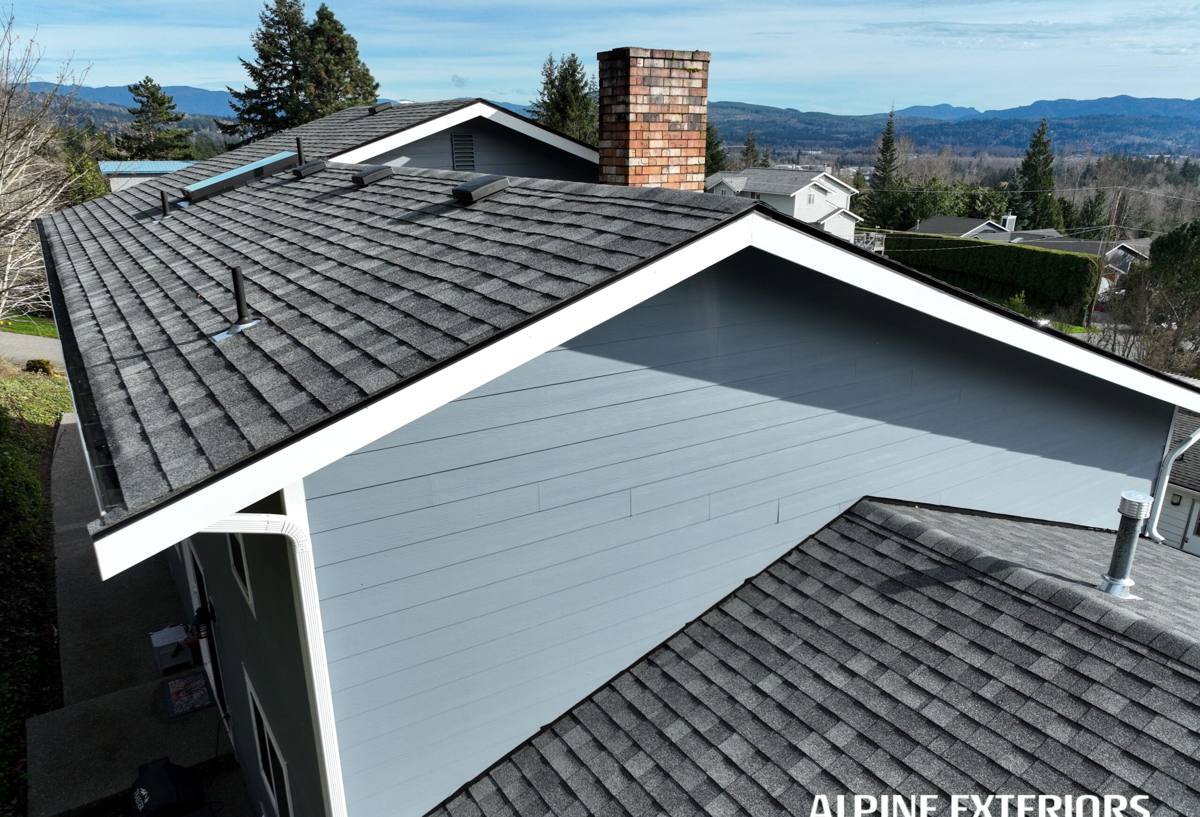
What a Correctly Installed Roof Needs in This Environment
Fasteners and Flashing
Standard galvanized fasteners and flashing corrode faster in salt air than most homeowners expect. For a coastal-exposed property like a Birch Bay home, we favor corrosion-resistant fastener and flashing options — stainless or heavier-coated hardware at the exposed edges, valleys, and penetrations — rather than whatever is cheapest by the box. This is one of the areas where cutting corners doesn't show up as a problem for a year or two, and then shows up all at once as rust streaking and loosened flashing.
Underlayment and Water-Shedding Details
Wind-driven rain finds its way under roofing material at the weakest points — eaves, valleys, sidewalls, and anywhere a pipe or vent penetrates the roof deck. A synthetic underlayment with good lap performance, plus self-adhered ice-and-water shield membrane at eaves, valleys, and penetrations, gives the roof a real second line of defense instead of relying on the shingles or panels alone to keep water out.
Ventilation That Actually Balances
Roof ventilation isn't just an attic-comfort issue here — it's a moisture-control issue. A roof deck that stays cool and damp because it's shaded and under-ventilated is exactly the kind of surface moss and algae prefer. Balanced intake at the soffits and exhaust at the ridge keeps air moving under the roof surface, which helps the material dry out between rain events instead of staying wet.
Choosing a Roofing Material for a Birch Bay Property
There's no single "best" roofing material for every home — it depends on budget, roof pitch, how much shade and moss pressure the lot has, and how long you plan to own the home. Here's how the common options stack up for a shoreline-exposed property specifically.
| Material | Salt Air Performance | Moss Resistance | Typical Lifespan | Relative Cost |
|---|---|---|---|---|
| Architectural asphalt shingle | Good with corrosion-resistant flashing | Moderate — benefits from algae-resistant granules | 25–30 years | Lowest |
| Standing seam metal | Excellent when specified with a marine-grade or coastal-rated finish | High — sheds moss and debris well due to slick surface | 40–50+ years | Highest |
| Composite/synthetic shake or slate | Good | Moderate to high depending on texture | 30–50 years | Mid to high |
Architectural asphalt shingle remains the most common choice in Birch Bay because it balances cost and performance well when the underlying details — flashing, ventilation, underlayment — are done correctly. Standing seam metal costs more up front but handles wind-driven rain and moss pressure about as well as any material available, which matters more on a shaded, water-exposed lot than it does a few miles inland. We'll walk through the real trade-offs for your specific roof rather than pushing one product across the board.
Tear-Off vs. Overlay: What's Actually Involved
A lot of homeowners ask whether a new layer can just go over the old roof. In most cases on a coastal property, we don't recommend it. Here's why the two approaches compare so differently for a Birch Bay home specifically.
| Factor | Full Tear-Off | Overlay |
|---|---|---|
| Deck inspection | Full visibility — rot, soft spots, and past leaks get found and fixed | Deck stays hidden; existing damage goes unaddressed |
| Moss and trapped moisture | Removed entirely with the old roofing | Trapped between layers, continues to hold moisture |
| Weight on structure | Normal, single-layer load | Added weight — a concern on older framing |
| Warranty eligibility | Full manufacturer warranty typically available | Often voids or limits manufacturer warranty |
Given how much rain and moss exposure a Birch Bay roof deals with over its life, we've found that decks under an aging roof frequently have some degree of hidden moisture damage — soft sheathing, rusted fasteners, or old leaks that were never fully dried out. A tear-off is the only way to find and fix that before it's sealed under a new roof for another 25-plus years.
Our Installation Process
Every roof is different, but a correct installation on a coastal-exposed home generally follows the same sequence:
- On-site inspection and measurement — we look at pitch, exposure to wind and salt spray, tree cover and moss history, and the condition of the existing roof and deck.
- Tear-off — old roofing, flashing, and any damaged underlayment come off down to the deck.
- Deck repair — any soft, rotted, or delaminated sheathing gets replaced before anything new goes down. This step gets skipped by crews trying to move fast, and it's the one that causes problems years later.
- Underlayment and ice-and-water shield — synthetic underlayment across the field, self-adhered membrane at eaves, valleys, and all penetrations.
- Flashing — new, corrosion-resistant flashing at valleys, walls, chimneys, and every roof penetration.
- Roofing material installation — shingles, panels, or shakes installed to manufacturer spec and local wind-exposure requirements.
- Ventilation tie-in — ridge and soffit ventilation balanced and connected properly, not just installed and left disconnected from the intake side.
- Cleanup and walkthrough — magnetic sweep for debris, gutter check, and a walkthrough so you understand what was done and what to watch for going forward.
Permits and Local Considerations Around Birch Bay
Birch Bay is unincorporated Whatcom County, which means roofing permits and inspections run through the county rather than a city building department. Requirements can also vary by exposure category — a home closer to the water may fall under a different wind-load consideration than one set back from the shoreline. Some Birch Bay neighborhoods also carry HOA or community covenants that touch on exterior appearance, including roofing material and color. We handle the permitting piece and flag anything covenant-related before work starts, so there are no surprises mid-project.
Signs Your Roof Needs Replacement, Not Just Repair
- Granule loss heavy enough that shingles look patchy or bald in spots
- Moss or algae growth that keeps coming back within months of cleaning
- Curling, cracking, or lifted shingle edges, especially on wind-exposed slopes
- Rust streaking or corrosion visible on flashing, vents, or fasteners
- Soft spots or sagging visible from the ground or in the attic
- Daylight visible through the roof deck from inside the attic
- Repeated leaks around the same chimney, skylight, or valley despite past patching
- Roof is nearing or past the manufacturer's rated lifespan for its material
One or two of these on their own might mean a repair is enough. Several at once, especially on a roof that's already 20-plus years old, usually means repair costs start approaching what a proper replacement would cost anyway.
Maintenance That Protects the Investment
A correctly installed roof still needs upkeep in this climate. Moss should be treated before it establishes a heavy mat, not after — an annual or biannual soft treatment keeps it from working into laps and fastener lines. Gutters need to stay clear so water isn't backing up under the eave edge during heavy rain events. And an occasional visual check of flashing and penetrations, particularly after a hard windstorm off the bay, catches small issues while they're still small.
Why Hire a Crew That Already Works in Birch Bay
A roofer who mostly works dry, inland jobs will spec a roof the same way whether it's going up in Ferndale proper or right on the waterfront in Birch Bay — and that's exactly the approach that leads to premature flashing corrosion, recurring moss, and leaks at the valleys within a handful of years. Working this specific stretch of coastline regularly means knowing which details actually matter here: which fasteners hold up against salt air, where wind-driven rain typically finds its way in, and how much moss pressure a shaded lot near the water is really going to see.
Before hiring anyone for a roof replacement in Birch Bay, it's worth asking a few direct questions:
- Do you pull the required Whatcom County permit, or is that left to me?
- What underlayment and ice-and-water shield do you install at eaves and valleys?
- Will fasteners and flashing be upgraded for salt air exposure, or standard-grade?
- Is this a full tear-off, and will the deck be inspected and repaired as needed?
- How is ridge and soffit ventilation balanced on this specific roof?
- What does the workmanship warranty cover, separate from the manufacturer's material warranty?
A contractor who answers those without hesitation has done this kind of roof before. One who can't is guessing.
If your Birch Bay home needs a new roof or you're not sure whether a repair will hold, we're happy to take a look and walk the roof with you. Use the form below to request a free, no-pressure estimate.