 Ferndale
 Blaine's Coastal Exposure Is a Different Kind of Test for Siding
Blaine sits right on the water — Drayton Harbor and Semiahmoo Bay put homes here in near-constant contact with salt-laden air, something most siding products simply weren't engineered to handle over the long term. Add Whatcom County's wet season, where driving rain off the Strait of Georgia comes in sideways for weeks at a stretch, and you have a climate that punishes any siding system with a weak point. Then there's moss and algae season, which in this part of Washington isn't really a season at all — it's most of the year, especially on north-facing walls and anything shaded by mature trees or a neighboring structure.
None of this is unusual for us. It's the baseline we design every installation around when we're working in Blaine. A siding job that would hold up fine forty miles inland can fail early here, and the failure points are predictable once you've seen enough of them: swollen seams, cupped panels, chalky or peeling paint, and soft trim boards where moisture found a way in and stayed.
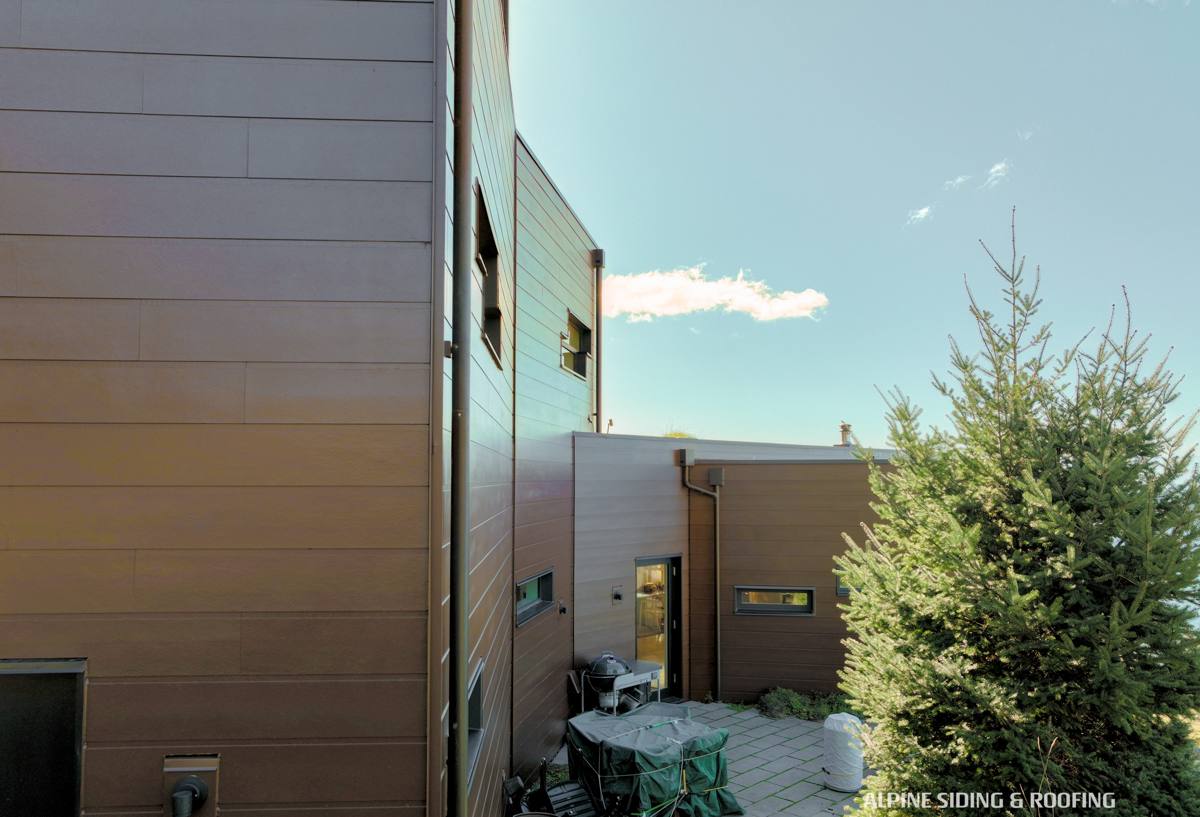
What Correct Siding Installation Actually Involves
Siding installation is not just fastening panels to a wall. The siding itself is the least important variable in whether a home stays dry and looks good in ten years — the water-management system behind it is what actually does the work. On a correctly installed home, the sequence looks like this:
- A weather-resistive barrier installed with proper shingle-lap orientation, so water is directed down and out, not trapped behind the cladding
- Flashing at every window, door, deck ledger, and roofline intersection — the places where most water intrusion actually starts
- A drainage plane or rainscreen gap so any moisture that does get behind the siding can drip out instead of sitting against the wall sheathing
- Correct fastener type, spacing, and penetration depth for the specific siding product being installed
- Proper caulking and sealant only where the manufacturer specifies it — over-caulking traps moisture just as often as it keeps it out
Skip or rush any one of these steps and the siding can look fine for a year or two while the wall assembly underneath is already failing. In a climate like Blaine's, that gap between "looks fine" and "is fine" closes fast.
Why This Matters More on Waterfront-Adjacent Homes
Homes closer to the water in Blaine take on wind-driven rain from more directions and see faster paint and finish degradation from salt exposure. That doesn't change the installation method, but it raises the stakes on getting flashing and drainage details right the first time — repairs on a home exposed to that kind of weather are more disruptive and more expensive to get to than on a sheltered inland lot.
Why We Only Install James Hardie Fiber Cement
We made a decision as a company to install James Hardie fiber cement siding exclusively — not vinyl, not LP SmartSide, not Cemplank, not Allura, not primed spruce or cedar. That's a narrower lineup than most siding contractors offer, and we're upfront about why: in a climate like Whatcom County's, the products we don't install all carry the same category of long-term risk, whether it's moisture absorption at panel edges, UV and impact vulnerability, or a finish that needs re-coating on a schedule most homeowners don't want to keep up with.
James Hardie fiber cement is non-combustible, dimensionally stable in wet-dry cycling, and available in HZ5 formulations engineered for the kind of freeze-thaw and moisture exposure the Pacific Northwest delivers. The factory-applied ColorPlus finish is baked on under controlled conditions rather than field-applied, which matters directly for a coastal town like Blaine — a factory finish holds color and resists the chalking and fading that salt air and UV exposure accelerate on field-painted products. It's backed by a transferable warranty, which also matters if this home changes hands down the road.
We're not saying every other product on the market is without merit — some have real advantages in cost or installation speed. But when we weigh those trade-offs against what actually holds up on the homes we service in this specific climate, Hardie is what we're willing to put our name behind and warranty our work on.
Comparing Siding Materials for Blaine's Climate
| Material | Moisture Behavior | Finish Durability | Fire Resistance |
|---|---|---|---|
| James Hardie fiber cement | Dimensionally stable, engineered HZ lines for wet climates | Factory-baked ColorPlus finish, resists chalking/fading | Non-combustible |
| Vinyl | Can warp or buckle with temperature swings; seams can allow water behind panels | Color molded in but fades over time, cannot be effectively repainted long-term | Combustible, can melt/deform near heat sources |
| LP SmartSide (engineered wood) | Vulnerable at cut edges and fastener points if not sealed exactly to spec | Field or factory finish, needs consistent maintenance | Combustible |
| Primed spruce/cedar | Absorbs moisture readily; highest maintenance burden in wet climates | Requires regular repainting/staining, especially on weather-facing walls | Combustible |
This isn't a knock on every alternative in every climate. It's specifically why, for homes taking on Blaine's combination of salt air, sustained rain, and moss pressure, we standardized on one product system rather than offering several.
Our Installation Process
1. On-Site Assessment
We walk the exterior and look at what's actually happening on the walls — moss buildup patterns, where paint or existing siding is failing first, condition of trim and fascia, and any signs of past moisture intrusion around windows or roof lines. This tells us as much as the age of the current siding does.
2. Tear-Off and Sheathing Check
Once old siding comes off, we inspect the wall sheathing underneath. This is the step that gets skipped by crews trying to move fast, and it's the step that matters most — if sheathing is soft or water-damaged, covering it back up with new siding just hides a problem that will keep spreading.
3. Water Management Layer
We install the weather-resistive barrier and flashing system correctly the first time, with attention to every penetration point — windows, doors, hose bibs, light fixtures, deck attachments. This layer is what actually keeps Blaine's driving rain out of the wall assembly.
4. Hardie Panel Installation
Panels or planks go on per James Hardie's fastening and clearance specifications, including proper ground clearance and gaps at trim to allow for material movement and drainage.
5. Final Walkthrough
We go over the finished job with the homeowner, point out anything worth knowing about maintenance, and make sure everything matches what was agreed to before we call it done.
Signs a Blaine Home Needs New Siding Soon
- Persistent moss or algae staining that comes back within weeks of cleaning
- Soft spots, bubbling, or visible rot at the bottom edges of siding boards
- Paint that's chalking, peeling, or fading unevenly, especially on the weather-facing side of the house
- Warped, cupped, or separated panels, particularly around window and door trim
- Rising energy bills that suggest the wall assembly is no longer doing its job as a moisture and air barrier
Any one of these on its own might just mean a cleaning or a repair. Several at once, especially combined with a home's age, usually means the underlying water-management layer has been compromised and it's time to look at full replacement rather than another round of patching.
What to Ask Before Hiring Any Siding Contractor in Blaine
- Do you carry proper licensing and insurance for exterior work in Washington State?
- Will you inspect and address the sheathing underneath, not just install over what's there?
- What's your flashing detail at windows, doors, and rooflines — can you explain it, not just show a brochure?
- Do you have experience specifically with coastal or high-moisture properties in Whatcom County?
- Is the warranty on labor separate from the manufacturer's material warranty, and what does each actually cover?
A contractor who can answer these clearly and specifically, without hedging, is usually one who does this work correctly and often. Vague answers on flashing and water management are the biggest red flag in this climate — that's where the money gets saved by cutting corners, and it's the part of the job you can't see once the siding is up.
Why a Crew That Already Works Blaine Matters
Siding installation done to a manufacturer's general spec sheet isn't the same as siding installed by a crew that already knows how a specific area behaves. We know which directions on a Blaine lot tend to take the worst of the wind-driven rain, which wall orientations grow moss fastest, and where salt exposure tends to show up first on trim and fasteners. That local pattern recognition shapes decisions on-site — where to add extra flashing attention, where drainage details need to be tighter than the bare minimum — in ways a general spec sheet doesn't capture on its own.
It also means fewer surprises during the job. Permitting, typical wall assemblies in this area's housing stock, and common problem areas on older Whatcom County homes are all things we've already worked through many times over, not something we're learning on your project.
Living With Hardie Siding After Installation
One of the practical advantages of switching to fiber cement in a climate like this is how little ongoing maintenance it asks for compared to wood or repainted alternatives. A periodic rinse to keep moss and organic growth from taking hold, an eye kept on caulking at trim joints over the years, and that's most of it — there's no repainting cycle to keep up with the way there is on cedar or field-finished products, since the ColorPlus finish is factory-applied and warrantied against fading and chalking.
That lower maintenance burden matters more in Blaine than it would somewhere drier. Homes here are fighting moss, salt, and rain for most of the year, and a siding system that doesn't need constant attention to keep looking and performing well is worth more here than the sticker price alone suggests.
If you're seeing early wear on your home's siding or just want an honest read on where things stand, we're happy to take a look. Reach out for a free, no-pressure estimate using the form below.