 Ferndale
 Why Birch Bay Decks Take a Different Kind of Beating
Birch Bay sits right on the water, and that changes what a deck has to survive. Salt-laden air off the bay works its way into every exposed fastener and metal connector, driving rain comes in sideways during winter storms, and the shoulder seasons stay damp long enough for moss and algae to take hold on anything that doesn't drain and dry quickly. A deck built the same way you'd build one twenty miles inland in Whatcom County often shows problems within a few years out here — soft spots, streaking, corroded hardware, or boards that cup and warp because water had nowhere to go.
None of that means a deck can't hold up in Birch Bay. It means the materials and the details around them have to be chosen for this specific environment, not a generic one. That's the whole case for composite decking done right in this neighborhood.
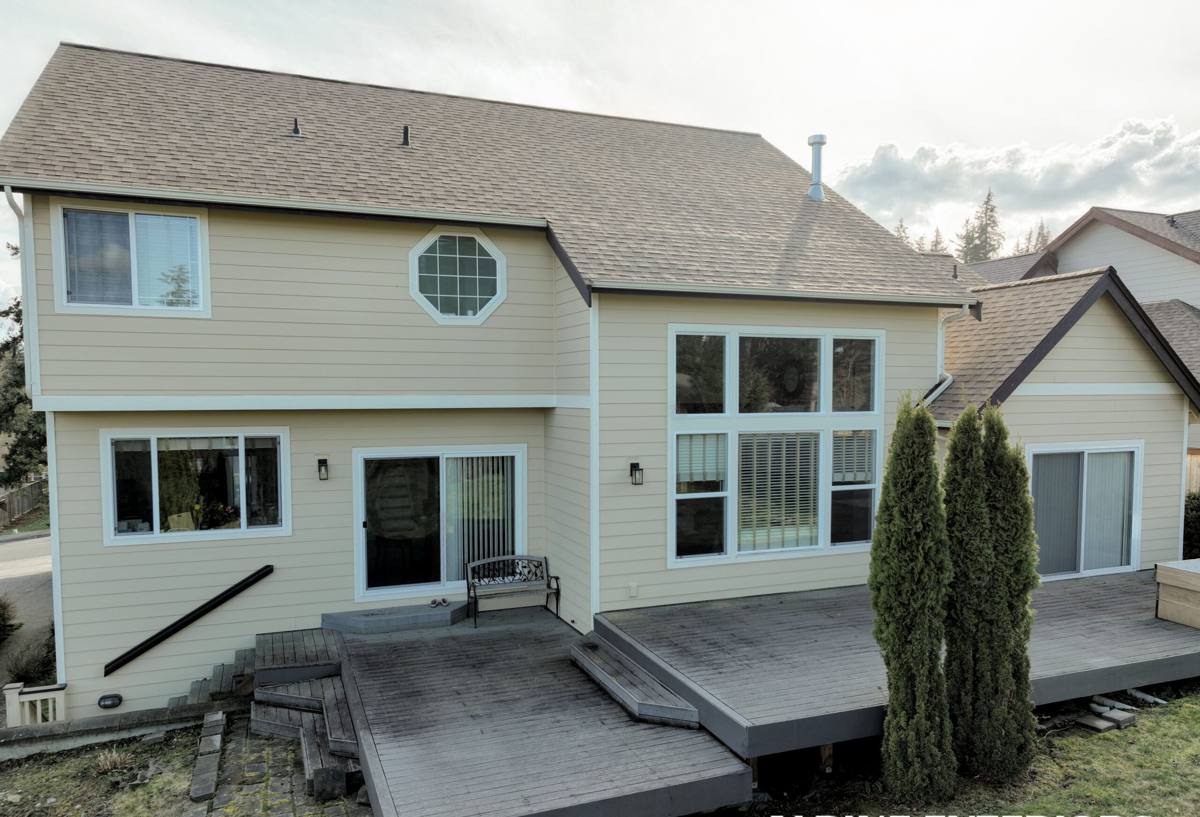
Why Composite Makes Sense for a Coastal Property Like This
Moisture Behavior
Quality composite decking is engineered to resist moisture absorption in the board itself, which matters a lot when a deck is exposed to salt spray and long stretches of wet weather. Wood decking, even treated wood, absorbs and releases moisture with every wet-dry cycle. Over years in a marine climate, that cycling is what drives splitting, cupping, and the soft, spongy feel that shows up in old wood decks near the water.
UV and Color Retention
Composite boards with a proper cap layer resist fading and graying far better than raw wood, which is worth noting here because Birch Bay gets a mix of intense summer sun reflecting off the water and long gray winters — both of which work against a finish over time.
No Annual Refinishing
A stained or sealed wood deck in this climate typically needs refinishing every year or two just to keep water out of the wood. Composite doesn't need that cycle. That's a real, practical difference for anyone who doesn't want a recurring maintenance project tied to the calendar every spring.
We're not going to tell you composite is maintenance-free — nothing exposed to Whatcom County weather is. But it shifts the maintenance burden from "refinish or the wood fails" to routine cleaning, which is a much lower bar to clear.
What a Correct Composite Deck Build Involves
The decking boards themselves get most of the attention, but the framing underneath and the details around the edges are what actually determine whether a deck lasts in this climate. A composite deck installed over a poorly built or poorly protected substructure will still fail — the surface just hides the problem for a while longer than wood would.
Framing and Joist Protection
Composite boards are heavier than wood and behave differently under load, so joist spacing has to match the manufacturer's span tables for the specific product, not just standard framing practice. We also wrap or tape exposed joist tops so the fastener penetrations and cut edges of the framing lumber aren't sitting bare under a board that will trap moisture against them.
Ledger Board and House Connection
Where the deck attaches to the house is the single most common failure point on any deck, coastal or not, and it's the spot that's hardest to inspect once the deck is built. Proper flashing at the ledger board, correct fastening into structural framing, and a small gap for drainage behind the ledger all matter more here because of how much moisture this area sees over a wet Whatcom County winter.
Fasteners and Hardware
Standard fasteners corrode faster in salt air. We use fastener systems and structural hardware rated for coastal or marine exposure — stainless steel or coated hardware appropriate to the application — rather than whatever is cheapest at the point of purchase. Corroded fasteners are one of the most common causes of loose railings and squeaking boards on older decks near the water.
Hidden Fastening and Board Spacing
Most composite systems use a hidden fastener clip rather than face-screwing, which gives a cleaner surface and avoids the small pockets around screw heads where water and debris (and eventually moss) like to collect. Board spacing has to account for composite's expansion and contraction with temperature, and for drainage — tight, closed-up gaps hold moisture and speed up the moss and algae growth that's already a fight in this climate.
Comparing Composite Board Types
Not all composite decking is built the same, and the differences matter more in a marine environment than they would somewhere drier. Here's how the main categories generally compare for a Birch Bay application.
| Board Type | Moisture Resistance | Maintenance | Typical Lifespan Consideration |
|---|---|---|---|
| Uncapped composite | Moderate — wood fibers can still absorb some moisture at cut edges | Periodic cleaning; more prone to surface staining and mold near the water | Shorter service life in wet, salty conditions than capped products |
| Capped composite | High — polymer shell resists moisture and staining | Routine washing; no sealing or staining | Best balance of durability and cost for a coastal property |
| PVC/cellular decking | Very high — no wood content to absorb moisture | Low; typically the easiest to keep clean | Strong option for maximum moisture resistance, usually at a higher material cost |
| Pressure-treated wood | Low without diligent upkeep | Regular sealing/staining required, especially in salt air | Lowest upfront cost, highest ongoing labor and refinishing over time |
For most Birch Bay homes, we steer clients toward fully capped composite as the practical middle ground — it holds up to the salt air and rain without the premium price of full PVC decking, and it doesn't carry the refinishing burden of wood.
Cost Factors on a Birch Bay Deck
Every deck is different, so we're not going to put a fake number on this page. What we can tell you is what actually moves the price up or down on a real Birch Bay project.
| Factor | Why It Matters Here |
|---|---|
| Deck size and shape | More boards, more cuts, more edge detail — straightforward multiplier on material and labor |
| Condition of existing structure | A deck built over an old, undersized, or corrosion-damaged frame usually needs new substructure before decking goes down |
| Board tier | Uncapped composite, capped composite, and PVC carry different material costs, discussed above |
| Height and railing requirements | Elevated decks near the water need railing systems and hardware rated for the same exposure as the deck itself |
| Site access | Waterfront and bluff-adjacent lots in Birch Bay sometimes have tighter access, which affects labor time |
| Fastener and flashing spec | Marine-grade hardware and proper ledger flashing cost more than standard hardware, but it's not optional here |
How Our Process Works
1. On-Site Assessment
We look at the existing structure (if there is one), the ledger connection to the house, drainage around the site, and sun/wind exposure specific to your lot. Birch Bay properties vary a lot depending on how close and how exposed they are to the water, so this step isn't a formality.
2. Straight Talk on Materials
We'll walk through board tiers, colors, and hardware options honestly, including trade-offs — cost, appearance, and how much upkeep each option realistically needs in this climate. No pressure toward the most expensive option if it's not what the project calls for.
3. Framing and Structural Work
Any repairs or upgrades to the substructure happen before a single composite board goes down. This is the part of the job that doesn't show later but determines whether the deck is still solid in ten or twenty years.
4. Decking Installation
Boards go down with correct spacing, hidden fastening where applicable, and attention to how water will move off the deck surface and away from the house.
5. Railings, Stairs, and Final Details
Railing systems, stair stringers, and any trim or fascia get installed and checked for the same corrosion-resistant hardware standard used throughout the build.
6. Walkthrough
We go over the finished deck with you, including what routine care looks like and what to watch for as the seasons change.
Maintenance in a Marine, Mossy Climate
Composite decking cuts down on maintenance, but "low-maintenance" isn't "no-maintenance," especially with the moss season that Whatcom County's damp fall-through-spring stretch brings. A little routine care goes a long way toward keeping a composite deck looking and performing the way it should.
- Sweep debris (leaves, needles, seed pods) off the deck regularly — trapped organic matter is what feeds moss and algae growth
- Rinse or wash the surface periodically to clear salt residue, especially after storms with wind off the bay
- Keep gaps between boards clear of debris so water can drain instead of pooling
- Check railing posts and hardware annually for looseness, which can signal a fastener starting to corrode
- Trim back vegetation that shades the deck and keeps it damp longer than it needs to be
- Address any moss or algae growth promptly with a cleaner appropriate for composite — don't let it establish and spread
- Inspect the ledger board area at the house connection once a year, since it's the hardest-working joint on the deck
Why Local Experience in Birch Bay Matters
A contractor who mostly works inland projects can still build a technically sound deck, but they may not default to the coastal details — the flashing approach, the fastener spec, the framing protection — that a Birch Bay deck actually needs, because those details aren't necessary most other places in Whatcom County. Choosing a crew that already works this stretch of coastline means those decisions are built into the plan from the start, not added after something fails.
We're a Ferndale-based crew, and Birch Bay is part of our regular service area — we're familiar with the kind of exposure properties get depending on how close they sit to the water, and we build accordingly rather than applying a one-size-fits-all approach.
Is Composite Right for Every Birch Bay Deck?
Usually, but not always. If you're working with a tight budget and are willing to commit to a real annual maintenance routine, treated wood can still be a reasonable choice for some projects. If you want the lowest possible maintenance and don't mind paying more upfront, PVC decking is worth a look. For most homeowners in this area, capped composite lands in the sweet spot between upfront cost, appearance, and how well it holds up to salt air and rain without constant attention. We'll give you an honest read on which fits your specific situation rather than pushing one answer for every project.
If you're thinking about a new deck or replacing an aging one in Birch Bay, we're happy to take a look and talk through what your property actually needs. There's a form below for a free, no-pressure estimate — no obligation, just a straight answer on materials, scope, and what the job would involve.