 Ferndale
 Building Decks That Actually Hold Up in Everson
Everson sits inland along the Nooksack River corridor, but that doesn't spare it from the wet side of Whatcom County weather. Homeowners here deal with long stretches of driving rain, high humidity off the river bottomland, and a moss season that can stretch from October well into spring. Closer to Bellingham Bay and the coastline, salt-laden air adds another layer of corrosion risk to fasteners and hardware — and even inland, that same marine-influenced weather pattern keeps wood surfaces damp far longer than they would stay in a drier climate. A deck built the same way you'd build one in Arizona or eastern Washington simply won't last here.
The difference between a deck that looks good for two years and one that looks good for twenty comes down to decisions most homeowners never see: how the ledger board is flashed, what fasteners are used, how the joists are spaced and protected, and whether the structure is designed to shed water instead of trap it. That's the whole focus of this page — what a custom deck actually needs to survive and perform in Everson's climate, and what a correctly built one looks like from the ground up.
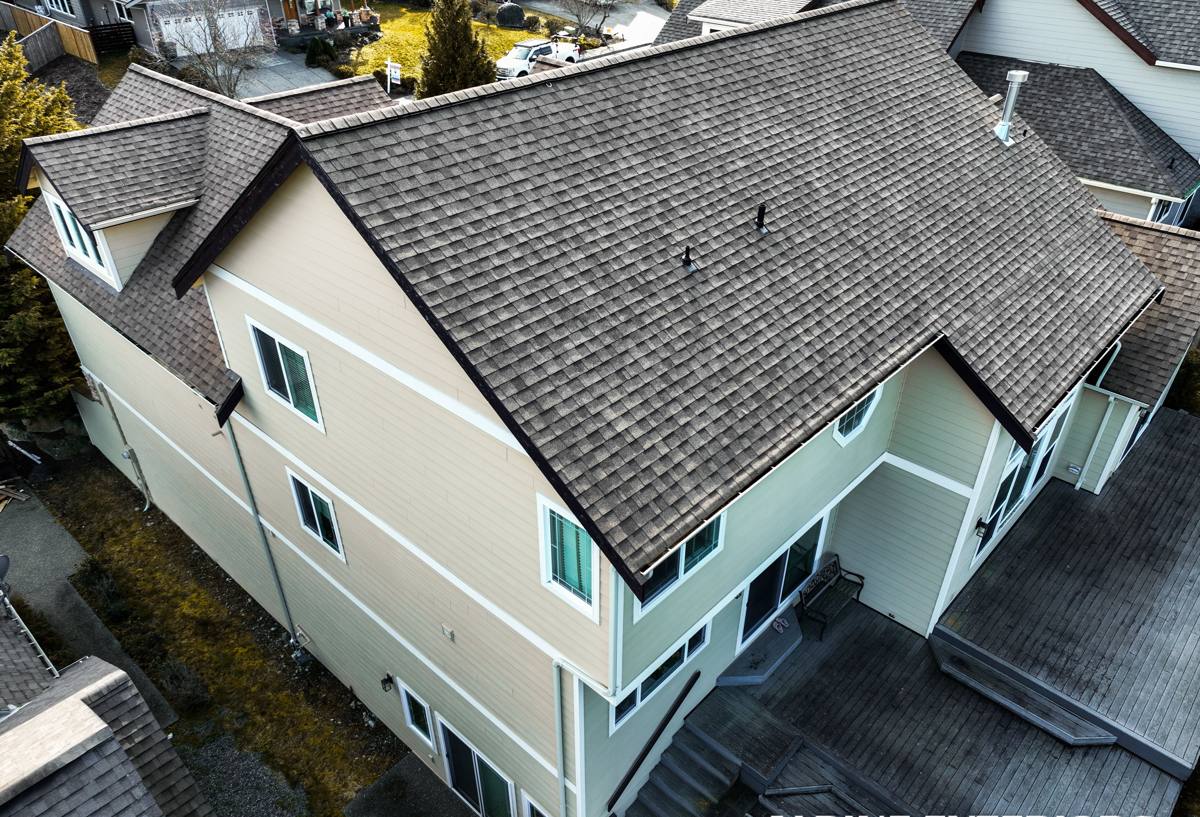
What Everson's Climate Does to a Deck Over Time
Moisture Is the Enemy, Not the Rain Itself
Rain falling on a deck surface isn't the real problem — it's rain that gets trapped between boards, behind ledger boards, or under railing posts and can't dry out before the next storm arrives. In a region where it can rain for days at a stretch and humidity stays elevated between storms, wood that doesn't get a chance to fully dry starts to trap moisture in joints, fastener holes, and end grain. That's where rot begins.
Moss and Algae Growth
Whatcom County's long moss season isn't just a cosmetic issue. Moss and algae hold moisture against the deck surface, make boards slippery and dangerous underfoot, and can work into seams and screw holes where they accelerate decay. A deck surface that's shaded by trees or sits low to the ground — common in Everson's wooded and riverside lots — is especially prone to this if it isn't ventilated and sloped correctly.
Hardware Corrosion
Standard fasteners and connectors that aren't rated for the wet, humid, occasionally salt-tinged air of this region will rust, stain the decking, and eventually fail structurally. This is one of the most common shortcuts we see on decks that were built cheap — and one of the most expensive to fix after the fact, because by the time rust stains show up on the surface, the connector underneath is often already compromised.
What a Correctly Built Deck Involves
A deck that's going to perform in this climate needs to be right in the parts nobody sees as much as the parts everyone does. Here's what we consider non-negotiable on every custom deck we build:
- Proper ledger board flashing where the deck attaches to the house, so water is directed away from the wall assembly instead of into it
- Stainless steel or coated, corrosion-resistant fasteners and structural connectors throughout — not just at visible points
- Footings set below frost depth and sized for the actual load and soil conditions of the site, not a generic minimum
- Joist spacing and blocking appropriate to the decking material chosen, since composite and PVC products often have different span requirements than wood
- A slight, consistent slope away from the house so water sheds off the surface instead of pooling
- Gapping between boards sized correctly for the material, allowing airflow and drainage underneath
- Railing posts through-bolted to the frame, not just lag-screwed into a rim joist
- Adequate under-deck ventilation, especially on lower decks or those in shaded, wooded areas typical of Everson lots
Skipping any one of these doesn't usually show up right away. It shows up in year three or four, as soft spots, rust streaks, or a railing that's gone loose — and by then the fix is a lot more involved than it would have been to do it right the first time.
Choosing the Right Decking Material
There's no single "best" decking material — there's a best material for your budget, your maintenance tolerance, and how the deck sits relative to sun and shade on your property. We'll walk through the honest trade-offs rather than push whatever has the best margin.
| Material | Upfront Cost | Maintenance | How It Handles This Climate |
|---|---|---|---|
| Pressure-treated wood | Lowest | Annual cleaning, periodic sealing or staining | Good if maintained consistently; neglect leads to graying, splintering, and faster moss buildup |
| Cedar | Moderate | Regular sealing to preserve color and resist moisture | Naturally more rot-resistant than most softwoods, but still needs upkeep in a wet climate |
| Composite decking | Higher | Occasional washing, no staining or sealing | Resists rot and doesn't need refinishing, but can still grow surface algae/moss if not cleaned and needs proper ventilation underneath |
| PVC/capped polymer | Highest | Lowest — soap and water cleaning | Fully moisture-resistant material; best long-term option for consistently damp or shaded sites, at the highest material cost |
For a lot of Everson homeowners, especially on shaded or riverside properties, we lean toward recommending composite or capped polymer decking for the walking surface simply because it removes the maintenance burden that wood demands in a climate like this. But there are plenty of sites — open, sunny, well-ventilated lots — where a well-built and properly maintained wood deck is a perfectly sound, more affordable choice. We'll walk your specific site with you before recommending either way.
Cost Factors on a Custom Deck
Every deck is priced around the specifics of the site and the design, so we won't quote a number without seeing the property — but these are the factors that move the price the most, in roughly the order they matter:
| Factor | Why It Matters |
|---|---|
| Size and footprint | Square footage is the baseline driver of material and labor cost |
| Decking material | Pressure-treated wood, cedar, composite, and PVC span a wide cost range, as shown above |
| Height and structure | A deck more than a few feet off grade needs more substantial framing, stairs, and often guardrails, which adds cost |
| Site access and soil | Difficult access or soil that needs extra footing work can add labor time |
| Railing style | Basic wood rail, cable rail, and glass panel systems all price very differently |
| Permitting | Most new decks over a certain size or height require a permit through Whatcom County, which adds time and a modest fee to the project |
Local Considerations Specific to Everson
Everson properties often sit on larger lots with more tree cover and proximity to the Nooksack River floodplain than you'd find in denser parts of Whatcom County. That matters for a deck project in a few practical ways: shaded sites need extra attention to airflow and moisture management underneath the structure, and any construction near the floodplain may involve additional review from the county depending on exact location and elevation. Most residential deck construction in unincorporated Whatcom County and in Everson requires a building permit — we handle that process as part of the job rather than leaving it to the homeowner to sort out.
We also pay attention to how a deck ties into the rest of the home's exterior. If your siding, trim, or fascia is due for attention at the same time, it's worth coordinating that work so flashing and water management are consistent across the whole exterior rather than patched together at different times by different contractors.
Our Process, Start to Finish
- Site visit and consultation: We walk the property, look at drainage, sun exposure, existing structure (if replacing a deck), and talk through how you actually plan to use the space.
- Design and material selection: We put together a layout and go over material options honestly, including cost and maintenance trade-offs for your specific site.
- Permitting: We handle the permit application and county requirements so it's done correctly the first time.
- Construction: Footings, framing, decking, and railings are built to the standards outlined above — not the code minimum, but what actually holds up here.
- Final walkthrough: We go over the finished deck with you, including basic care and what to expect from your chosen material over time.
Keeping Your Deck Looking Good for Years
Whatever material you choose, a little seasonal attention goes a long way in this climate. Here's what we recommend to every Everson homeowner after their deck is built:
- Sweep debris off the surface regularly, especially in fall when leaves and needles accumulate and trap moisture
- Wash the deck surface at least once a year to remove moss and algae buildup before it takes hold
- Check and clear gaps between boards so water and debris don't accumulate
- Inspect railings and stair connections annually for looseness
- For wood decking, reseal or restain on the schedule recommended for your specific product — usually every 1-2 years
- Keep nearby vegetation trimmed back to allow sunlight and airflow across the deck surface
Why Hire a Crew That Already Works in This Area
A deck built by someone unfamiliar with Whatcom County's rain patterns, soil conditions, and permitting process is a deck that's more likely to cut corners in places that matter here — flashing details, fastener grade, drainage slope — because those things simply aren't as critical in drier climates. We build and maintain exteriors across Ferndale and the surrounding Whatcom County communities, including Everson, and we design every deck around the reality of this climate rather than a generic national standard. That's not a marketing line — it's the difference between a deck that needs major repair in five years and one that's still solid in twenty.
If you're planning a new deck or replacing one that's showing its age, we'd be glad to take a look at your property and talk through what makes sense for your site, your budget, and how you want to use the space. Reach out for a free, no-pressure estimate using the form below.