 Ferndale
 Why Everson Roofs Take Extra Wear
Everson sits a little farther inland than our coastal Ferndale customers, so it doesn't get the same direct salt exposure that homes closer to Bellingham Bay deal with. But it still sits inside the same marine weather pattern that defines this whole corner of Whatcom County: long stretches of driving rain, short winter daylight, and heavy tree cover that keeps roofs shaded and damp well past the point where a sunnier roof would have dried out. That combination is what actually damages roofs here — not one big storm, but months of a roof surface that never fully dries between rain events.
A roof built to a national code minimum can handle an average storm. What it struggles with is the accumulated moisture cycle: moss holding water against shingles for weeks at a time, flashing that was never quite sealed right slowly wicking water under siding, and gutters that back up during the heaviest rain of the year and dump water exactly where it shouldn't go. Repair work out here is mostly about undoing the slow damage from that cycle before it turns into something structural.
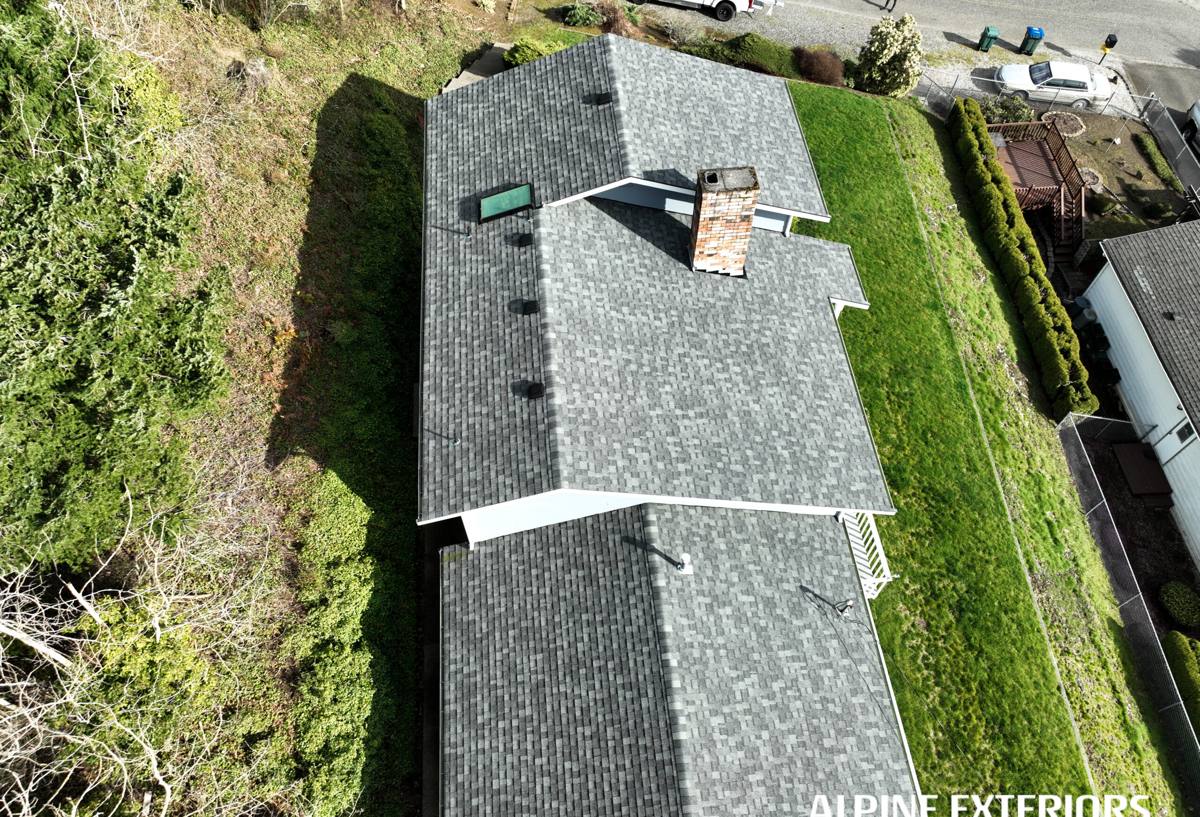
What Typically Fails First
Moss and Algae Growth
Moss doesn't just sit on top of a roof — it grows roots into shingle mat, lifts tabs, and holds a wet sponge against the roof deck for most of the wet season. On shaded, north-facing slopes and roofs under fir or cedar cover, moss can establish faster than most homeowners realize. By the time it's visible from the ground, it's usually already lifted shingle edges enough for wind-driven rain to get underneath.
Flashing and Roof-Wall Intersections
This is the area we see fail most often, and it's also the area a siding crew is trained to look at differently than a roofer who only thinks about shingles. Anywhere a roof meets a wall, chimney, dormer, or skylight, there's a flashing detail that has to shed water correctly. Step flashing that was installed short, counter-flashing that was caulked instead of properly lapped, or kick-out flashing that was left off entirely at a roof-to-wall termination are common culprits — and they don't just cause roof leaks, they send water straight down behind the siding.
Wind-Driven Rain and Nail Pops
Whatcom County storms tend to bring rain sideways as much as down. That drives water uphill under shingle tabs that are even slightly loose, and it works nails back out over repeated freeze-thaw and wet-dry cycles. Nail pops and lifted tabs are minor on their own, but they're the entry point for the leaks that eventually show up as a stain on an interior ceiling.
What a Correct Repair Actually Involves
Diagnose Before You Patch
The biggest mistake in roof repair is treating the visible symptom instead of the source. A stain on a ceiling might be twelve feet from where water is actually entering the roof, because water travels along the underlayment or roof deck before it drips. A correct repair starts with tracing the path — checking the flashing, the decking, the underlayment condition, and the surrounding shingle field — before anything gets cut open or replaced.
Matching Materials and Doing the Transitions Right
Repairs fail when new material doesn't integrate properly with what's already there — mismatched shingle profiles, flashing that isn't properly woven into the existing courses, or sealant used as a substitute for correct lapping. Sealant has its place, but it's a backup, not a waterproofing strategy on its own. Every flashing lap and shingle course should be able to shed water on its own, with sealant adding a margin of safety rather than doing the primary work.
| Repair Type | What's Typically Involved | General Cost Driver |
|---|---|---|
| Spot flashing repair | Re-flashing a chimney, wall, or vent boot; resealing and re-lapping correctly | Low — limited area, one access point |
| Moss-related shingle repair | Removing damaged shingles, treating the deck, replacing affected sections | Moderate — depends on how far damage has spread |
| Valley or roof-wall repair | Rebuilding a leaking valley or roof-to-siding transition, often includes siding trim work | Moderate to higher — more materials and labor at a complex intersection |
| Widespread deck or structural repair | Replacing rotted decking or framing found under compromised shingles | Higher — usually signals it's time to compare repair against replacement |
Repair vs. Replacement: How We Help You Decide
Not every call needs a full roof. If the roofing material itself is still in reasonable shape and the problem is isolated — a bad flashing detail, a moss-damaged section, a few storm-lifted shingles — a targeted repair is the honest recommendation, and it's usually a fraction of the cost of a new roof. We'll tell you plainly when that's the case.
Where it gets harder is when repair calls start repeating in the same general area, or when we find rot in the decking once shingles are pulled back. At that point patch-and-go work stops being cost-effective, because you're paying labor twice for the same underlying problem. We'll show you what we found and explain the trade-off in plain terms — we don't have an incentive to push a bigger job than the roof actually needs, and we'll say so directly if a repair is the right call.
Our Process, Start to Finish
Inspection
We get on the roof, not just in the attic or on a ladder from the ground. That means checking flashing details, shingle condition, moss coverage, and the roof-to-siding transitions that a lot of repair estimates skip entirely.
Repair Day
We explain what we're doing and why before we start cutting into anything, including which sections get replaced versus which flashing gets rebuilt. If we find something worse than expected once material is pulled back — soft decking, for example — we stop and talk to you before proceeding, not after.
Cleanup and Documentation
Debris and old material get hauled off the same day. We'll also walk you through what was done so you have a record of the repair, which matters if you sell the home or need to reference it later.
Where Roofing Meets Siding — Why It Matters Here
As a siding and exteriors crew based in Ferndale, we spend most of our time looking at exactly the zone where roof repair problems most often start: the transition between roof edge, wall, trim, and siding. A roof leak that isn't actually a roof problem — it's a flashing or kick-out problem at the wall — is one of the most common things we find, and it's easy for a roofer who only thinks about shingles to miss, and just as easy for a siding installer who never gets on the roof to miss from the other direction. Working both sides of that intersection is where a lot of repeat leaks finally get solved for good.
This also means when we repair a roof-wall detail, we're not just patching the roofing — we're making sure water can't get behind the siding either, which is often the actual source of rot that homeowners notice as soft trim or a stained wall before they ever notice a roof leak.
Keeping a Repaired Roof Healthy Through Moss Season
A good repair buys you time, but Whatcom County's wet, shaded conditions mean moss and debris will come back if the roof isn't checked periodically. A little regular attention goes a lot further here than it would in a drier climate.
- Clear gutters and downspouts before the fall rains start, and again mid-winter if the property has heavy tree cover
- Keep overhanging branches trimmed back to cut down on shade and debris buildup on the roof surface
- Have moss physically removed rather than just treated, since chemical treatment alone doesn't stop moss that's already rooted into shingle mat
- Watch for granule buildup in gutters, which signals accelerated shingle wear
- Do a visual check after any major windstorm for lifted or missing shingles
- Get flashing and roof-wall transitions looked at every few years, even if there's no visible leak yet
Why a Ferndale-Based Crew That Already Works Everson Matters
Roof repair diagnosis is faster and more accurate when the crew already understands how Whatcom County's rain and moss patterns actually behave on real roofs in this area, rather than applying a one-size-fits-all approach from a drier region. Being based in Ferndale also means we're not driving in from out of the area for a service call — we're already working this part of the county, which matters when a leak needs attention before the next storm rolls through rather than weeks out on someone's schedule.
We also see the same handful of failure patterns repeat across homes in and around Everson, which means we're usually not guessing at the cause — we're checking the spots that experience tells us are most likely to be the source before we ever get on a ladder.
If you've got a roof leak, moss buildup, or a repair that's been on your list for a while, we're happy to take a look. Estimates are free, there's no pressure to book anything on the spot, and you'll get a straight answer about what actually needs to be done — just fill out the form below to get started.