 Ferndale
 Why Fairhaven's Location Changes What Siding Has to Do
Fairhaven sits along Bellingham Bay in Whatcom County, close enough to salt water that the air itself carries moisture and salt onto every exterior surface, day after day. Add Whatcom County's long, wet fall-through-spring stretch and the shaded, tree-heavy lots common in this part of the county, and you get a climate that is genuinely harder on siding than most inland areas of Washington. Homes here deal with three things at once: salt-laden air that accelerates corrosion on unprotected metal and fasteners, wind-driven rain that gets pushed sideways into seams and laps most siding never has to resist, and a moss and algae season that can run most of the year on north-facing or shaded walls.
None of that is unique to any one street or block — it's the baseline for anyone living near this stretch of water in Whatcom County. But it means a siding job that would hold up fine in a drier, sunnier part of the state can fail early here if it wasn't built for this specific exposure. That's the lens we use on every Fairhaven-area estimate.
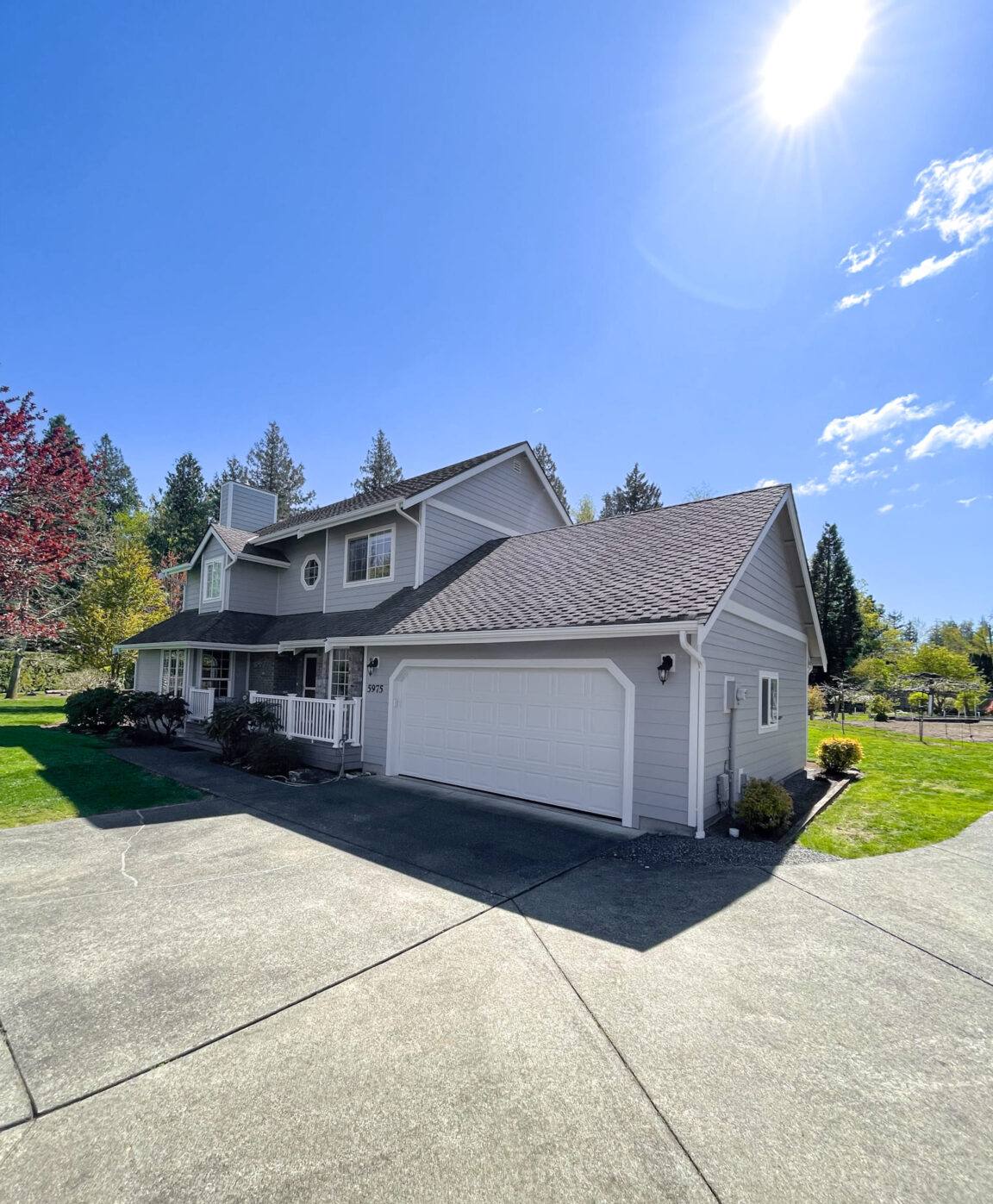
What Fiber Cement Siding Actually Needs to Handle Here
Moisture Management, Not Just Water Resistance
"Water-resistant" siding and siding that's actually detailed to shed water are two different things. In a climate with sustained driving rain, the siding itself is only part of the system — the flashing, the weather-resistive barrier behind it, the laps, and the gaps at penetrations do most of the real work. Fiber cement performs well here because it's dimensionally stable and doesn't wick moisture the way wood-based products can, but only if the installation behind it is correct. A great board installed with sloppy flashing details will still let water in.
Standing Up to Salt Air Over Decades
Salt air is slow but relentless. It attacks exposed fasteners, thin field-applied paint films, and any spot where a coating has been compromised by a cut edge or a nail hole that wasn't sealed. Fiber cement's mineral composition doesn't corrode the way metal siding can, and a factory-applied finish holds up to salt exposure far better than paint rolled or sprayed on site after installation, because it's cured under controlled conditions and bonded more completely to the substrate.
Resisting Moss, Algae, and Mildew
Shaded walls and roof lines in this part of Whatcom County stay damp for extended stretches, which is exactly what moss and algae need to take hold. Fiber cement doesn't feed mold and mildew growth the way wood or wood-composite products can, since there's no organic wood fiber at the surface for it to root into. It still needs the same basic upkeep as any siding — periodic washing on shaded elevations — but it isn't a food source for what's growing on it.
Why We Install Only James Hardie Fiber Cement
We don't install vinyl, LP SmartSide, or the other engineered wood and fiber cement alternatives on the market. That's a standard, not a sales pitch, and it comes down to what those products ask of a house in this climate versus what James Hardie's system is actually engineered for.
Climate-Engineered HZ Product Lines
James Hardie builds its siding in different formulations for different climate zones — HZ5 for regions with more moisture and freeze-thaw exposure, HZ10 for hot-humid regions. Western Washington, including Whatcom County, falls into the moisture-and-moderate-freeze category the HZ5 formulation is built around. That's a meaningfully different product than what gets shipped to a dry, hot climate, and it's a big part of why we don't treat fiber cement as one interchangeable product across the country.
ColorPlus Factory Finish
Most of what fails first on painted exterior siding is the paint, not the substrate underneath it. James Hardie's ColorPlus finish is baked on in a factory under controlled temperature and humidity, with multiple coats and a clear coat over the color layer. That gives it better fade resistance and a stronger bond than a field-applied paint job, which matters most exactly where the sun and salt air are working against it hardest — the south and west-facing walls that take the brunt of the weather.
Non-Combustible and Backed by a Real Warranty
Fiber cement is non-combustible, which some homeowners care about for insurance and safety reasons independent of climate. James Hardie backs its siding with a long, transferable limited warranty — real protection that adds resale value, not just a marketing line, because it follows the product through a change of ownership rather than resetting.
What a Correct Fiber Cement Installation Actually Involves
The product is only half the equation. A James Hardie install done to spec, versus one done fast and loose, is the difference between siding that performs for decades in this climate and siding that develops problems in five years. Here's what we hold every job to:
- Proper weather-resistive barrier installed and lapped correctly behind the siding, not just tacked up as an afterthought
- Flashing at every window, door, and roof-to-wall intersection, installed to shed water outward and downward
- Correct fastener type, spacing, and placement per Hardie's published installation instructions — this is where a lot of shortcut jobs fail first
- Proper clearance from grade, roof lines, decks, and patios so the bottom edge of the siding never sits in standing water or constant splash-back
- Caulking only where Hardie's instructions call for it, with the right sealant — over-caulking traps moisture just as badly as under-caulking lets it in
- Field-cut edges sealed to protect the factory finish at every cut
- A rainscreen gap where conditions call for it, giving any moisture that does get behind the siding a path to drain and dry out
Our Process, Start to Finish
We keep the process straightforward because that's what actually protects the homeowner:
- Walkthrough and assessment — we look at the existing siding, the sheathing and moisture barrier condition where visible, and the specific exposure of each wall (which sides take the driving rain, which stay shaded and damp).
- Written estimate — a clear scope, product line, color, and price, with the reasoning behind any recommendations tied to your home's actual exposure, not a generic package.
- Prep and tear-off — removing old siding down to sound sheathing, repairing any rot or damage found underneath before anything new goes on.
- Weather barrier and flashing — the part of the job that determines whether the siding stays dry for the next 30-plus years.
- Installation to Hardie spec — correct fastening, clearances, and sealing at every step, not just at the parts that show.
- Final walkthrough — going over the finished work with you before we call it done.
Cost Factors on a Fiber Cement Job Near the Water
Every home is different, so we don't quote off square footage alone. These are the variables that actually move the number:
| Factor | Why It Matters Here |
|---|---|
| Existing siding removal | Tear-off and disposal of old material, plus any sheathing repair found underneath once it's exposed |
| Wall exposure and complexity | Shaded, moss-prone elevations and walls that take direct wind-driven rain often need more careful flashing and detailing |
| Trim and architectural detail | Corner boards, window trim, and multiple roof lines add labor beyond flat wall footage |
| Siding profile and plank width | Lap siding, panel systems, and shingle-style Hardie products differ in material and install time |
| Access and site conditions | Tree cover, tight lot lines, and grade around the foundation affect scaffolding and staging |
Why a Crew That Already Works This Area Matters
A crew that's used to working homes near the water in Whatcom County isn't guessing about exposure — we already know which walls in this kind of setting tend to stay damp longest, which details need extra attention against driving rain, and how to sequence a job around the wetter stretches of the year here. That local pattern recognition shows up in the small decisions on a job site: where to add extra flashing even when it's not strictly required, which cut edges need the most attention, how to stage a tear-off so exposed sheathing isn't left open to a rain system rolling in off the bay. Being based in Ferndale means we're a short drive from Fairhaven and the rest of Whatcom County, so warranty callbacks and follow-up visits aren't a logistical burden — we're already in the area.
Maintenance and What to Expect Long-Term
Correctly installed James Hardie siding is low-maintenance, not no-maintenance. In this climate, that means an occasional rinse-down on shaded, moss-prone walls, a visual check of caulking at trim and penetrations every year or two, and prompt attention if you notice a section of trim, a downspout, or flashing that's come loose — small issues are cheap to fix and expensive to ignore once water gets behind the siding. The ColorPlus finish means you're not on a five-to-seven-year repaint cycle the way you would be with field-painted wood or fiber cement, which matters a lot when the salt air and sun are working against any coating.
If you're weighing a siding replacement or repair on a home in the Fairhaven area, we're happy to walk the property, look at what your specific walls are dealing with, and put together a straightforward, no-pressure estimate — use the form below to get started.