 Ferndale
 Marietta's Exterior Siding Has a Harder Job Than Most
Marietta sits in the low-lying, water-adjacent part of Ferndale, and that location changes what "good siding" actually means. Homes a few miles inland in Whatcom County deal with rain and cold, full stop. Homes in Marietta deal with all of that plus salt-laden marine air moving in off the water almost daily, driving rain that comes in sideways during winter storms, and a moss season that can stretch from fall through spring in the shaded, damp corners of a lot. Siding here isn't just cladding — it's the first line of defense against a climate that's actively trying to get behind it.
That's the lens we use on every Marietta project: not "does this look good going up," but "does this hold up in this specific place, in year eight, in year fifteen, in year thirty." A lot of siding failures we get called out to inspect weren't caused by bad material. They were caused by an installation that didn't account for where the house actually sits.
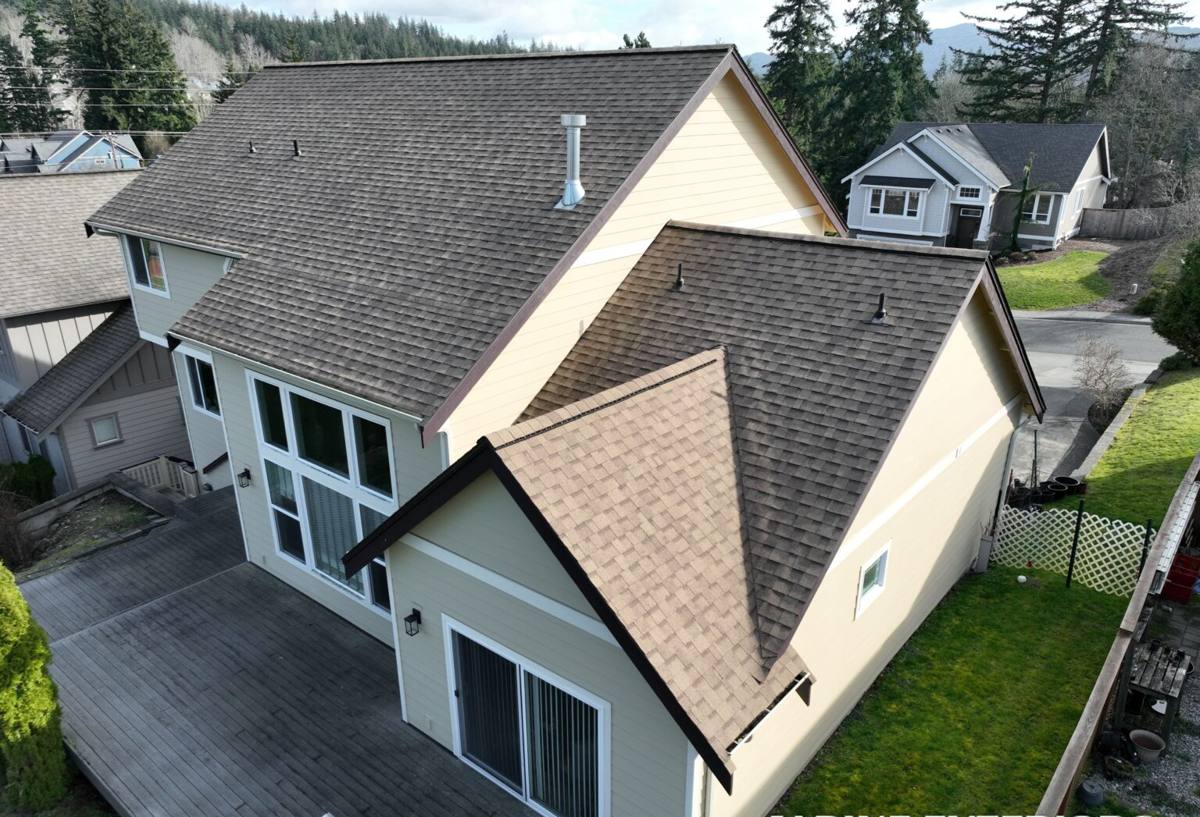
What Salt Air, Rain, and Moss Actually Do to a Home's Exterior
Each of these three factors stresses siding in a different way, and a correct installation has to answer all three at once.
Salt Air
Airborne salt is corrosive to unprotected metal fasteners, trim flashing, and hardware, and it accelerates the breakdown of finishes that aren't built to resist it. Over years, a house facing the water can show fastener bleed-through, corroded trim pieces, and a finish that chalks or fades faster than the same product would inland.
Driving Rain
Wind-driven rain doesn't just fall on siding — it gets pushed sideways and upward into laps, seams, and penetrations. If the water-resistive barrier behind the siding, the flashing details around windows and doors, and the lap spacing aren't done correctly, water finds its way behind the cladding and into the wall assembly, where it does damage you won't see until it's expensive.
Moss and Sustained Moisture
Long stretches of damp, shaded weather let moss and algae take hold on north-facing walls, under eaves, and anywhere air doesn't circulate well. Beyond the cosmetic issue, sustained organic growth holds moisture against the siding surface longer than it would otherwise sit there, which matters most for products that aren't dimensionally stable when wet.
What a Correct Siding Installation Requires in This Environment
"Correct" isn't a marketing word here — it's a specific, checkable set of steps. Skipping any one of them is how a siding job that looks fine on installation day turns into a moisture or corrosion problem five to ten years later.
Water Management Comes First
Before a single piece of siding goes up, the wall needs a continuous, properly lapped water-resistive barrier, correctly integrated flashing at every window, door, and penetration, and back-flashing or drainage space where required. In a driving-rain environment, this layer is doing more work than the siding itself — the siding sheds most of the water, but the barrier behind it handles what gets past.
Fastening and Hardware Matter More Here
In a salt-air environment, fastener selection isn't a detail to gloss over. Corrosion-resistant fasteners and trim hardware, installed to manufacturer spacing and depth specifications, are what keep the installation performing instead of staining and loosening years earlier than it should.
Clearances and Airflow
Proper ground clearance, gaps at grade and roof lines, and gutter and drainage details that route water away from the base of the walls all reduce how much sustained moisture the lower courses of siding sit in. This is also where moss gets a foothold fastest if it's overlooked — tight, poorly ventilated corners near grade.
Why We Install Only James Hardie Fiber Cement
We standardized on James Hardie siding for every home we work on, including in Marietta, and it's a deliberate call rather than a default. Fiber cement is non-combustible and dimensionally stable — it doesn't swell, cup, or rot the way wood-based products can when they take on repeated moisture, which matters directly in a climate with this much sustained dampness and driving rain.
Hardie's ColorPlus factory finish is baked on under controlled conditions rather than field-applied, which gives it better, more consistent resistance to fading and wear than a job-site paint job — a real advantage against salt air and UV exposure over a long ownership period. Hardie also engineers specific product lines (its HZ5 line, for example) for wetter, harsher climate zones, which is the category the Pacific Northwest coastal belt falls into. That's paired with a strong, transferable manufacturer warranty, which matters to buyers if the home ever sells.
None of this means other siding products are junk — some have real strengths. It means that after years of installing and repairing exterior siding in this specific climate, fiber cement done right is what we're willing to put our name behind and what we recommend homeowners actually budget for, rather than the cheaper option that needs more attention sooner.
Our Installation Process for Marietta Homes
- Site and wall assessment — we look at sun and wind exposure, drainage at grade, existing moisture damage, and how close the home sits to open water or exposed wind corridors.
- Tear-off and substrate check — old siding comes off and the sheathing underneath gets inspected for rot or existing water damage before anything new goes up.
- Water-resistive barrier and flashing — a continuous barrier and correctly lapped flashing at every window, door, and penetration, sized for wind-driven rain exposure.
- Hardie installation to manufacturer spec — correct fastener type, spacing, and depth; proper lap and clearance dimensions; factory-finished panels and trim installed with the gaps and caulking details Hardie's specifications call for.
- Trim, flashing, and detail work — corners, transitions, and penetrations are where most future leaks originate if rushed, so these get the most attention.
- Final walkthrough — we go over the finished work with the homeowner and flag any maintenance items specific to the home's exposure.
Cost Factors for a Marietta Siding Project
Every home is different, so we don't quote broad numbers without seeing the house — but these are the variables that actually move the price up or down.
| Factor | Why It Matters | Effect on Cost |
|---|---|---|
| Tear-off vs. new construction | Removing and disposing of old siding, and repairing any substrate damage found underneath | Increases cost when hidden moisture damage is found |
| Home size and wall complexity | More corners, dormers, and roof intersections mean more flashing and trim detail | More labor-intensive, higher cost per square foot |
| Existing moisture or rot damage | Damaged sheathing or framing has to be repaired before new siding can go on | Adds material and labor beyond the base siding job |
| Trim and accessory selection | Corner boards, trim profiles, and color options carry different material costs | Moderate impact, homeowner's choice |
| Site access and exposure | Water-facing walls and hard-to-reach areas take more care and time to detail correctly | Moderate impact, depends on the lot |
Signs Your Siding Is Already Losing the Fight
In this climate, siding problems tend to show up gradually and get dismissed as cosmetic until they aren't. Worth checking for:
- Soft or spongy spots when you press on the siding, especially near the bottom courses or corners
- Persistent moss, algae, or dark staining that comes back shortly after cleaning
- Visible gaps, warping, or buckling in panels or lap seams
- Paint or finish that's peeling, chalking heavily, or fading unevenly on water-facing walls
- Rust streaks around fasteners or trim hardware
- Interior signs — musty smells, peeling interior paint, or staining on walls that back up to exterior siding
Any one of these on its own might be minor. Several together, especially on the walls most exposed to weather off the water, usually mean the current siding or its installation is falling short.
Why Local Experience in Marietta and Ferndale Matters
A crew that's worked this specific stretch of Whatcom County already knows which walls take the worst of the driving rain, where moss comes back fastest, and how much more attention salt-air exposure demands on fasteners and trim compared to a job a few miles inland. That's not something you can fully substitute with a generic install checklist — it comes from having done the work here, seen what fails first, and adjusted the details accordingly.
It also matters for the boring but important logistics: knowing local permitting expectations, being available for a warranty callback without a long drive, and understanding how this area's weather patterns should shape scheduling around a tear-off (you don't want a home's sheathing exposed to a Marietta rain event any longer than necessary).
If you're weighing a siding replacement on a Marietta home, we're happy to take a look and give you a straight, no-pressure estimate based on what your house actually needs — not a generic package. Fill out the form below to get started.