 Ferndale
 Why Board & Batten Fits Bellingham Homes
Board and batten has become one of the most requested siding profiles in Bellingham, and it's not just a style trend. The vertical lines read as clean and modern on newer builds, but they also pair naturally with the craftsman and farmhouse-influenced homes common throughout Whatcom County. It works on a full elevation or as an accent — a gable end, a porch wall, a dormer — mixed with horizontal lap siding elsewhere on the same house.
What most homeowners don't think about until later is that board and batten is a different animal from lap siding once you get past the visual. The vertical boards and the battens that cover each seam create more joints, more fastening points, and more places where water can find a way in if the install isn't done to spec. In a climate like Bellingham's — salt-influenced air off the water, long stretches of driving rain, and a moss season that doesn't really end — those details matter more than they would in a drier part of the state.
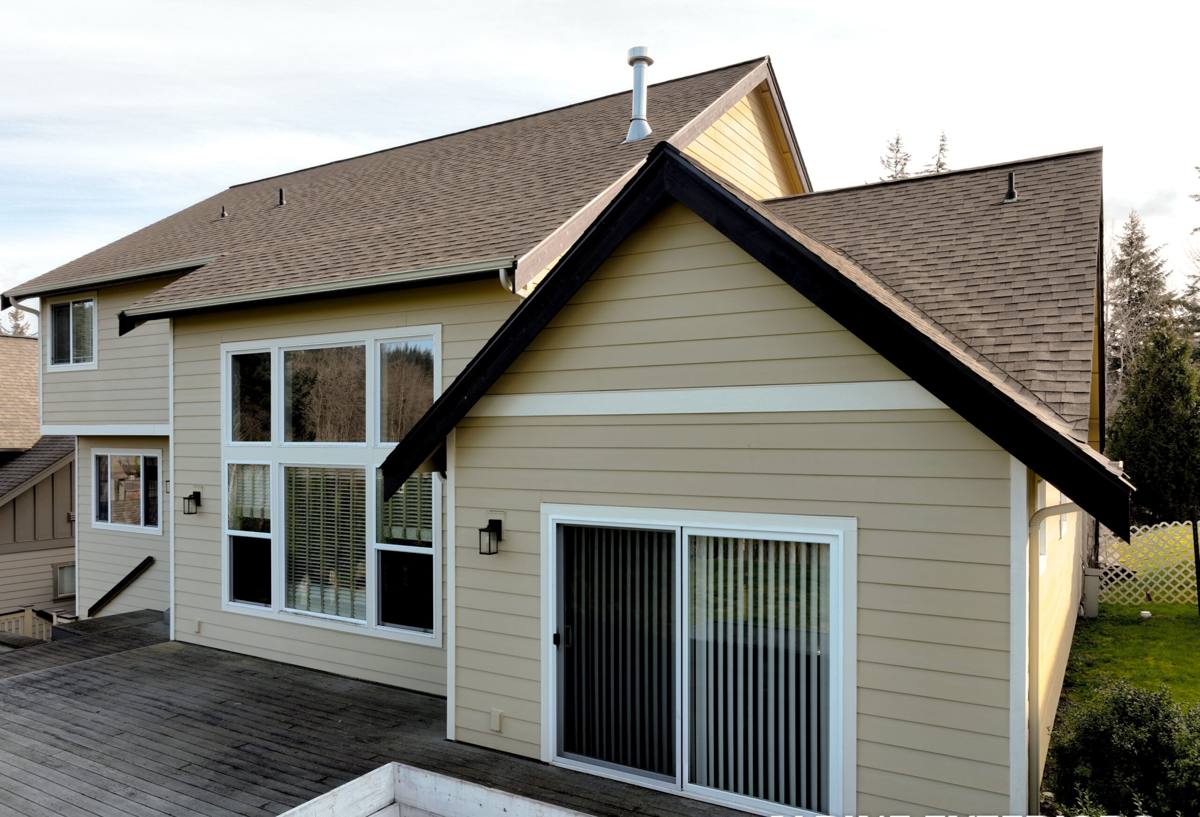
What Bellingham's Climate Actually Does to Vertical Siding
Salt Air and Marine Exposure
Homes closer to the water pick up salt-laden air that settles on exterior surfaces and accelerates corrosion of anything metal — fasteners, flashing, trim caps. On board and batten specifically, the battens themselves cover a seam that's fastened at intervals, so a corroding fastener under a batten is hidden from view until the batten starts to loosen or a stain bleeds through the paint. Corrosion-resistant fasteners and properly detailed flashing aren't optional upgrades here; they're baseline requirements for the assembly to last.
Driving Rain and Wind-Driven Moisture
Whatcom County storms don't just drop rain straight down — wind pushes it sideways into wall assemblies, and vertical board and batten has more vertical seams for wind-driven water to test than a horizontal lap profile does. Every batten needs correct overlap and fastening spacing, and the weather-resistive barrier behind the siding needs to be lapped and sealed correctly at every penetration. Skip a step there and water doesn't show up as a leak right away — it shows up months or years later as staining, soft trim, or paint failure.
Moss and Prolonged Shade
Ferndale and Bellingham both sit in a climate where moss and mildew have months of damp, mild conditions to work with, especially on north-facing walls and anywhere tree cover keeps a wall shaded and slow to dry. Vertical battens create small ledges and shadow lines that hold moisture and organic debris longer than a flat wall would. Siding material that resists moisture absorption, combined with a paint finish that holds up to regular washing, keeps that buildup from turning into a long-term maintenance headache.
Why We Only Install Board & Batten in James Hardie Fiber Cement
Board and batten is available in several materials — vinyl, engineered wood, primed wood, and fiber cement among them. We install it exclusively in James Hardie fiber cement, and that's a deliberate standard, not a default. Vinyl board and batten looks the part from the street but expands and contracts with temperature swings more than fiber cement, which can telegraph through fastener lines and battens over time, and it doesn't hold up as well to direct impact. Engineered wood and primed wood products depend heavily on caulking and paint maintenance to keep moisture out of the substrate — in a climate this wet, that's a maintenance burden we're not willing to put a homeowner's wall behind.
James Hardie fiber cement doesn't swell, rot, or feed moss the way wood-based products can, and it holds its shape through the Pacific Northwest's wet winters and dry summers without the expansion issues vinyl deals with. For vertical applications we typically build the assembly from HardiePanel vertical siding with HardieTrim boards as the battens, engineered as a system rather than field-improvised from separate panel and trim products. That system-level engineering — panel, batten, and the specified fastening pattern all designed to work together — is a big part of why it performs consistently over time.
ColorPlus Factory Finish
Most of our board and batten installs use Hardie's ColorPlus finish — a factory-applied, baked-on finish that's more consistent and more durable than field-applied paint, and it comes backed by its own finish warranty separate from the substrate warranty. For a profile with this many seams and edges, having a finish that's already cured and consistent before it goes on the wall removes one more variable from the equation.
What a Correct Board & Batten Installation Involves
The visual result of board and batten is simple — vertical lines with a clean batten over each seam. What's underneath that determines whether it lasts twenty years or starts showing problems in five. A correct install includes:
- A properly lapped and sealed weather-resistive barrier behind the entire assembly, with no gaps at seams or penetrations
- Correct furring or rainscreen detailing where called for, so water that does get behind the cladding has a path to drain and dry
- Manufacturer-specified fastener type, spacing, and embedment — not "close enough," since under-driven or over-driven fasteners are one of the most common causes of early siding failure
- Flashing integrated correctly at windows, doors, and any horizontal transitions, so water is directed out and away rather than trapped behind trim
- Proper batten spacing and fastening so seams stay covered and tight through seasonal movement
- Caulking only where the manufacturer's install specs call for it — over-caulking a fiber cement assembly can trap moisture instead of shedding it
- Field-touch-up of any cut edges with manufacturer-approved product to maintain the moisture barrier at every cut
None of these steps show up in a finished photo. They're the difference between a wall that holds up through a Whatcom County winter and one that needs attention in a few years.
Board & Batten vs. Other Common Siding Choices in This Area
| Factor | Board & Batten (James Hardie) | Vinyl Board & Batten | Engineered Wood Board & Batten |
|---|---|---|---|
| Moisture resistance | Does not absorb water or swell | Resists water but relies on drainage plane behind it | Vulnerable at cut edges and seams if not maintained |
| Performance in wind-driven rain | Stable, non-combustible, holds shape | Can flex, gaps can open at seams over time | Depends heavily on caulk and paint upkeep |
| Moss/mildew resistance | Resistant surface, holds finish well | Resistant but can show streaking | More susceptible if finish isn't maintained |
| Finish longevity | Factory ColorPlus finish, long warranty | Color molded in, can fade | Field-applied paint needs recoating |
| Fire resistance | Non-combustible | Combustible | Combustible |
Cost Factors for a Bellingham Board & Batten Project
Every board and batten job is priced around a handful of real variables, and knowing them upfront makes for a more useful conversation during your estimate:
- Wall complexity — full-elevation coverage costs more per square foot than an accent application, but a mixed lap-and-batten design can also add labor for the transition detailing
- Existing wall condition — if there's rot, moisture damage, or an outdated barrier behind the current siding, that gets addressed before new siding goes up, and it affects the scope
- Trim and batten spacing — tighter batten spacing means more material and more fastening labor than a wider spacing
- Color and finish selection — factory ColorPlus finishes vary slightly in cost by line, and custom field-painted finishes add labor
- Access and site conditions — multi-story walls, tight lot lines, or landscaping that limits staging can add time
We walk through all of this on-site rather than quoting blind, because the honest answer to "what will this cost" depends on what's actually happening at your house.
Our Process, Start to Finish
We start with an on-site walk-through of the walls getting new siding, checking the existing substrate and sheathing condition where it's exposed, and talking through batten spacing, color, and where board and batten will meet other siding profiles or trim. From there we provide a written estimate that spells out material, labor, and any repair work identified during the walk-through — no surprise change orders for problems we could have caught up front.
Installation follows manufacturer specifications for the weather-resistive barrier, flashing, fastening, and batten layout, with a final walk-through once the job is done so you can see the finished work and ask questions before we consider the job complete.
Why a Crew That Already Works in Bellingham Matters
Board and batten done wrong doesn't usually fail in an obvious way right away — it fails slowly, behind the wall, in exactly the conditions Whatcom County provides in spades. A crew that installs in this area regularly has already worked through how local wind-driven rain patterns, salt exposure near the water, and prolonged damp shade affect a vertical siding assembly, and builds the install accordingly rather than treating every job as if it's going up in a dry climate. That local experience, paired with using one siding system we know inside and out, is what keeps a board and batten wall performing the way it's supposed to for decades, not just for the first few dry summers.
If you're weighing board and batten for a home in the Bellingham area, we're happy to walk your walls with you and give you a straight answer on what it involves and what it costs — request a free, no-pressure estimate using the form below.