 Ferndale
 Birch Bay Decks Take a Different Kind of Beating
Decks in Birch Bay don't fail the same way decks fail ten miles inland. Being right on the water changes the math. Salt-laden air corrodes metal fasteners and connectors faster than it does even a few miles east. Wind off the bay drives rain sideways into board gaps and ledger connections that were never designed to shed water from that angle. And the long, damp Whatcom County shoulder seasons keep wood surfaces wet for weeks at a stretch, which is exactly the condition moss and algae need to get established. A deck built to a generic spec, or built by a crew that mostly works drier inland lots, tends to show its age in Birch Bay years before it should.
This page is specifically about replacing a deck in Birch Bay — not general deck repair, and not a copy of what we'd tell a homeowner in a sheltered part of Ferndale. The fixes, materials, and sequencing below reflect what actually holds up this close to salt water.
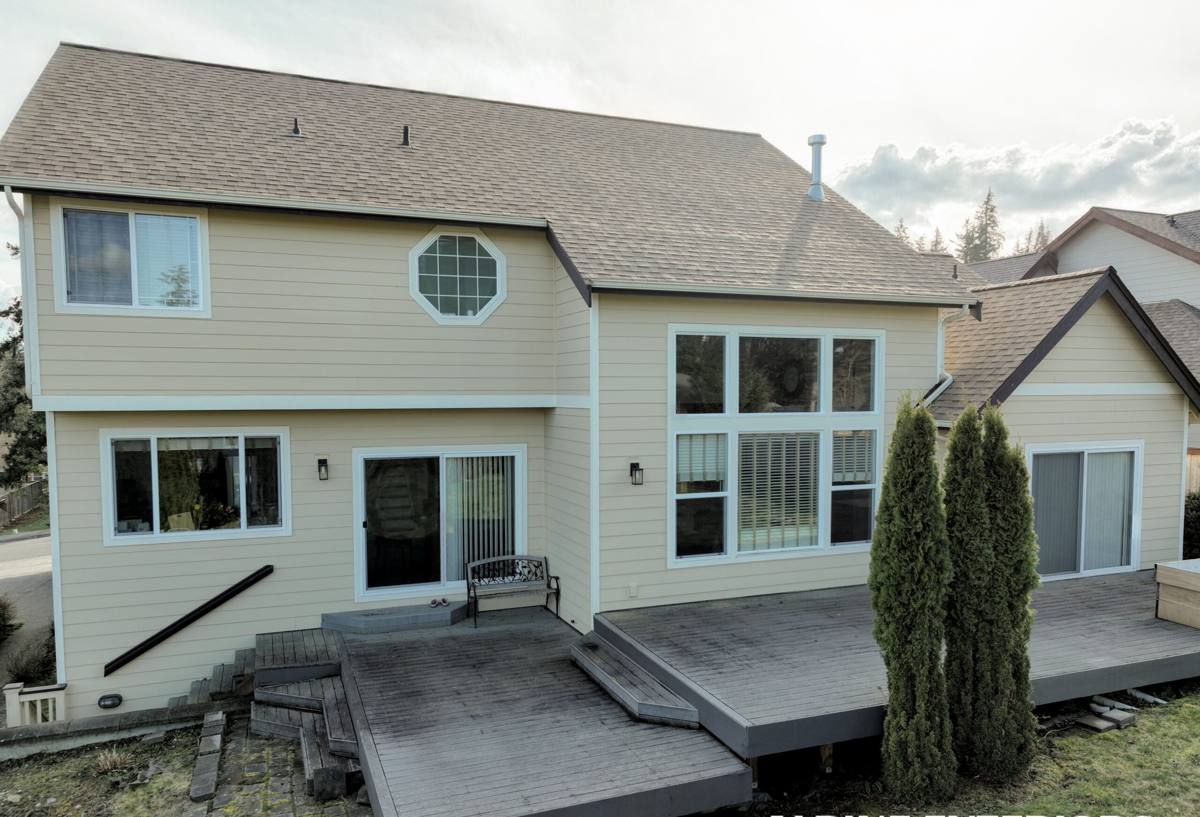
Signs a Birch Bay Deck Needs Replacement, Not Another Repair
Homeowners often ask us to "just fix the bad boards." Sometimes that's the right call. Often, once we're underneath a coastal deck, it isn't. Here's how to tell which situation you're in before you spend money.
Repair usually makes sense when:
- A handful of deck boards are cupped, splintering, or soft, but the framing underneath is dry and solid
- The railing is loose at a post or two but the posts themselves aren't rotted at the base
- Fasteners are rusting at the surface but the wood around them isn't punky
Replacement usually makes sense when:
- The ledger board — where the deck attaches to the house — shows soft wood, black staining, or gaps where flashing has failed
- Joists or beams are soft when probed with a screwdriver, especially near the ground or where boards meet
- Support posts have rot or corrosion at the base, where they sit in or near soil and standing water
- Multiple structural fasteners are heavily rusted, not just the visible surface screws
- The deck flexes, bounces, or feels different underfoot than it did a few years ago
The honest answer is that a deck's framing is what determines its real lifespan, and framing problems are hidden under the decking boards you can see. That's why we always inspect from underneath before recommending repair versus replacement — guessing from the surface leads to underestimating the job.
What a Correct Deck Replacement Actually Involves
A deck replacement done right in Birch Bay is not just swapping old boards for new ones on the same frame. Depending on the condition we find, it typically includes:
Ledger and flashing
The ledger board attachment to your house is the single most common point of hidden failure on any deck, and it's even more critical here because wind-driven rain hits it harder and more often. We install proper flashing that directs water away from the house band joist rather than behind it, and we use ledger fasteners rated for the load and for corrosion resistance — not standard construction screws that were never meant for continuous moisture exposure.
Framing and footings
Joists, beams, and posts get sized to current code span tables for your deck's dimensions and load, not just matched to what was there before. Footings need to sit below the local frost depth and bear on solid, undisturbed soil — this matters in Whatcom County's wetter, lower-lying areas where soil can stay saturated much of the year. Undersized or shallow footings are a common shortcut in older decks and a common cause of a deck that shifts or settles.
Fasteners and hardware
This is where coastal proximity really changes the spec. Standard galvanized hardware corrodes faster in salt air than it does further inland. We use stainless steel or high-grade coated fasteners and connectors rated for coastal or marine-adjacent exposure at every structural connection — joist hangers, post bases, ledger bolts. It costs more up front than using whatever's on the shelf, but replacing corroded hardware in five years costs a lot more than that.
Decking surface and rail system
The visible decking and railing get selected based on how much sun, rain, and moss exposure your specific spot on the property gets, and on how much upkeep you actually want to do. More on that below.
Choosing Decking Material for a Salt-Air, High-Moisture Site
There's no single "best" decking material — there's a best fit for your site, your budget, and how much maintenance you're willing to do. Here's how the common options actually perform in Birch Bay's conditions, in plain terms.
| Material | How it handles salt air & moisture | Maintenance | Typical lifespan here |
|---|---|---|---|
| Pressure-treated wood | Good if properly sealed and re-sealed; end grain and fastener holes are the weak points where moisture gets in | Annual cleaning, re-sealing every 1-3 years | 10-15 years with upkeep, less if neglected |
| Cedar | Naturally rot-resistant, but surface graying and moss growth happen quickly in damp shade | Regular cleaning and periodic oiling to hold color and resist moss | 15-20 years with upkeep |
| Composite decking | Doesn't rot or splinter; some early-generation composites held moisture at the core in wet climates, newer capped composites shed water much better | Periodic washing to keep moss and mildew from taking hold on the surface | 25+ years, backed by manufacturer warranty |
| PVC/vinyl decking | Fully sealed surface, no organic material for moss or rot to attach to | Occasional washing | 25-30+ years |
We don't push one material on every job. A wood deck that's cleaned and sealed on schedule can look great in Birch Bay for a long time — the tradeoff is that schedule has to actually happen every year or two, and driving rain plus shaded, north-facing sections of a lot make that upkeep more demanding here than inland. Composite and PVC cost more upfront but remove the moss-and-rot maintenance burden almost entirely, which is why a lot of coastal homeowners choose them even on a second or third deck after seeing how fast wood ages this close to the water.
Our Deck Replacement Process
We keep this straightforward because a deck project shouldn't be a mystery to the homeowner paying for it.
- On-site inspection. We get underneath the existing deck, probe the ledger, joists, beams, and posts, and check the flashing. This tells us whether you're looking at a full tear-out or a partial rebuild.
- Written scope and estimate. You get a clear breakdown of what's being replaced, what materials are proposed, and why — not a vague lump sum.
- Permit and code check. We confirm what Whatcom County or City of Ferndale permitting applies based on your deck's size, height, and location, and handle that paperwork.
- Demolition and disposal. Old decking, framing, and hardware come out and get hauled off — we don't leave debris piled on your property.
- Framing rebuild. New ledger flashing, joists, beams, footings, and posts go in to current code and to a coastal-durability standard, not just the minimum.
- Decking, rail, and stair installation. Your chosen surface material and railing system go on, with attention to fastener spacing and drainage gaps so water doesn't pool between boards.
- Final walkthrough. We go over the finished deck with you, including basic care guidance specific to the material you chose.
Permits and Whatcom County Considerations
Most deck replacements that involve structural changes — new footings, a different footprint, or a deck attached at a new height — require a permit. Even a like-for-like rebuild on existing footings can trigger permit requirements depending on size and railing height. We handle this as part of the project rather than leaving it for the homeowner to sort out, because getting it wrong can mean a failed inspection or a problem at resale. Setbacks from property lines and proximity to shoreline or critical areas can also come into play for properties closer to the water, which is worth flagging early rather than after materials are ordered.
Living With Your New Deck Through Moss Season
No decking material is completely maintenance-free in this climate — the goal of a correct build is to make maintenance easy instead of constant. A few habits keep any Birch Bay deck performing well:
- Sweep leaves and debris off the surface regularly, especially in fall — trapped organic material is what moss and algae feed on
- Keep gutters and downspouts near the deck clear so runoff isn't dumping directly onto the deck surface or framing
- Rinse the deck surface periodically, particularly shaded sections that stay damp longer
- Check railing and stair connections once a year for looseness — hardware is the first thing to show wear in salt air
- Re-seal wood decking on the schedule your product calls for; don't wait until it's visibly gray and dry
Why a Crew That Already Works Birch Bay Makes a Difference
A lot of what determines whether a deck lasts in Birch Bay isn't visible in a brochure — it's fastener grade, flashing detail, footing depth, and material choices matched to a specific site's sun and wind exposure. That's the kind of judgment that comes from having actually built and repaired decks in this exact area, not from a generic regional spec sheet. We're based in Ferndale and we work this stretch of Whatcom County regularly, so we've seen firsthand which shortcuts show up as problems in three years versus which details hold up for twenty. That local track record is also why we're comfortable standing behind the work — we're not driving off after the job and hoping it holds.
Get a Straightforward Estimate
If your Birch Bay deck is showing rot, corrosion, or just isn't holding up the way it used to, we're happy to take a look and give you an honest read on repair versus replacement — no pressure either way. Fill out the form below for a free estimate.