 Ferndale
 Siding in Blaine Has to Answer to the Water
Blaine sits about as close to the Salish Sea as a Whatcom County property can get, and that proximity shapes everything about how siding ages here. Salt-laden air moves off the water and settles on exterior walls day after day, year after year. Combine that with the driving, sideways rain that blows in off the coast during fall and winter storms, and a moss season that can run from October well into spring, and you have one of the more demanding siding environments in the county. A product that performs fine forty miles inland can struggle here — chalking early, absorbing moisture at the seams, or hosting moss and algae within a couple of seasons.
We install James Hardie fiber cement siding in Blaine and the surrounding Ferndale-area coastline because it's engineered to hold up to exactly these conditions. This page covers what Blaine homes specifically need from their siding, what a correct installation looks like in a marine environment, and how our process protects the investment for the long haul.
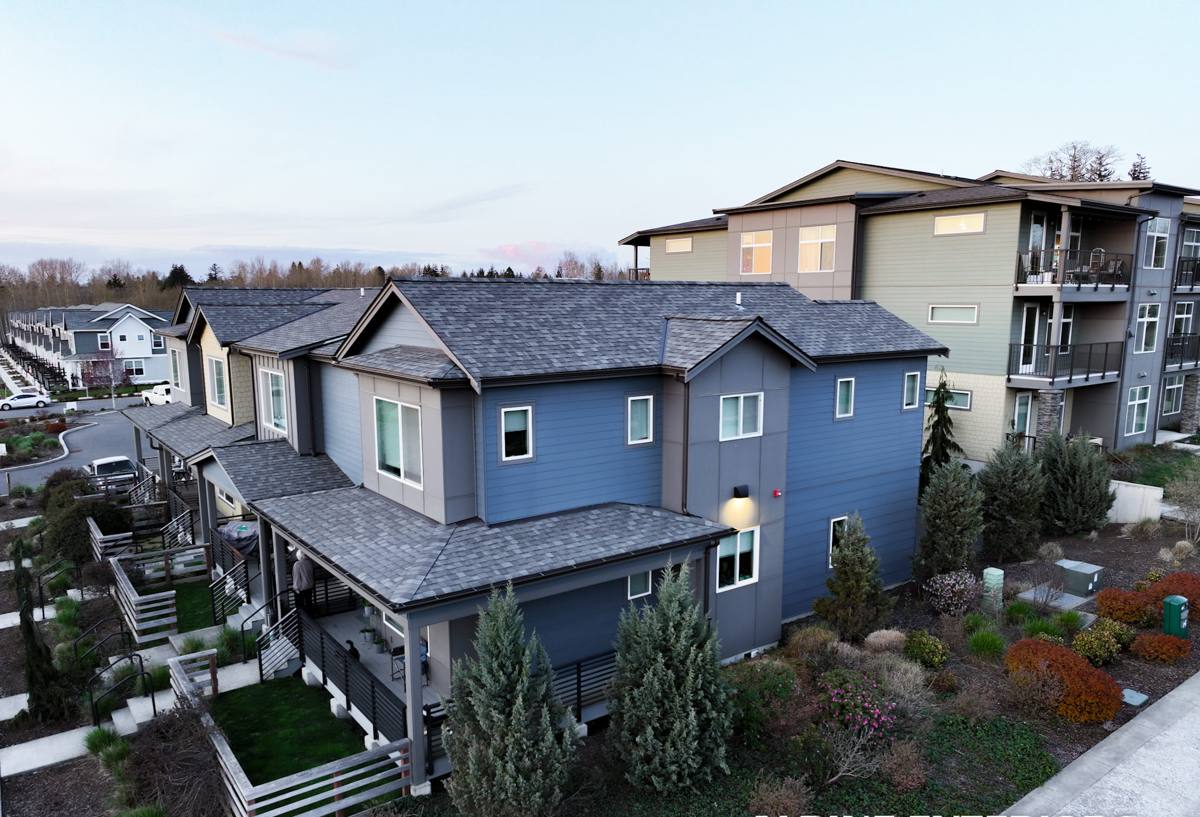
What Salt Air and Driving Rain Actually Do to Siding
It helps to understand the mechanism, not just the symptom. Salt air isn't just "coastal weather" — it's a mild corrosive and a moisture magnet. Airborne salt particles are hygroscopic, meaning they pull moisture out of the air and hold it against whatever surface they land on. On siding, that means more time spent damp, more cycles of wetting and drying, and more stress on fasteners, seams, and any exposed cut edges.
Driving rain adds a second problem: wind-driven water doesn't just run down a wall, it gets pushed sideways and upward into laps, seams, and trim joints that a calm rain would never reach. On a house that's exposed to open water or unbroken wind — which describes a lot of Blaine-area lots — that means the siding's water-shedding detailing (lap coverage, flashing, caulk joints) has to be right, not approximate.
Why Moss Season Matters More Here
Western Whatcom County's extended wet season gives moss and algae a long runway to establish on any exterior surface that stays damp and shaded. North-facing walls, areas under mature trees, and surfaces near ground level are the usual starting points. Once organic growth gets a foothold in siding seams or on a porous painted surface, it holds moisture against the substrate — which accelerates whatever damage the salt air and rain are already causing. Siding that resists moisture absorption in the first place breaks that cycle before it starts.
Why We Standardized on James Hardie
We install James Hardie exclusively — not vinyl, not LP SmartSide, not Cemplank, not Allura, not cedar or primed spruce. That's a deliberate call, not a lack of options.
- Non-combustible fiber cement core — resists fire, doesn't warp in heat, and won't soften or deform the way vinyl can in direct summer sun exposure.
- ColorPlus factory finish — baked-on color that resists fading and chalking far better than field-applied paint, which matters on a coastline where UV and salt both attack a painted surface.
- HZ5 climate-engineered formulation — Hardie's cold/wet-climate product line is built for exactly the freeze-thaw and moisture cycling the Pacific Northwest delivers.
- Dimensional stability — fiber cement doesn't expand and contract with moisture the way wood-based products do, so seams and caulk joints stay tighter over time.
- Strong transferable warranty — backed by the manufacturer, and it moves with the house if it sells, which matters to buyers evaluating a coastal property.
We're honest about the trade-offs of the products we don't install: vinyl is cheaper up front and low-maintenance in mild climates, but it can crack or warp under UV and thermal stress and it's not fire-rated. Cedar and primed spruce look great initially but demand a repaint and moisture-check cycle that most homeowners underestimate, especially in a wet marine climate. LP SmartSide and other engineered-wood products perform reasonably in drier regions but are more sensitive to sustained moisture exposure at cut edges and seams — a real risk on a property that takes driving rain most of the year. None of that makes those products bad; it just means they're not the right match for what Blaine's climate does to a house.
What a Correct Installation Looks Like Here
James Hardie siding is only as good as its installation. The product is engineered to perform, but a marine-climate installation has specific details that can't be skipped without shortening the siding's real-world life.
Water Management Comes First
Before a single piece of siding goes up, the wall needs a correctly lapped weather-resistive barrier, properly integrated flashing at every window, door, and penetration, and a drainage plane that lets any incidental moisture escape rather than pool behind the cladding. On a coastal, rain-exposed elevation, this layer matters more than the siding itself — it's the difference between a house that sheds water and one that traps it.
Fastening and Clearances
James Hardie publishes specific fastener patterns, minimum ground clearances, and gap requirements at trim and butt joints. In a high-moisture, salt-air environment, we hold to those specs strictly — correct fastener spacing prevents panel movement and cracking, and correct ground clearance keeps splash-back moisture away from the bottom course, which is often the first place deterioration shows up on coastal homes.
Caulking and Sealant Selection
Not all sealants hold up to salt air and constant wetting. We use sealants rated for the exposure and apply them at every joint where the manufacturer specifies it — trim-to-siding, panel-to-panel, and around every penetration. A missed or under-spec caulk joint is one of the most common ways water gets behind otherwise well-installed siding.
Installation Checklist for a Marine-Exposure Home
- Weather-resistive barrier lapped correctly, shingle-style, top to bottom
- Flashing integrated at every window, door, and roof-to-wall intersection
- Minimum clearance held between siding and grade, decks, and roofing
- Fastener pattern and spacing matched to Hardie's published specs
- Marine-grade sealant used at all specified joints
- ColorPlus touch-up paint used only where the manufacturer allows, to preserve warranty coverage
- North-facing and shaded elevations checked for airflow to reduce moss risk
Comparing Siding Options for a Blaine Property
| Factor | James Hardie Fiber Cement | Vinyl | Cedar / Primed Wood |
|---|---|---|---|
| Salt air resistance | Strong — non-porous core, factory finish | Moderate — can chalk and become brittle | Weak without diligent maintenance |
| Driving rain / moisture | Engineered HZ5 line for wet climates | Adequate if seams are tight | Prone to swelling, cupping at seams |
| Moss/algae resistance | Good — dense, low-porosity surface | Fair | Poor — organic material feeds growth |
| Fire rating | Non-combustible | Not fire-rated | Combustible |
| Maintenance cycle | Occasional wash, no repainting for years | Low, but limited repair options | Repaint/reseal every few years |
| Warranty | Strong, transferable | Varies by manufacturer | Typically none beyond installer |
What the Estimate and Install Process Involves
Every Blaine-area estimate starts with a walk-around focused on exposure: which elevations take the most wind-driven rain, where salt air and shade combine to create moss risk, and where the current siding or existing water management has already started failing. From there we put together a scope that specifies the Hardie product line, color, and trim details, along with the flashing and drainage work the wall actually needs — not just a siding swap.
During installation, we sequence the work to keep the wall assembly protected at every stage — the barrier and flashing go on before any panel does, and we don't leave a wall open to weather overnight during an active install. On tear-off jobs, we also use the opportunity to inspect sheathing for any hidden moisture damage from the old siding system before it's covered back up.
Why a Crew That Already Works Blaine Matters
A siding crew that works Blaine and the Ferndale coastline regularly has already seen how this specific stretch of climate behaves on real houses — which elevations take the worst of the weather, where moss shows up first, and which detailing choices actually hold up after a few wet seasons rather than just looking good on installation day. That's not something a crew coming from a drier or more sheltered part of the state necessarily accounts for by default. Local, repeat experience with this climate is part of what a correct installation depends on.
If you're planning a siding project in Blaine or anywhere along the Ferndale coastline, we're happy to walk the property, look at your specific exposure, and put together a straightforward, no-pressure estimate using the form below.