 Ferndale
 Why Semiahmoo Roofs Age Differently Than Roofs Inland
A roof twenty miles inland and a roof near the water in Whatcom County are not the same project, even if the shingle in the brochure looks identical. Homes in and around the Semiahmoo area sit close enough to salt water and open exposure that the roof takes a steady combination of salt-laden air, wind-driven rain, and a moss season that can run most of the year. None of that shows up on day one. It shows up in year eight or ten, when a roof that should still have a decade left is already curling at the edges, staining green in the shaded valleys, or leaking at a flashing detail that was never quite right to begin with.
Salt air is corrosive to exposed metal — nails, flashing, vent stacks, gutter hardware — faster than most manufacturers' warranty language accounts for. Driving rain doesn't just fall straight down here; wind pushes it sideways and up under laps, edges, and poorly sealed penetrations. And Whatcom County's long, wet, mild winters are close to ideal growing conditions for moss and algae, which hold moisture against the shingle surface and shorten its working life. A new roof installed for this specific environment is a different job than the same roof installed in a dry inland subdivision, even though both use similar-looking materials.
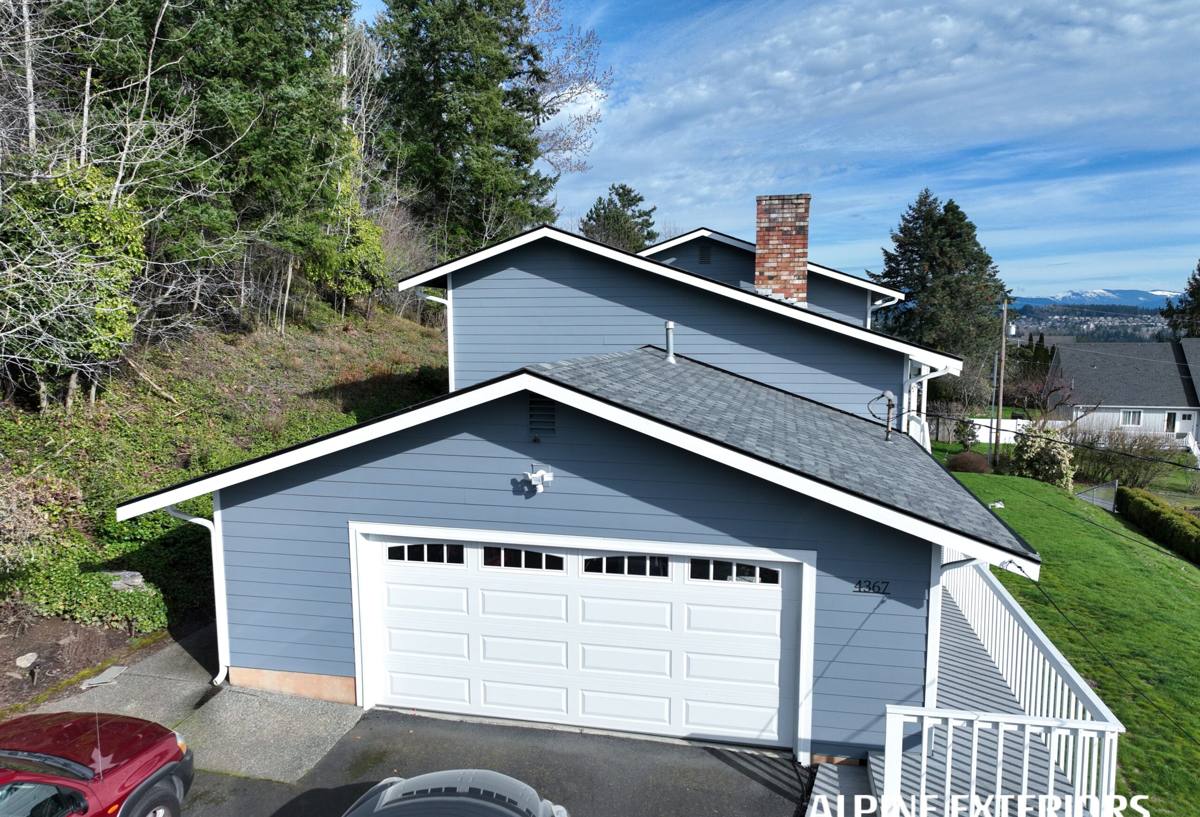
Signs a Semiahmoo-Area Home Needs a New Roof, Not Another Repair
Not every problem calls for a full tear-off and replacement — but a few signs consistently mean repair is throwing money at a roof that's past the point of patching:
- Granule loss heavy enough that you can see bare, shiny asphalt on multiple shingles, not just one or two spots
- Shingles that are cupping, curling, or cracking across a wide area rather than in one isolated patch
- Moss or algae that keeps returning within a season or two of cleaning, especially on north-facing or shaded slopes
- Daylight visible through the roof deck from inside the attic, or soft, spongy sheathing underfoot during an inspection
- Multiple past repairs in different areas of the same roof, which usually signals the whole system — not just the shingle — is failing
- A roof approaching or past the upper end of its material's realistic lifespan in a coastal, high-moisture climate, which tends to run shorter here than manufacturer averages assume
If you're only seeing one of these in one spot, a repair may genuinely be the right call, and we'll tell you that. This page is about the point where replacement is the more honest recommendation.
Choosing a Roofing Material for Salt Air and Heavy Moss Exposure
There's no single "best" roofing material for every home — it depends on your roof's exposure, your budget, and how much long-term maintenance you're willing to do. Here's how the common options actually perform in a coastal Whatcom County environment:
| Material | Salt Air Behavior | Moss/Algae Resistance | Typical Trade-Off |
|---|---|---|---|
| Architectural asphalt shingle | Good, with corrosion-resistant fasteners and flashing | Fair — algae-resistant (AR) shingles help but don't eliminate cleaning needs | Best upfront cost; needs periodic moss/algae maintenance |
| Standing seam metal | Very good with proper coating and stainless or coated fasteners | Very good — moss struggles to hold on a smooth, sloped metal surface | Higher upfront cost; requires correct fastener spec to avoid galvanic corrosion near salt air |
| Synthetic/composite shingle | Good — resists moisture absorption better than wood-based products | Good, though performance varies by product line | Mid-to-upper cost; product quality varies more between manufacturers |
| Cedar shake | Poor without aggressive, ongoing maintenance | Poor — wood holds moisture and feeds moss growth | We steer clients away from cedar in this specific climate; the maintenance burden and moisture risk outweigh the look |
We're upfront when a material isn't a good fit for a given roof's exposure. That's a professional judgment call based on how these products actually hold up under salt air and near-constant moisture, not a knock on any single manufacturer.
What a Correctly Installed Roof Actually Involves
A new roof is more than shingles nailed over the old ones. In a climate that pushes rain sideways and grows moss in the shade, the parts you don't see matter as much as the parts you do:
Full Tear-Off and Deck Inspection
We remove the existing roofing down to the deck rather than layering over it. That's the only way to actually see the sheathing — soft spots, rot, or water staining from long-term leaks don't show up until the old material is off. Any damaged decking gets replaced before anything new goes down; installing a new roof over a compromised deck just hides the problem for another few years.
Underlayment and Ice-and-Water Protection
Given how much wind-driven rain this area sees, underlayment choice isn't a place to cut corners. We use synthetic underlayment as the primary water-resistive barrier, with self-adhered ice-and-water shield membrane at the eaves, valleys, and any low-slope transitions — the spots where wind-driven rain is most likely to work its way backward under a standard shingle lap.
Flashing at Every Penetration
Chimneys, vent stacks, skylights, and wall-to-roof transitions are where the overwhelming majority of roof leaks actually originate — not the open field of shingles. Corrosion-resistant flashing, properly stepped and sealed at each of these points, is non-negotiable in a salt-air environment where standard fasteners and thin flashing corrode faster than they would inland.
Balanced Attic Ventilation
A roof that can't breathe traps moisture underneath it, which accelerates deck rot and feeds moss growth from the inside out. We check intake (soffit) and exhaust (ridge or roof vents) as part of every replacement, not as an afterthought — proper ventilation is part of what makes a new roof actually last its rated lifespan in this climate.
How Our Installation Process Works
- On-site inspection and estimate. We walk the roof, check the attic where accessible, and give you an honest read on condition — repair versus replacement — along with a straightforward written estimate.
- Material selection. We walk through the trade-offs above based on your roof's exposure, budget, and how much long-term maintenance you want to take on.
- Scheduling around the weather. Whatcom County's wet season means timing matters. We plan installation windows realistically and won't leave a deck exposed if weather is closing in.
- Tear-off and deck repair. Old roofing comes off, the deck gets inspected, and any damaged sheathing is replaced before we move forward.
- Underlayment, flashing, and ventilation installed correctly. This is the stage that determines whether the roof performs for its full expected life or starts leaking in year five.
- New roofing installed to manufacturer spec. Proper nailing patterns, exposure, and fastening — details that affect both wind resistance and warranty validity.
- Final walkthrough and cleanup. We review the finished roof with you, cover warranty paperwork, and make sure the site is cleared of debris and nails.
Cost Factors Homeowners Should Actually Understand
Roof replacement pricing varies widely based on real factors, not just square footage. A few of the biggest:
| Factor | Why It Matters |
|---|---|
| Roof pitch and access | Steeper or harder-to-access roofs take longer and require more safety equipment, which affects labor cost |
| Deck condition | Rot or soft sheathing found during tear-off adds material and labor that can't always be predicted before the old roof comes off |
| Number of penetrations | Every chimney, skylight, and vent stack is another flashing detail — more penetrations mean more labor and materials |
| Material choice | Asphalt, metal, and synthetic products carry different material costs and different installation labor requirements |
| Layers to remove | Tearing off multiple existing layers costs more in labor and disposal than a single-layer tear-off |
We give real, itemized estimates rather than a single number pulled from square footage alone — you should know what you're actually paying for.
What to Expect From a Roofing Contractor Before You Hire One
- A written estimate that itemizes materials, labor, and any deck repair contingency — not just a lump sum
- Proof of licensing and insurance you can independently verify, not just a claim
- A clear explanation of what underlayment, flashing, and ventilation are included — these details separate a roof that lasts from one that doesn't
- A realistic timeline that accounts for local weather rather than promising a fast turnaround regardless of conditions
- A manufacturer-backed warranty on materials, plus a workmanship warranty from the installer
- Willingness to explain trade-offs between material options honestly, including why they might steer you away from a product for your specific roof
Why It Matters to Hire a Crew That Already Works This Area
A roofing crew that primarily works drier, inland conditions can install a technically correct roof and still get the details wrong for a coastal Whatcom County home — under-specifying flashing corrosion resistance, skipping ice-and-water membrane in spots that don't matter inland but matter here, or recommending a material that looks fine on paper but struggles against salt air and moss. Ferndale Siding works roofs across this climate regularly, which means the underlayment coverage, fastener choice, and ventilation balance aren't guesswork — they're informed by what actually holds up here versus what fails early.
Local knowledge also shows up in smaller ways: knowing which slopes in this area tend to hold shade and grow moss fastest, understanding realistic install windows around the wet season, and being available if a warranty question or a storm-related concern comes up after the job is done.
After Installation: What Keeps a New Roof Performing
A correctly installed roof still benefits from basic upkeep in this climate. Keep gutters clear so water isn't backing up under the eaves. Have moss and algae growth addressed early rather than letting it establish, especially on shaded north-facing slopes. Keep an eye on flashing around chimneys and vents after major storms, since wind-driven rain is what tends to expose a weak point first. None of this is heavy maintenance — it's the difference between a roof that hits its full expected lifespan and one that needs early attention because small issues went unaddressed.
If your roof near Semiahmoo is showing its age, or you just want a straight answer about repair versus replacement, we're glad to take a look. Reach out for a free, no-pressure estimate using the form below.