 Ferndale
 Why Bellingham Siding Wears Differently Than Siding Inland
Bellingham sits close enough to the water that salt-laden air is a real factor in how exterior materials age, not just a coastal talking point. Combine that with Whatcom County's driving rain — the kind that comes in sideways off the Strait during fall and winter storms — and a moss season that can run eight months or longer on shaded north- and west-facing walls, and you get siding that takes a beating most inland homes never see. Repair needs here tend to show up earlier and in specific places: lower courses near grade, inside corners that trap moisture, and any spot where flashing or caulking has quietly failed.
We're based just up the road in Ferndale and work Bellingham regularly, so we're not guessing at how local siding fails — we see the same failure patterns on homes across the neighborhoods we visit, from older builds with original wood or early fiber cement to newer construction that's only a decade or two in.
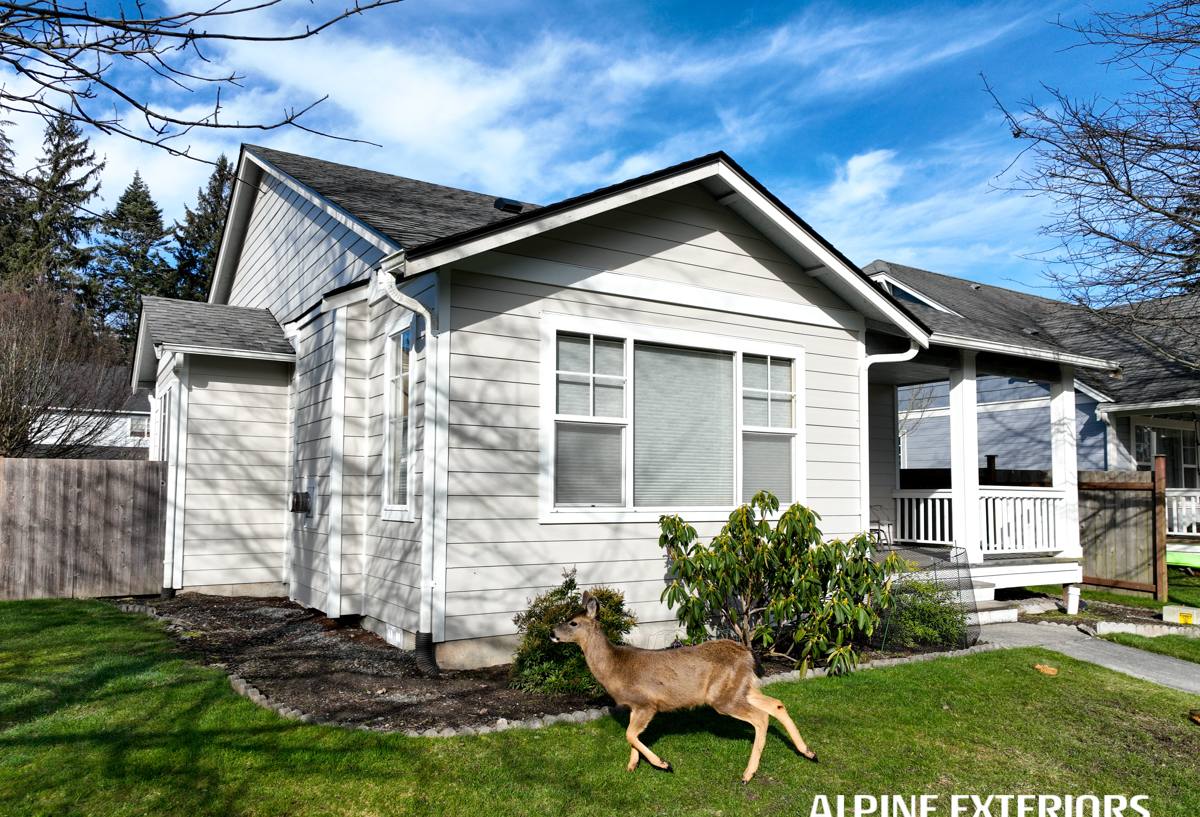
Signs Your Siding Needs Repair, Not a Full Tear-Off
Most siding problems we get called out for in Bellingham are localized. A full replacement isn't always the right call, and we'll tell you plainly when repair is the smarter move. Watch for these signs:
- Soft or spongy spots when you press on a board, especially near the bottom courses or below windows
- Visible cracking, splitting, or buckling in individual boards or panels
- Paint that's bubbling, peeling, or failing in isolated patches rather than across the whole wall
- Persistent moss or algae growth that keeps returning to the same section no matter how often it's cleaned
- Gaps opening up at seams, corners, or where siding meets trim, windows, or doors
- Staining or dark streaking that suggests water is tracking behind the siding, not just running down the face
- Woodpecker or pest damage isolated to one or two areas
If damage is scattered across most of the house, or the underlying material has been failing for years, replacement usually ends up being the more cost-effective path — we'll walk you through that honestly rather than patching something that's on its way out anyway.
What Actually Causes Most Siding Damage Here
Moisture Intrusion
The majority of repair calls we get in Bellingham trace back to water getting behind the siding rather than damage to the face of it. Failed caulking at joints, poorly flashed window and door openings, and butt joints that were never properly sealed all let moisture in. Once it's behind the siding, it can sit there through our long wet season and do real damage to the substrate before it ever shows up as a visible problem.
Moss and Organic Growth
Moss doesn't just look bad — on porous or aging materials it holds moisture against the surface for months at a time, which accelerates rot and paint failure underneath. Shaded, north-facing walls and areas under overhangs or near mature trees are the usual trouble spots.
Salt Air and UV Exposure
Proximity to Bellingham Bay means siding and its finish take on a slow, steady exposure to salt-bearing air that can accelerate corrosion of fasteners and trim, and break down lower-quality paint finishes faster than you'd see further inland.
Impact and Age
Everyday impact damage — ladders, debris in windstorms, landscaping equipment — combines with straightforward material aging. Older cedar and early-generation fiber cement products are more likely to show their age in ways that call for repair sooner.
What a Correct Siding Repair Actually Involves
A repair that's done right isn't just pulling off a damaged board and nailing up a new one. We treat every repair call as a chance to find out why that section failed, not just patch the symptom.
- Diagnose the cause, not just the damage. If a board rotted, we want to know if it was a flashing failure, a caulking gap, grade too close to the siding, or something else — otherwise the replacement board fails the same way.
- Check for hidden moisture. Visible damage is often smaller than what's happening behind the siding. We check adjacent boards and the water-resistive barrier where accessible.
- Remove only what's actually compromised. Good repair work is surgical — replacing more than necessary wastes your money, replacing less than necessary means you're back out here again next year.
- Correct the underlying issue. Re-flash, re-seal, or adjust drainage as needed so the same spot doesn't fail again.
- Match the finish. Color and texture matching matters — a patch job that stands out from ten feet away isn't a finished job in our book.
Repairing Different Siding Types: What We Can — and Can't — Match
We install James Hardie fiber cement exclusively, and that shapes how we approach repairs. If your home already has Hardie siding, we can typically source matching boards and ColorPlus finishes and get a repair that blends in cleanly. If your home has an older or different material — cedar, older fiber cement brands, LP SmartSide, or vinyl — we'll still assess and repair it honestly, but we'll also tell you straight if that material is nearing the point where repairs are becoming a losing game.
That's not a sales pitch dressed up as an inspection. It's the same reason we standardized on Hardie for new installs in the first place: it holds up better to the moisture, moss, and salt-air conditions we deal with here, it's non-combustible, and its factory-applied ColorPlus finish resists the fading and peeling that drives a lot of the repeat repair calls we see on painted wood and lower-grade composite sidings. When a homeowner is facing their third or fourth repair on aging cedar or an older composite product, we'll lay out both options — targeted repair now, or a longer-term fix — and let you decide with real numbers in front of you.
Repair vs. Replacement — Common Cost Factors
| Factor | Favors Repair | Favors Replacement |
|---|---|---|
| Extent of damage | Isolated to one or two wall sections | Spread across most or all elevations |
| Underlying material age | Siding is relatively recent, structurally sound | Siding is at or past its expected service life |
| Root cause | One-time impact or a fixable flashing/caulk failure | Systemic moisture intrusion or design flaw |
| Repair history | First repair call on this section | Same areas have been repaired repeatedly |
| Color/material match | Matching product still available | Discontinued color or product, poor match likely |
Our Repair Process
We keep repair jobs straightforward and don't pad the scope:
- On-site assessment — we look at the damaged area and check surrounding sections for related issues, not just the spot you called about
- Honest scope and estimate — a clear explanation of what needs to be replaced, why, and what it'll cost, with no pressure toward a bigger job than you need
- Repair work — removal of compromised material, correction of the underlying cause where one exists, and installation of matching replacement material
- Finish and cleanup — sealing, caulking, and paint/finish matching so the repair blends with the surrounding siding
- Follow-up guidance — if we see signs the rest of the siding is heading toward the same failure, we'll tell you so you can plan ahead instead of getting surprised
Why It Matters That We Already Work in Bellingham
A crew that only occasionally works this area doesn't have the same feel for how houses here actually age. We know which orientations take the worst of the driving rain, which neighborhoods deal with heavier moss pressure, and how salt air off the bay tends to show up first in fasteners and trim before it's obvious on the siding face. That local pattern recognition is what keeps a repair job from turning into a guessing game — and it's why we can usually tell you on the first visit whether you're looking at a quick fix or something bigger.
Because we're headquartered in Ferndale, getting a crew out to Bellingham for an assessment or a repair doesn't mean waiting on a contractor who's juggling jobs across three counties. We treat Bellingham as home turf, not a drive-to market.
A Quick Self-Check Before You Call
Before scheduling an estimate, it can help to walk your home's exterior and note what you find. Bring this list along:
- Press gently on siding near the bottom of each wall and around window/door trim — note any soft spots
- Look for gaps or cracked caulking at corners, seams, and where siding meets trim
- Check for moss or dark staining that keeps recurring in the same spots
- Note any areas with visible impact damage or missing/loose pieces
- Check gutters and downspouts for damage that could be sending water onto the siding
Bringing that information to your estimate helps us move faster and gives you a clearer picture of what's driving the damage.
If you're seeing any of these signs on a Bellingham home, we're happy to take a look and give you a straight answer on whether repair or replacement makes more sense — no pressure, no inflated scope. Use the form below to request a free estimate.